Join the ScotiabankStartRight® Program designed for Newcomers‡ and get up to $2,300* in value in the first year.
Whether you’re preparing to move to Canada or have just arrived, managing your personal finances is vital. Creating a realistic budget is one of the most important personal finance strategies for newcomers. A good approach helps you track spending, reduce financial stress, avoid debt, and build a strong financial foundation in Canada.
Why Managing Your Personal Finances Matters Before AND After You Move to Canada
Moving to Canada comes with many financial surprises—from housing costs to daily expenses. Budgeting helps you:
Prepare for the true cost of living across Canadian cities
Plan for housing, transportation, food, childcare, and other essentials
Toronto and Vancouver, Canada’s most popular cities for newcomers, are major job hubs; however, housing costs are the highest. If you dream of homeownership, you’ll likely be able to buy a larger home in a suburb or smaller city.
Even if you haven’t started working yet, a budget improves your confidence and helps you stretch your savings while you settle.
While managing your own finances is a great skill to develop, many newcomers find that a 30-minute conversation with a professional provides the most clarity. Check out our guide on how personal banking advisors help newcomers to see how a free meeting can simplify your transition.
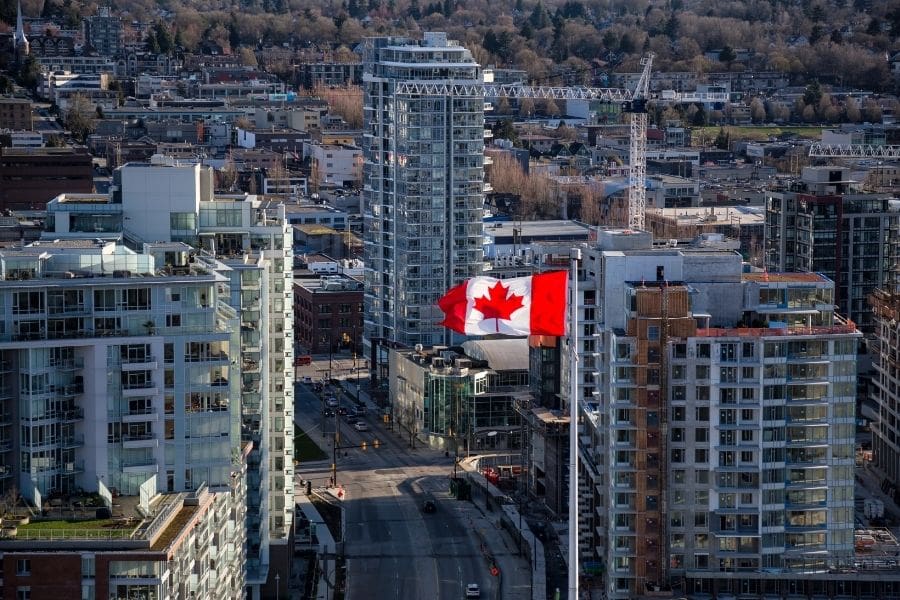
Housing costs in Vancouver and Toronto are among the highest in Canada.
Understanding Housing Costs: What Newcomers Should Expect
Housing is often the highest expense for newcomers. Canada Mortgage and Housing Corporation (CMHC) defines “affordable” housing as when shelter costs are less than 30% of the household’s before-tax (gross) income.
For example, a family earning $60,000/year should ideally have monthly shelter costs under $1,500.
Calculation:
30% of $60,000 = $18,000
$18,000/12 months = $1,500/month.
This definition ensures that households have income left over for other essentials such as food, transportation, and savings, especially important when arriving in a new country.
Before you move, research typical salaries for your profession. Tools like the Canada Job Bank help newcomers explore wage ranges and regional differences so you can budget realistically. Read more: Canada Job Bank | Your Vital Research Tool.
6 Essential Personal Finance Steps for Newcomers to Canada
Follow these six practical steps to estimate expenses, prioritize essentials, build credit, and adjust your budget to live comfortably in Canada.
Planning your budget before arriving in Canada helps you estimate key expenses such as rent, utilities, and groceries.
Step 1: Estimate Your Major Expenses Before You Move
Start by researching typical costs for rent, utilities, groceries, transportation, and insurance. Knowing your expected expenses helps you plan a realistic budget even before you arrive in Canada.
Use these typical monthly cost ranges to prepare your pre-arrival budget:
Buy a SIM card or a temporary plan to connect immediately.
Food & groceries
$400 – $800
Plan meals; cooking at home saves money.
Public transit
$70 – $150
Check city transit pass costs.
Insurance (health + renters)
$25 – $200
Consider short-term private travel medical health insurance.
Personal care & entertainment
$50 – $200
Focus on essentials until settled.
👉 Tip: Costs vary depending on city and lifestyle. Toronto and Vancouver are job hubs, but have higher housing prices; smaller cities offer more affordable rent.
Step 2: Set Up Your Budget Once You Arrive
Once you’re in Canada, keep a record of all of your expenses and update your budget with real numbers. Track your spending to identify where your money goes and adjust your budget:
If you are worried that a high rent payment might stop you from reaching your long-term goals, it is a great idea to talk to a bank advisor. They are great at showing you exactly how rent and daily expenses affect your overall budget. Watch this short video to see how they can help you manage your money with confidence:
Step 3: Prioritize Essential Expenses to Strengthen Your Personal Finances
Focus first on housing, food, transportation, and insurance. Ensuring you cover these basics will reduce financial stress and keep you within your budget.
Housing & utilities
Your highest monthly expense. Compare neighbourhoods and consider renting slightly outside the city centre for affordability.
Food & groceries
Cooking at home is often more cost-effective than eating out.
Transportation
Public transit is cost-effective in most cities.
Insurance
Protect yourself with renters’ insurance and provincial or private health coverage.
👉 If you are a student, worker, or visiting family member, travel medical health insurance is essential until provincial health coverage begins.
Limit discretionary spending (eating out, shopping, entertainment) until your essentials are stable.
Maintain a financial buffer for unexpected expenses. More money = less stress!
Step 4: Build Your Canadian Credit History Early
Managing a budget responsibly helps you establish and maintain good credit. Timely payments and low debt are crucial for applying for credit cards, loans, or even renting an apartment in Canada.
Your budget keeps you on track so you can:
Pay bills on time
Qualify for a Canadian credit card
Keep debt low
Build a strong credit score for future goals (buying a home, renting, or getting a loan).
💡 Pre-arrival tip: Open a Canadian bank account before you arrive if possible. Some banks allow online account setup for newcomers.
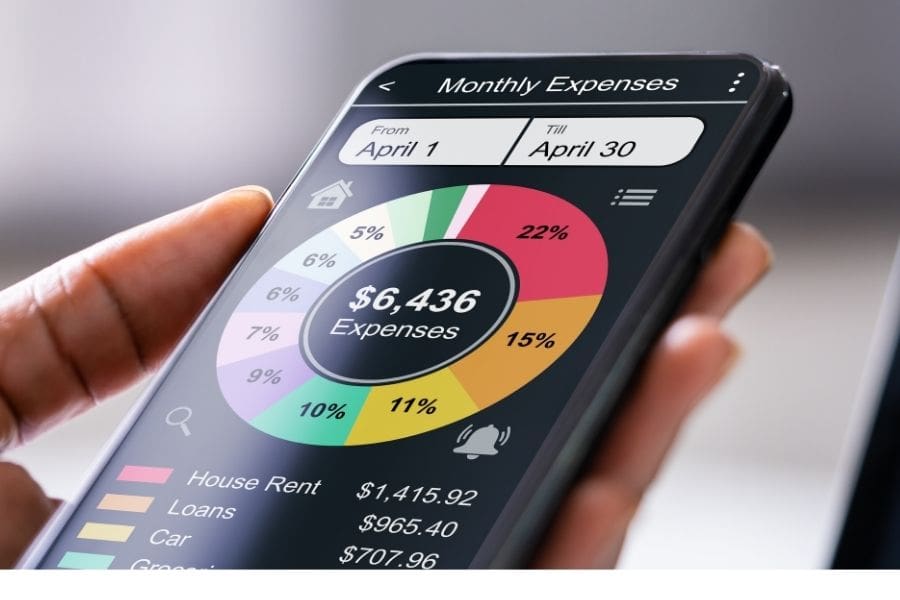
Using a money-tracking app to monitor personal finances and monthly expenses in Canada.
Step 6: Review and Adjust Your Personal Finances Regularly
Costs and needs change as you settle in. Your budget will evolve as your life in Canada changes. Review it monthly to:
Use a budget planner and money-tracker apps to track spending
Identify areas to cut
Save for long-term goals like education or homeownership
Plan for emergencies and unexpected costs.
FAQs
1. How much money do I need to live in Canada as a newcomer?
Most newcomers spend between $2,000 and $4,000 per month depending on the city, housing choices, and lifestyle. Rent is often the highest cost. Read more: How Much Money Will I Need to Move to Canada?
2. What should I include in my budget before moving to Canada?
Include rent, utilities, groceries, transit, phone plans, health insurance, and settlement costs like deposits, winter clothing, and short-term accommodation.
3. Is Canada expensive for newcomers?
Canada can feel expensive, especially in Toronto or Vancouver. Planning a budget early helps you manage costs and avoid financial stress.
4. How can newcomers save money when they first arrive in Canada?
Use public transit, cook at home, choose budget-friendly phone plans, and compare rentals using trusted platforms like Rentals for Newcomers.
5. Why is budgeting important for newcomers to Canada?
A budget helps you manage settlement costs, avoid debt, build credit, and prepare for long-term goals like buying a home or continuing your education.
Newcomers discussing personal finance strategies to manage their budget in Canada.
Key Takeaway
Whether you’re planning your move or have just arrived, creating a budget is essential for financial stability in Canada. With the right planning and tools, you can establish a solid financial foundation and experience a seamless transition to life in Canada.
Retirement savings are essential for all Canadians to live comfortably after they retire. And the earlier you start saving, the better. For newcomers, understanding retirement savings options can be confusing. So in this article, I’ll demystify the Registered Retirements Savings Plan (RRSP). With a clear understanding, you can start saving as soon as possible to achieve your dreams and goals in Canada!
What is a Registered Retirement Savings Plan?
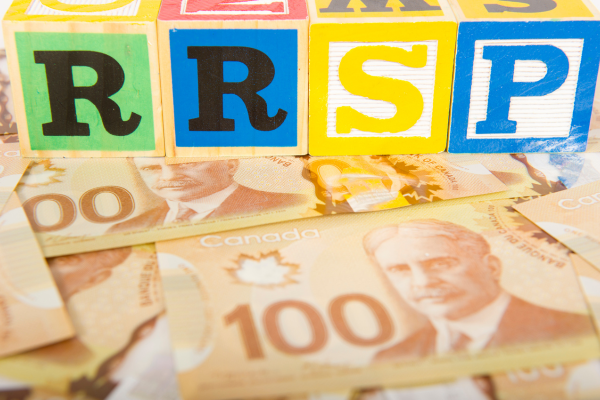
An RRSP is a tax-deferred retirement savings plan. This plan encourages you to save in your earning years so that you can have income in your retirement years.
The term “tax-deferred” means that when you open an RRSP and contribute to it, you can claim a deduction from your income. And any income earned in the RRSP remains tax-free unless you make a withdrawal from your RRSP. In other words, you defer or delay taxes until the time you make any withdrawal. Therefore, you can defer income taxes until later when you may be subject to lower taxes as your income goes down.
During the years when you earn a high income, you are subject to higher tax rates. So, contributing to an RRSP will help you lower your tax liability.
Am I Eligible to Open an RRSP?
You are eligible to open an RRSP if you satisfy these conditions and you:
Have “earned income” from the previous tax year
Reported the earned income to the Canada Revenue Agency (CRA) on your tax return
Have not yet turned 71 years of age.
Can I Open More than One RRSP?
You can open multiple RRSP accounts. However, it will be easier to manage one RRSP account rather than tracking several accounts.
How Do I Set Up My RRSP? Do I Need to go to My Bank?
You can set up an RRSP through a:
Bank
Credit union, or
Trust or insurance company.
[cjtoolbox name=’Buying A Home As A Newcomer Webinar’]
How Much Can I Contribute to My RRSP in the Current Year?
Computing the maximum RRSP contribution for the current year involves four steps.
STEP ONE:
Calculate 18% of the income you earned in the previous tax year. Add the following income to determine your earned income:
Your employment income. Calculate this as taxable benefits minus union or professional dues.
Net amount of rental income from renting real property. No other property income will be considered in computing earned income.
Net amount of self-employment income.
Research grants received or royalties received from your own invention or published work.
Spousal support payments (alimony/maintenance) received due to a court order.
Canada Pension Plan or provincial disability pension plan income received.
Supplementary employment insurance benefits that the employer pays to you. A good example is the top-up payments (i.e. the difference between your salary and the amount that is paid by employment insurance) that your employer may pay during maternity or parental leave. Do not count any employment insurance benefits that you received from Employment and Social Development Canada (ESDC).
Less: Spousal support payments made.
No other income or capital gains will be considered as earned income for an RRSP.
Now multiply your earned income by 18%.
STEP TWO:
Visit www.canada.ca to find out the contribution limit for the current year.
In 2024, the website shows that the annual RRSP contribution limit is $30,780 (for tax year 2023).
STEP THREE:
Compare 18% of your earned income for the previous tax year as computed in step one and the annual contribution limit determined in step two.
Take the lesser of these two amounts.
STEP FOUR:
To the lesser amount that you determined in step three, add unused RRSP contribution room from the previous years that were carried forward to the current year.
Now, subtract the:
Previous year’s pension adjustment (PA)
Current year’s past service pension adjustment (PSPA).
Now, you have arrived at your maximum RRSP contribution for the current year. The maximum RRSP contribution is also known as:
Contribution room
RRSP deduction limit, or
Deduction room.
What Does Pension Adjustment (PA) Mean?
If you participate in a registered pension plan or a deferred profit-sharing plan, you earn pension benefits. This is the amount of PA.
What is Past Service Pension Adjustment (PSPA)?
In simple terms, PSPA is the amount of extra pension credits you get when either there is:
An upgrade in your pension benefits or
A pension buyback.
In a pension buyback, you pay a fixed amount to purchase years of missed pensionable service to enhance your retirement pension. For example, you can miss pensionable service years when in your earning years you:
Took a leave of absence or time off your work or
Deferred the decision to join your employer’s pension plan.
Thereby losing the opportunity to accumulate years of service in the pension plan.
The amounts of PA and PSPA go on to reduce your maximum RRSP contribution amount for the current year.
How Do I Calculate the Maximum Registered Retirement Savings Plan Contribution?
Let’s say you want to determine your maximum RRSP contribution for 2023 and you earned:
$90,000 in employment income and
$1,000 in taxable capital gains in the previous tax year (i.e. 2022).
At the beginning of 2023, you have unused RRSP contribution room from previous years that total $7,000.
As a member of a registered pension plan, your pension adjustment for 2023 amounts to $3,000.
To compute the maximum RRSP contribution follow these four steps:
STEP ONE:
Compute 18% of your earned income. In your instance, earned income will be $90,000. Taxable capital gains are disregarded while computing earned income. Thus, 18% of your earned income = 0.18 x 90,000 = $16,200.
STEP TWO:
On www.canada.ca, you find the RRSP dollar limit for 2023 is $30,780.
STEP THREE:
Take the lesser of the above two amounts. The lesser amount = $16,200.
STEP FOUR:
To $16,200, add the unused RRSP contribution of $7,000 and subtract your pension adjustment amount of $3,000.
So, your maximum RRSP contribution = $16,200 + $7,000 – $3,000 = $20,200.
Can I Make Excess Contributions?
Let’s take the above example. Since we worked out that your maximum RRSP contribution is $20,200, this is the maximum that you can contribute in the current year (in this case, 2023).
You contribute an excess amount of up to 2,000 without any penalty. But, any amount beyond $2,000 will be subject to a penalty of 1% of the excess beyond $2,000 for each month (or part of the month) that this excess contribution exists. For example, if your maximum RRSP contribution is $20,200, you may contribute:
$20,200 + $2,000 (excess amount not subject to penalty)
However, if you contribute, say, $23,200, there will be a penalty as computed below.
Split the amount of $23,200 as shown:
1. $20,200. This will not attract any penalty. 2. An excess amount of $2,000 which escapes any penalty. 3. An excess amount of $1,000 (which is beyond the excess amount mentioned in 2 above). This excess of $1,000 will attract a penalty of 1% for every month (or part of the month) that it remains in the RRSP.
Thus, you will pay $10 (i.e. 1% of $1,000) as a penalty for each month or part of the month that this amount remains in the RRSP.
If you make an excess contribution, make sure to withdraw it immediately to reduce the penalty as much as you can. Besides, you are not allowed to deduct from income any excess contribution. It, therefore, helps to avoid making excess contributions in the first place.
Is There a Deadline to Make Registered Retirement Savings Plan Contributions?
Yes, the deadline to make an annual RRSP contribution is typically at the end of February or early March for the preceding tax year. For the 2023 tax year, the deadline to make an RRSP contribution is Thursday, February 29, 2024. Most banks send deadline reminders so that you take advantage of this tax-saving benefit.
Are RRSP Deposits Insured?
If your financial institution goes out of business, the Canada Deposit Insurance Corporation (CDIC) insures up to $100,000 in deposits in seven categories.
The CDIC covers insurance up to $100,000 for the RRSP deposit category. Additional information on this is available at www.cdic.ca.
What about Withdrawals from the RRSP?
You can withdraw RRSP funds at any time. But any funds that you withdraw will be added as taxable income for the year that you withdraw funds. In other words, you will not get a tax break when you withdraw funds.
Can I Withdraw RRSP Funds to Buy a House or Pay for Education?
Two plans allow you to withdraw RRSP funds without being subject to taxes or interest:
However, both of these plans require you to pay back the amount that you withdraw. You must pay back the funds that you withdraw each year so that the amount that you withdraw for the HBP is paid within 15 years for the HBP and 10 years for the LLP.
When you withdraw RRSP funds for either program you will lose the tax-deferred income that you could have made on the amount that would have remained within your RRSP. Moreover, if you’re unable to pay back the annual dues, they get added to that year’s income and you’ll need to pay taxes on that amount.
What Happens When My RRSP Matures?
While you can withdraw from or register the RRSP at any time, you must deregister it by the end of the calendar year in which you turn 71. At that point, you have three options:
1. Transfer your RRSP proceeds to a registered retirement income fund (RRIF). Click here to learn more about RRIFs.
2. Withdraw the RRSP proceeds and pay taxes on the same in the year that you receive the proceeds.
3. Use the RRSP proceeds to purchase eligible annuities.
Can I Name a Beneficiary?
A beneficiary is a person your RRSP funds will go to if you die before your RRSP matures. You can name anyone of your choice as a beneficiary of your RRSP. However, from the tax deferral standpoint, it is better to name the following:
Your spouse or common-law partner
A child or a grandchild who is under 18 and is financially dependent on you at the time of your death
A child or a grandchild who is mentally or physically informal and is financially dependent on you at the time of death. Age is irrelevant in this case.
What is a Spousal RRSP? How Does it Work?
Let’s say you make more money than your spouse (or common-law partner) does. And you know that the maximum RRSP contribution limit is restricted by your earned income.
If your spouse makes less money than you do, then the amount they can contribute to their personal RRSP will be lower. However, you’re able to make greater contributions to your own RRSP.
Now if you expect that your spouse’s earnings will continue to be lower than your earnings in the future, it makes sense to contribute more to a spousal RRSP. As well, if you withdraw funds from a spousal RRSP you will pay a lower tax rate on those funds.
Your contribution to the spousal RRSP will be limited by your personal limit. But because you make the contribution, you get to claim this as a deduction.
In summary, an RRSP can be a great way to save for your retirement in Canada. When you understand the financial benefits of an RRSP you can begin to save sooner and benefit from an early start.
Opening a bank account before you arrive in Canada offers many benefits including transferring funds before you travel to Canada. Also, when you land in Canada, immigration officials may ask you to show proof of funds. When you open a bank account before you arrive, you can easily prove that you have available funds.
Canadian banks are among the most solid, secure financial institutions. The Canada Deposit Insurance Corporation (CDIC) provides insurance to protect eligible deposits made to CDIC-member banks. And for Canadians, knowing their money is CDIC-protected is reassuring!
How to Choose a Bank in Canada
It’s necessary to open a bank account in Canada. Most Canadians rely on their bank to:
Receive paycheques
Pay bills
Save money and earn interest.
To select a bank, you can visit the bank’s website to compare services and fees. While many banks have national branches and automatic banking machines (ABM) networks, it’s best to select a bank that has branches in the community where you will live.
Also, when you open a bank account, you will receive a statement that includes your mailing address. You can use your statement as identification when you apply for:
Government services
A provincial health card, or
A driver’s license.
Arrive in Canada Financially Prepared
Join us for an eye-opening session on how to build your financial future in Canada with confidence. This free webinar is hosted in partnership with Scotiabank, a trusted leader in newcomer banking.
Together, we’ll guide you through how the Canadian banking system works and share free tools and strategies to help you plan, save, and invest wisely as a newcomer.
Banks offer a wide range of accounts to choose from, and that can be overwhelming. But keep in mind that most newcomers will require a chequing account to deposit funds, write cheques, and pay bills. You will also need a debit card to deposit and withdraw funds from an ABM or branch. You may also want a higher-interest savings account and credit card.
Banks offer banking service packages at low-cost monthly fees. For example, the Scotiabank StartRight™ Program for Newcomers*¹ offers low-cost options to meet your banking needs. To help you make your important banking decisions, Scotiabank can explain your options in the language you prefer and provide personal support at the bank branch.
Feel free to ask for an explanation if there is anything you don’t understand. The role of the bank employee is to provide quality customer service and answer any questions you may have. You don’t have to worry about asking questions or taking up too much of their time.
Most importantly, get answers to your questions and only sign a contract when you’re confident you understand the terms.
Documents You Need to Open a Bank Account
To open a bank account in Canada, you will require the following documents:
Permanent Resident Card or Confirmation of Permanent Residence
One piece of government identification, such as your passport or driver’s license
International students require a letter of acceptance from a Canadian educational institution and a study permit.
If you are a foreign worker, you will require a valid passport and work permit.
To open a bank account, you must go to a local branch in person and have two original pieces of identification. You will have an interview with a bank employee who will:
Discuss different banking options
Suggest the right bank account based on your needs