Join the ScotiabankStartRight® Program designed for Newcomers‡ and get up to $2,300* in value in the first year.
How to Apply for an Ontario Health Card: Step-by-Step Guide for Newcomers
Written By
Corinna Frattini
•
Jun 3, 2026
•
Healthcare
What You Need to Know
Ontario Health Card Application Process: Requires an in-person visit to ServiceOntario with three original identification documents.
Ontario Health Insurance Plan (OHIP): Covers basic medical services for eligible provincial residents.
Residency Rules: Requires physical presence in Ontario for at least 153 days in any 12 months.
Documents Required: Official, original paperwork such as a Permanent Resident Card or Confirmation of Permanent Residence (COPR)
Medical Exceptions: OHIP doesn’t cover routine dental exams and prescriptions.
What is the Ontario Health Insurance Plan (OHIP)?
The Ontario Health Insurance Plan (OHIP) pays for affordable, basic medical services for all eligible Ontario residents. To access this provincial healthcare system, you must complete the Ontario health card application process. Once approved, your card fully covers everyday medical essentials, including visits to your family doctor, appointments at walk-in clinics, hospital stays, and emergency room visits.
Who is Eligible for OHIP?
To qualify for free provincial healthcare, you must meet all three basic residency requirements plus at least one additional immigration status requirement.
Basic Residency Requirements
Requirement
Timeframe Rule
What it Means for Newcomers
Physical Presence (First six months)
153 days out of the first 183 days
You must physically stay in Ontario for about 5 of your first 6 months immediately after you move here.
Physical Presence (Yearly)
153 days in any 12 months
To keep your card active, you cannot spend more than 212 days (approx. 7 months) outside of Ontario per year.
Primary Home
Ongoing
You must make Ontario your primary, main province of residence.
💡 When to Apply: You can, and should, visit ServiceOntario to register for your health card the day you arrive in the province. You do not need to wait 153 days before applying.
Additional Status Requirements
Along with the residency rules in the table above, you must fall into at least one of these categories:
Canadian Citizen
Permanent Resident (or currently applying for Permanent Residence with immigration approval)
Valid Work Permit holder (working full-time for an Ontario employer for at least 6 months)
Convention Refugee or Protected Person
How to Apply for an Ontario Health Card
To apply for an Ontario Health Card, you must visit a ServiceOntario center in person, fill out the Registration for Ontario Health Insurance Coverage form, and present three original documents proving your legal status, residency, and identity.Follow these four steps to complete your Ontario health card application:
1. Gather Three Original Documents: Bring one original document to prove your Canadian citizenship or immigration status, one to prove you live in Ontario, and one to prove your identity. ServiceOntario does not accept photocopies.
2. Locate a ServiceOntario Center:Find a ServiceOntario location that handles health card services. Many locations allow you to book an appointment online to skip the line.
4. Submit Your Application to a ServiceOntario Representative: Submit your form and three documents to the ServiceOntario representative. They will verify your eligibility, take your digital photo, and hand you a temporary paper receipt.
The Foolproof Ontario Health Card Application Checklist
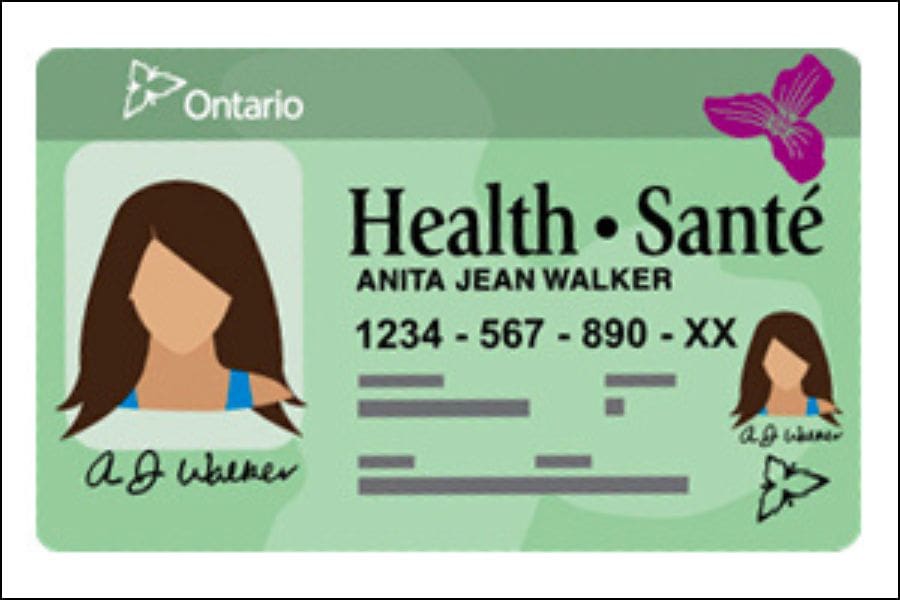
A specimen example of the current Ontario Photo Health Card design layout, courtesy of ServiceOntario.
Before you go to your ServiceOntario appointment, be sure to have one original document from each of these three categories.
1. Proof of Canadian Citizenship or Eligible Immigration Status
This document must prove you are legally authorized to stay in Canada. Accepted documents include:
Canadian Passport
Canadian Birth Certificate
Permanent Resident (PR) Card
Confirmation of Permanent Residence (COPR)
Valid Work Permit or Study Permit
💡 Work Permit Pro-Tip: If you are applying under a valid work permit, ServiceOntario will reject your application if you only present the permit. You must also bring an official employment letter printed on company letterhead, signed and dated by your employer, confirming that you are employed full-time, listing your specific job title, and stating that you will be working here for at least 6 months.
2. Proof of Ontario Residency
This document must display your name and current physical home address in Ontario. Accepted documents include:
Ontario Driver’s Licence or Ontario Photo Card
Utility bill (e.g., hydro, gas, water, cable)
Bank statement
Signed residential lease or mortgage agreement
3. Proof of Identity
This document must display both your name and your physical signature. Accepted documents include:
Credit card
Canadian or foreign passport (if not used for Category 1)
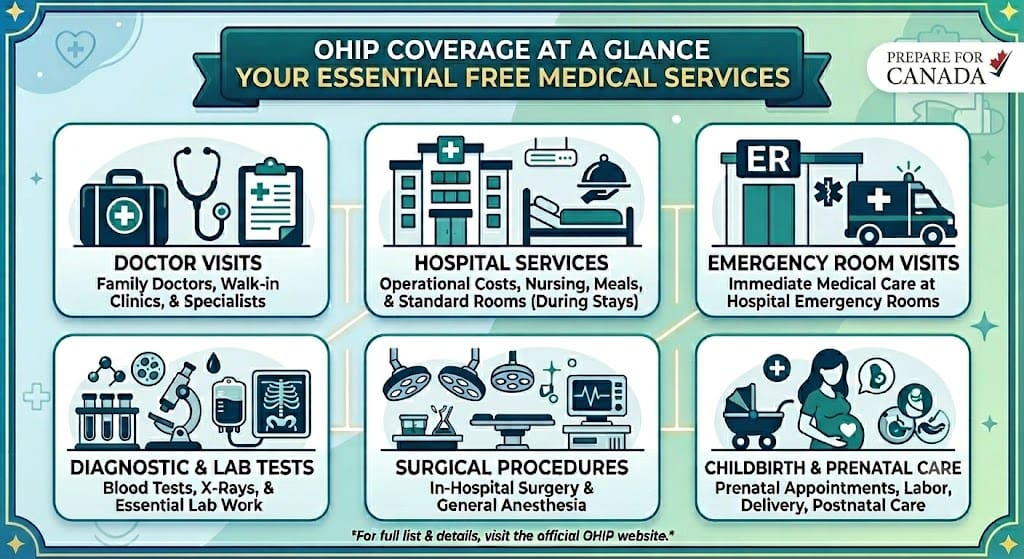
A quick-reference overview of the core medical treatments and services covered by OHIP.
The infographic shows what is normally covered, but there are some important exceptions where you might have to pay out-of-pocket. Check out the full list below for specific rules on prescription costs, private hospital rooms, and age limits:
What OHIP Covers
What OHIP Does NOT Cover (Out-of-Pocket)
Doctor Visits: Appointments with family doctors, walk-in clinics, and specialists.
Prescription Drugs: Medications filled at a pharmacy (Note: Prescriptions are free for youth aged 24 and under if they do not have private insurance through school or a parent’s work. For seniors aged 65 and older, the government covers most of the cost, but they usually have to pay a small annual fee or a few dollars per prescription.)
Hospital Services: Operational costs, nursing, meals, and standard rooms during a stay.
Hospital Upgrades: Private or semi-private hospital rooms. If you want a private or semi-private room, you must pay out-of-pocket or use private coverage. Unsure if your landing plan covers this? See our guide: Do You Need Travel Medical Health Insurance to Move to Canada?
Dental Surgery: Complex dental procedures that must be performed inside a hospital.
Routine Dental Care: Cleanings, fillings, check-ups, and extractions at a dentist’s office.
Eye Exams: Annual exams for residents aged 19 and under, or 65 and older.
Routine Eye Exams: Annual exams for adults aged 20–64 (unless a specific medical condition applies).
Podiatry: Partial coverage for registered chiropodist services.
Alternative Medicine: Physiotherapy, chiropractic care, and massage therapy (with minor exceptions).
Ambulance Services: The vast majority of the cost if a doctor deems it a medical necessity.
Ambulance Co-pay: A standard $45 co-pay fee, or the full cost (approx. $240+) if deemed non-essential.
Northern Health Travel Grant
If you live in Northern Ontario and must travel long distances for specialized medical care, OHIP may help pay for your transportation and accommodation costs. The government provides the Northern Health Travel Grant to ensure residents in remote areas have equal access to healthcare.
You may qualify for this travel coverage if you live in or near any of the following districts:
Algoma
Cochrane
Kenora
Manitoulin
Nipissing
Parry Sound
Rainy River
Sudbury
Thunder Bay
Timiskaming
Next Step: To find out if your specific trip qualifies or to download the reimbursement forms, visit the official Northern Health Travel Grant page.
📈 Data Insight: Under the province’s Primary Care Action Plan, Ontario expanded over 130 new primary care teams, reducing the historical Health Care Connect waitlist by over 87%. The province’s target wait-time threshold for matching new applicants to a doctor is a maximum of 12 months.
Next Steps for Newcomers in Ontario
Submitting your Ontario health card application is one of the most vital steps to successfully settling into your new life. Because mistakes or missing documents will force you to make a second trip to ServiceOntario, double-check your paperwork against the checklist above before you leave the house.
Once your application is approved, consider exploring affordable city recreation programs. While OHIP covers your doctor visits, these municipal programs offer the low-cost fitness and social connection vital for your mental health.
🏡 Avoid Rental Rejections: Master the Ontario Housing Market
How long does it take to get an Ontario Health Card?
ServiceOntario will mail your physical Ontario Health Card to you within 4 to 6 weeks after you apply. However, you can use your health coverage immediately on the day the province approves your application. Because Ontario permanently eliminated the old 3-month waiting period, your insured medical benefits protect you from day one.
How do I check the status of my OHIP application?
To check the status of your Ontario Health Card application, you can call the ServiceOntario INFOline at 1-866-532-3161. Have the temporary paper receipt that you received at your in-person appointment ready. The agent will ask you for the temporary numbers to track your file.
How much does an Ontario Health Card cost?
An Ontario Health Card is free. There is no application fee for eligible residents registering for the Ontario Health Insurance Plan (OHIP). Be aware of third-party phishing websites or scams that ask for payment or credit card details to “expedite” your health card; ServiceOntario is the only official government provider.
How do I replace a lost Ontario Health Card?
To replace a lost or stolen Ontario Health Card, call ServiceOntario immediately at 1-800-268-1154 to deactivate the lost card. * If your card does not have a photo on it: You must visit a ServiceOntario center in person to replace it.
If your card has a photo on it and your address hasn’t changed: You can order a replacement card online through the official ServiceOntario portal for free.
Is public health insurance the same across all Canadian provinces?
No, every province and territory in Canada runs its own public health insurance plan. While Ontario has eliminated its waiting period for OHIP, other provinces still enforce a traditional 3-month waiting period before newcomers can access free medical care. To compare provincial rules and find out how to secure coverage anywhere in the country, check out our guide: How Can Newcomers Get Public Health Insurance in Canada?
WRITTEN BY
Corinna Frattini
Senior Editor and Content Writer, Prepare for Canada
Corinna researches and writes content to help newcomers make informed decisions about housing, employment, banking, and aspects of settling in Canada. With a background in human resources and leadership development, her articles focus on how newcomers can continue their careers in Canada. Her writing combines research, practical guidance, and clear language to support newcomers on their journey.