Join the ScotiabankStartRight® Program designed for Newcomers‡ and get up to $2,300* in value in the first year.
Finding short-term rentals in Canada for newcomers is a critical first step for Permanent Residents and international students. Booking temporary accommodation before you arrive gives you time to explore neighbourhoods, search for long-term lease options, complete settlement tasks, and settle in without pressure.
What You Need to Know
Find a short-term rental to give yourself time to explore long-term housing options and complete settlement tasks.
Use trusted platforms like Stay22, Airbnb, and VRBO; avoid classified ads to minimize the risk of rental scams.
Budget for nightly temporary housing costs ranging from $40 to over $250 CAD per night, depending on your needs.
Apply the “Commuter Strategy” to save 30% to 50% by choosing rentals outside city cores along major transit routes.
Watch for rental scam red flags, such as unrealistic low pricing or upfront demands for wire transfers.
Where Can I Find Short-Term Rentals in Canada?
Stick to trusted booking websites that protect your money, such as Stay22, Airbnb, Booking.com, VRBO, or newcomer services like Rentals for Newcomers. Avoid buy-and-sell sites like Kijiji or Craigslist, where anyone can post without verification.
Vetted hosts tailored for students and permanent residents.
Open Classifieds & Social Networks
Kijiji, Craigslist, Facebook Marketplace
High
Unregulated; high risk of lease wire scams and fake listings.
⚠️ Scam Alert: Classified sites like Kijiji and Craigslist are challenging to regulate. Never wire money, transfer cryptocurrency, or share sensitive banking info before verifying the physical unit and confirming the host can legally rent out their unit.
Why You Need Short-Term Rentals Before a Permanent Lease
Book temporary accommodation for your first 2 to 6 weeks in Canada. If you sign a 12-month lease before you arrive, you risk falling for a rental scam, renting an unseen place in bad condition, or getting stuck in a neighbourhood far from where you need to be.
📌 Immigration & Visa Tip: When applying for your Canadian visa or study permit, you need to show where you will live. A short-term booking confirmation from sites like Stay22, Airbnb, or Booking.com works as official proof of accommodation.
Key Settlement Tasks to Complete During Your Temporary Stay
Explore neighbourhoods: Check local transit, grocery stores, school districts, and safety before you commit to a 12-month lease.
Tour properties in person: View apartments, meet landlords face-to-face, and submit your rental applications.
How Much Do Short-Term Rentals Cost in Canada?
Temporary accommodation in Canada costs anywhere from $40 to over $250 CAD per night. To choose the right option, consider your family size, how much luggage you carry, and your budget.
Accommodation Type
Average Nightly Cost (CAD)
Best Suitable For
Primary Advantage
Furnished Apartments / Airbnbs
$120 – $250+
Families & Couples
Private kitchens and laundry; lowers dining costs by ~40%.
Low cost for initial 3–5 days while verifying longer leads.
What is the “Commuter Strategy” for Saving Money on Short-Term Rentals?
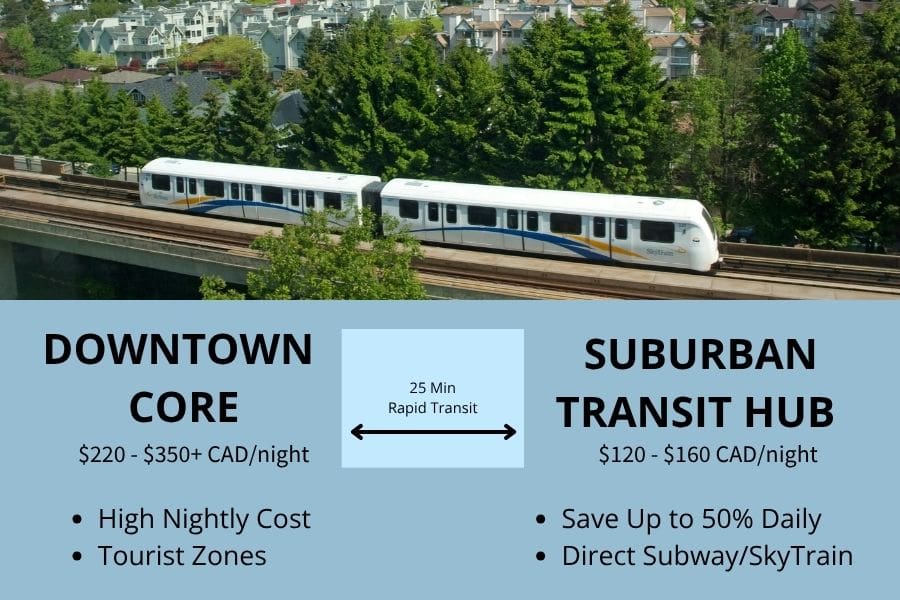
Staying near a suburban transit hub like a SkyTrain or subway line can cut your nightly short-term rental costs by up to 50%.
The Commuter Strategy reduces short-term housing costs by 30% to 50% by selecting rentals located 20 to 40 minutes outside downtown cores along rapid transit arteries.
In high-demand markets like Toronto and Vancouver, downtown stays can cost $250/night, compared to suburban locations that average $120-$160/night.
Vancouver: The SkyTrain Strategy
Aerial sunset view of Surrey and Metro Vancouver high-rise condo clusters providing short-term housing and temporary accommodation near transit.
Surrey City Centre: A major newcomer hub with direct rapid transit links.
Coquitlam: A 40-minute SkyTrain ride that can save you thousands in rental costs over a two-week landing period.
If your long-term goal is to live in the city, explore our deep dive on Living in Vancouver to understand the housing and job markets.
Toronto: The Subway & GO Train Strategy
Focus on Toronto Transit Commission (TTC) subway and GO Train lines:
North York (Line 1): Focus on the Yonge & Finch corridor. It’s a massive newcomer hub with every service you need.
Etobicoke (South/West): Look for rentals near Mimico or Long Branch GO Stations. You can reach Union Station in 15 minutes.
Scarborough (Line 2): Stick to areas near Line 2 (Bloor-Danforth) or Agincourt GO to ensure a smooth commute. Scarborough offers some of the best value for families needing larger temporary spaces.
The “Deep Value” Option: Consider Hamilton or Oshawa. While the commute is 60 minutes via the GO Train, the savings during match weeks are significant enough to fund your first month’s permanent rent.
If your long-term goal is to settle in the city, check out our Living in Toronto guide to help you make an informed decision.
Calgary & Edmonton: C-Train & LRT Commute Routes
Focus on residential nodes near C-Train (Calgary) or LRT (Edmonton) lines to maintain access without paying downtown core rates.
How Long Can I Stay in a Short-Term Rental?
City bylaws regulate the length of short-term stays in Canada at under 28 to 30 consecutive days. For example, the rental period in Toronto is less than 28 consecutive days.
Understanding Key Rental Laws
Primary Residence Rules: In cities like Toronto, Vancouver, and Calgary, hosts offering stays under 28 consecutive days can legally operate within their primary residence.
The 30-Day Mid-Term Discount: Booking a stay for 28 to 30+ consecutive days shifts the listing to a “mid-term rental.” This exempts the booking from local hotel taxes and triggers platform discounts of 15% to 35%.
How Do I Choose the Right Location for Temporary Accommodation?
Select a short-term rental located near public transit or your prospective workplace to test commuting times and evaluate essential neighbourhood amenities.
Staying in or near a city’s central district provides immediate access to key settlement needs:
Schools & Childcare: Walkable access for registering children in local school districts.
Healthcare & Services: Proximity to walk-in clinics, Service Canada centers (for SIN registration), and major bank branches.
Employer Access: Easier commute options while attending job interviews.
If you know where you will be working, a rental near your work can help you judge commuting times and costs. A rental in or near a city’s downtown core allows you to look for your first long-term rental home and offers many benefits.
🧳 Ready to Secure Your Temporary Stay?
Skip the search stress. To find temporary options across major Canadian cities today, use our Arrival Stay Booking Portal↗️
Checklist: 5 Red Flags to Avoid Rental Scams
Newcomers and international students are often the primary targets of rental scams. Walk away immediately if you encounter any of these five warning signs:
Unrealistic Pricing: The rent is well below market average for the neighbourhood.
Wire Transfer Demands: The host asks for payment via wire transfer, e-Transfer before signing, or cryptocurrency.
Excessive Personal Data Requests: The poster demands sensitive credit card info or banking passwords prior to a formal application.
Unverifiable Property: The property address cannot be pinpointed on Google Maps or lacks official city registration numbers.
No Direct Communication: The host refuses to meet via video call or provides excuses for why they cannot show video proof of the unit.
Once your arrival stay is set, prepare for your permanent move. Join our free webinar, Renting Your First Home in Canada↗️, and discover how to secure the perfect home for you!
Frequently Asked Questions (FAQ)
Can paying for a short-term rental build my credit score in Canada?
Paying an Airbnb host does not build credit. However, using a Canadian credit card to pay for your booking or using third-party rent-reporting platforms for mid-term stays helps establish your initial Canadian credit history.
Is it legal for a host to operate a short-term rental in major Canadian cities?
In cities like Toronto, Vancouver, and Calgary, short-term rentals are legal if the property is the host’s principal residence and the host has registered with the city.
Can I negotiate rates on short-term rentals?
Yes. If you plan to stay for 3 to 4 weeks or longer, contact hosts on platforms like Airbnb or VRBO before booking to ask for a monthly or extended-stay discount.
Should I book my temporary stay before I get my visa?
This is a common dilemma. We recommend booking fully refundable accommodation on our map as soon as you have a target landing date. This secures your price while giving you the flexibility to cancel if your visa processing is delayed.
Is it safe to stay in the suburbs?
Absolutely. Suburbs like Burnaby or North York are safe, with access to amenities such as affordable grocery stores and settlement services. These locations are often more useful to a newcomer than being in a tourist-heavy downtown core.
Quick Summary at Glance
Finding affordable housing in Canada remains challenging, especially for newcomers in 2026.
Affordable housing means paying less than 30% of your before-tax income on housing costs.
The Canadian government is working on increasing housing supply to improve affordability by 2030.
Consider strategies like early searching, networking, and exploring smaller cities to find affordable housing options.
Filter your search on trusted platforms like Rentals for Newcomers to safely find properties within your budget.
Look for rental properties with incentives, share rentals, or be flexible with your budget to reduce costs.
While rental rates across Canada are softening in 2026, finding affordable housing can be a challenge. For newcomers, this can be a frustrating obstacle, especially in your first few weeks and months in a new country. In this article, we outline practical solutions to help you stay within your affordability range. With patience and persistence, you will discover options that can help you save money for accommodation in Canada without compromising comfort and quality.
What is Affordable Housing?
Affordability is based on the proportion of your income that you pay for housing. An affordable home will require a smaller proportion of income, while an unaffordable one is larger, for example, greater than 30% of your before-tax household income.
Affordable housing is a broad term that includes private, public, and non-profit housing sectors. It also includes all forms of housing, such as rental, ownership, and temporary and permanent housing.
Affordability At-a-Glance
According to Aled ab lorwerth, Deputy Chief Economist, Canada Mortgage and Housing Corporation, Canada needs to dramatically increase the supply of housing to restore affordability by 2030.
In the meantime, the Canadian government is addressing the issue of affordable housing. They have implemented various programs and initiatives to help individuals and families find affordable accommodation and manage the cost of living.
Canada needs about 3.5 million additional housing units by 2030 to restore affordability
Housing demand varies across the country due to economic and demographic conditions
Housing supply gaps are greatest in Ontario and British Columbia (due to economic growth in these provinces)
Renting Options that Can Help with Affordable Housing
Renting is a popular option for individuals and families seeking affordable housing in Canada. In fact, Statistics Canada reveals that about one-third of Canadian households rent their residence. Keeping in mind that rental prices vary depending on the housing type, location, size, and condition of the property, here are some tips to find affordable rental options:
1. Look for rental properties in up-and-coming neighbourhoods
Consider searching for rental properties in areas that are undergoing revitalization. These areas may offer lower rent prices than more established neighbourhoods.
2. Keep your eye open for rental listings that offer incentives such as:
Free rent for one month or lower rent for the first few months
Free parking
Utilities (heat, water, electricity, internet, and cable) that are included in the rent
Gift cards, student specials, and more!
Incentives, especially utilities included in your monthly rent, can lower your housing costs.
3. Consider sharing a rental property to help with affordability
Another option to consider is sharing a rental property with others. This can often lead to lower rent prices compared to traditional rental properties. And, for newcomers, home-sharing can be a great way to ease financial pressures, expand your social network, and add to your quality of life!
Addressing Affordability in Major Cities in Canada
The “Renter’s Window” of 2026
Since the start of the year, the Canadian rental market has shifted. While high costs remain a challenge, a surge in new apartment completions and a national vacancy rate climbing toward 5.1% means that newcomers now have more options and more bargaining power than they did just a few months ago.
Tips to Find Affordable Housing
It’s important to start your search early and be flexible when searching for housing.
Finding affordable housing can be a challenging and time-consuming process. However, with the right strategies and resources, you can increase your chances of securing an affordable home. Here are some tips to help you in your search:
1. Start your search early
Facing a shortage of affordable housing, it’s important to start your search well in advance. Give yourself plenty of time to explore different neighbourhoods and visit properties. Another challenge you may face is that you’re likely competing with many others in the market for affordable housing. In this case, choice properties may be off the market quickly.
2. Know how to ‘sell yourself’ to potential landlords
In cities with tight rental markets with low vacancy rates, you will be competing with many others in the market for affordable housing. In this case, you need to ‘sell yourself’ as the best possible candidate for the landlord to select.
3. Utilize online resources
Trusted rental websites such as Rentals for Newcomers can help you search for rental properties within your price range. And, you can filter your search by price range for greater ease.
4. Network and seek affordable housing recommendations
Reach out to friends, family, and colleagues who may be able to recommend affordable housing options. People in your network may know about future vacancies within your budget that are not yet listed on rental websites.
5. Be flexible
Flexibility is key when searching for affordable housing. Consider compromising on certain amenities or locations to find a more affordable option. Keep an open mind and be willing to explore different possibilities, including basement apartments.
If you’re feeling overwhelmed or unsure about the process, consider seeking assistance from professionals such as real estate agents who can guide and support you throughout your search.
7. Explore smaller cities
Smaller cities that surround major cities may offer more affordable housing and provide easy access to amenities and public transit. For example, you can explore cities within the Greater Toronto Area (GTA), such as Hamilton, Ontario.
While the challenges of finding affordable housing in Canada may seem daunting, solutions and options are available. Remember, finding affordable housing requires persistence and patience. Don’t be discouraged if it takes time to find the perfect fit. By using available resources, you can increase your chances of finding suitable housing that is within your budget.
Quick Summary at Glance
Research the rental market and price trends across different provinces before arriving.
Match your housing search with cities offering strong job opportunities in your field.
Look for affordable housing in emerging cities like Edmonton, Saskatoon, or Regina.
Avoid open classified sites to protect yourself from rental scams.
Prepare all personal and financial documents in advance to impress landlords.
Finding affordable rental apartments in Canada can be challenging for newcomers and international students. This overview offers valuable tips on finding accommodation in Canada and preparing for a successful housing search. While finding a short-term rental before you arrive is vital, the hard work is finding affordable long-term housing. Researching the housing market before you arrive will provide you with information about rental prices in Canada.
Edmonton, Alberta
An Overview of 2025 Rental Prices in Canada
Rental prices in Canada soared in recent years. Prices rose in Edmonton, Saskatoon, and Regina, as people left high-rent cities like Toronto and Vancouver in search of more affordable rent. Only recently have prices started to fall, a trend experts say will continue throughout 2025. However, while rental prices are decreasing in many cities, affordability remains an issue.
How to Find Accommodation in Canadawith Rental for Newcomers
Why has RFN become so popular with newcomers seeking their first rental home in Canada? RFN helps people avoid the headaches, heartaches, and expenses of their rental search by promoting landlords who value newcomers.
Register for Free!
For immigrants arriving in Canada’s competitive rental market, Rentals for Newcomers is invaluable. Plus, it’s FREE, but you must create an account! Register for free and connect with landlords.
How to Find Affordable Apartments in Canada?
Rent prices vary across Canada, and some cities offer more affordable housing options. Researching and comparing rental prices can help you identify affordable cities. Equally important is exploring the local job market to ensure suitable job opportunities in your field exist. Researching local housing prices and job market conditions is the best way to build a strong financial foundation in Canada.
Research Canada’s Rental Housing Market
Newcomers seeking accommodation in Canada must research the rental market before arriving. Knowing the rental landscape can help you find your first home more quickly. Rentals for Newcomers is a great place to begin your research and find affordable apartments in Canada.
Rentals for Newcomers provides information about why you need renters insurance in Canada.
How Rentals for Newcomers Can Help You Find Accommodation in Canada
In addition to hosting rental listings from across Canada, RFN (a Prepare for Canada resource) provides:
Dave Frattini, the Managing Partner at Prepare for Canada and Rentals for Newcomers, says RFN is an invaluable tool to find accommodation in Canada.
Prepare to Find Accommodation in Canada
“Searching for affordable accommodation in Canada is more difficult than ever for newcomers,” said Frattini. He offers these tips to prepare to find rental accommodation in Canada:
Identify the type of housing and size you need for your family
Research rental prices in the city where you plan to settle
Gather essential documents to provide to potential landlords
“Sell yourself” with rental application tips to impress a landlord as a reliable and trustworthy tenant.
Newcomers must “sell themselves” as suitable tenants to landlords.
Frattini emphasizes that “newcomers must put their best foot forward when they meet landlords. Landlords can select the pick of the crop tenants for affordable rentals in prime locations.”
“Rentals for Newcomers is a great example of a partner agency,” said Jesse Greenwell, head of Communications Culture and Inclusivity at Mainstreet Equity Corp. Mainstreet is a leading real estate company for mid-market apartment rentals in Western Canada, “which can help prepare newcomers for Canada’s rental market.”
How Does RFN Help Newcomers Avoid Rental Scams?
RFN has access to the latest rental technology, tools, insights, and trends. This rental
technology allows RFN to verify landlords and ensure that scam listings are not on its site to protect newcomers. Sites like Craigslist and Kijiji are vulnerable to rental scams that target newcomers.
Get Verified Rental Listings
“Importantly, our listings are well managed,” said Frattini. “The platform is driven digitally and manually and we inform and update our audience about scams in the rental market in blog posts.”
Summary
Although rent prices are slowly decreasing and vacancy rates are improving, finding accommodation in Canada remains challenging for newcomers. Experts say this trend will continue throughout 2025. So, it’s vital to research and prepare to find your first long-term rental. Using Rentals for Newcomers can make your search easier, and faster, and help you avoid rental scams.
Finding the perfect student accommodation is a vital part of the university experience. But it can be overwhelming to know where to start. This overview will help you understand student housing options and what to consider before you arrive in Canada. From setting your budget to choosing the right location, these smart tips will help you discover the right housing.
Whether you’re looking for a dorm room, shared apartment, or private rental, our guide gives you information and resources to help you choose. We also highlight factors such as safety, amenities, and proximity to campus.
Tips to Find Affordable Student Accommodation
Finding affordable student accommodation can be a challenge but these smart tips can help:
1. Start Your Search Early
Searching for student housing takes time, especially if you want to find the perfect spot. It’s best to search for housing about two months in advance to browse the market and sign a lease.
2. Check Rental Sites Often
ental sites post new rental listings daily. You can start your search for off-campus student accommodation at Rentals for Newcomers (a Prepare for Canada resource).
3. Consider Sharing Accommodation
Discover how to find shared accommodation with Sparrow and manage your student accommodation costs.
4. Be Ready to Compromise
You may find it difficult to find exactly what you want at a price that fits your budget. A good way to move forward is to list things you’re willing to compromise on.
5. Look for Student-specific Housing Options
You may find budget-friendly student housing in neighbourhoods close to colleges and universities. Search for rentals that offer incentives, discounts, and gift cards for students. Engage with the school’s off-campus housing office for recommendations on landlords.
6. Present Yourself as a Reliable Tenant
When searching for housing, provide details about your student status, finances, and rental needs. This can help overcome challenges like a lack of credit history.
Why is it Important to find the Perfect Student Accommodation?
Choosing the right student accommodation is more than finding a place to live. It is about creating a safe and comfortable environment that will allow you to thrive. Your student accommodation will be your home for the next few years, so choose a place that meets all your needs.
Housing suitable for studying can make a huge difference in your grades. A comfortable space can help you focus on your studies. Living close to campus and social amenities can make it easy to join extracurricular activities and make new friends.
Factors to Consider When Choosing Student Accommodation
Choosing the right housing can be daunting, but it doesn’t have to be. Consider these factors when choosing student accommodation:
What’s Your Housing Budget?
The first step to help you find suitable student accommodation is to consider your monthly budget. Once you know how much you can afford, you can start searching. Consider your living expenses, including rent, utilities, groceries, entertainment, and transit. Remember to budget for all costs to manage financial stress and focus on your studies.
Is the Cost of Student Accommodation Important to You?
✓ Yes, I need the cheapest accommodation I can find
✓ No, I can afford a more expensive place
✓ I have some extra money, but I have to be careful
✓ I’d rather pay a bit more for a nice place to live
Consider how important the cost of student accommodation is to you.
How Much is Student Housing in Canada?
Student housing costs depend on the city, neighbourhood, type of housing, on-campus versus off-campus housing, etc. Sharing accommodation is likely the most affordable option. Generally, you can expect to rent a room for $500 – $1,000 monthly if you share accommodation.
However, if you attend school in a large city such as Toronto or Vancouver, you can expect to pay more. If you’re studying in cities like London, Ontario, you’ll find more affordable rent and student-friendly neighbourhoods. See which London, Ontario neighbourhoods are best for renting before choosing off-campus housing.
Is the Location Convenient and Safe?
Consider your location when choosing student accommodation. Living near campus can be convenient, especially with early classes.
The travel distance to school may be a deciding factor. Or, you may want lower-cost student housing that is further from school. Take advantage of public transit and look for housing near transit hubs to save costs. Check local public transit schedules and routes to ensure travel time and costs are reasonable.
Living in a safe neighbourhood is vital for your well-being. Consider how close the location of your student housing is to transit, social amenities, grocery stores, and healthcare facilities.
Is Being Near Campus a Deal Breaker for You?
✓ Yes, I prefer to live on campus so I don’t have to wake up too early for classes
✓ No, I want to get off campus when I’m not studying
✓ Definitely, it might be unsafe to live off-campus
✓ I want to live where other students live
Consider how important location is to you.
What Type of Student Accommodation Do You Need?
Different types of student accommodation are available, including dormitories (dorms), shared apartments, and private rentals. Each option has its advantages and disadvantages. Consider your lifestyle and preferences when choosing the accommodation that suits you best.
Student Accommodation Options
Here are some common student housing options in Canada:
On-Campus Housing (Residence or Dorms)
Living on-campus in a dorm can provide private or shared rooms.
PROS
CONS
Affordable
Limited privacy
Convenient location
Noisy and disruptive living environment
Access to campus amenities (library, fitness centre, etc.)
Restrictive rules and regulations
More opportunities to participate in campus life
Limited space
Off-Campus Student Housing (Private Rentals)
Private rentals are another option for students that can offer more privacy and independence. They are also more flexible with fewer rules and regulations than living in a dorm.
Apartments are often the first choice when it comes to private rentals. However, you can explore other types of housing such as homes, townhouses, and basement apartments.
You can search for rentals in student-friendly neighbourhoods close to colleges and universities. Look for rental listings that indicate proximity to campus and nearby budget-friendly restaurants, cafes, and shopping options.
PROS
CONS
More privacy and independence
Expensive
More space
Additional expenses for furniture
Greater control over your living environment
Limited access to campus amenities
Homestay
A homestay allows international students to live with local families. Homestay hosts can include couples, families, retirees, and individuals. While there are different homestay options, you can expect a private bedroom with room for your clothing, a quiet place to study, internet, laundry facilities, and meals.
Hosts provide safe accommodation and introduce their guests to life and culture in Canada. Universities can pair students with local homestay hosts.
PROS
CONS
Can be part of a family unit
Can be expensive
A supportive environment with home-cooked meals
Won’t be living on campus
Can immerse yourself in local culture
Must respect host family rules (cleanliness, guests, etc.)
Sharing Student Accommodation
Sharing off-campus housing is a popular option for students. It allows you to live independently while having the support of roommates. Sharing accommodation can also create close relationships and foster a sense of community.
However, sharing a living space can be a challenge when you have to deal with conflict. Assess potential housemates to ensure they match your personality, study habits, and lifestyle.
Do You Want to Live with Other Students?
✓ For sure, I can’t wait for group movie nights and parties!
✓ Having housemates is cool, but I want my own room
✓ Absolutely not, I need my own space
Assess if sharing accommodation is right for you!
Questions to Ask When Viewing Student Accommodation
Ask the right questions when viewing a student apartment to ensure it meets your needs:
What amenities are available? (i.e. onsite laundry, exercise room, swimming pool, security, etc)
What are the lease terms?
Is the building quiet?
How safe is this neighbourhood?
What’s included in the rent (i.e. cable, internet, heat, and water)? This can reduce your housing costs.
And, check that all the appliances work. You don’t want to discover they don’t work after you move in.
Finding student accommodation that meets your needs is vital to your grades, social life, and well-being. So, consider what the right environment is for your success. From your budget to the location and type of student accommodation you select, making the right decision will enhance your university experience in Canada.
Are you moving to Toronto soon? Finding an apartment in Toronto for rent is a big priority. While there is much to plan before you move to Canada, finding housing is at the top of the list. And, it’s challenging when you are looking for a place to live while you are living abroad.
Toronto is a big city with many diverse neighbourhoods and apartments to rent. But, you want to find a comfortable place that fits your lifestyle. This information will help you find an apartment in Toronto while you are living abroad!
Become familiar with Toronto’s housing market before you arrive.
Research Apartments for Rent in Toronto Before You Arrive
The first step to finding apartments for rent is to research the housing market. Your research will help you become familiar with:
Types of Apartments for Rent in Toronto
There are many types of housing in Toronto to rent, from apartments to condos to basement apartments to townhouses. You’ll also find studios, 1- and 2-bedroom apartments. It’s important to determine your needs before you begin your search.
Cost of Rental Apartments in Toronto
The cost of rental housing in Toronto is more expensive than in other cities in Canada. The rent you pay depends on the type of housing you require, size, amenities, and location. Living in downtown Toronto is more expensive than living in the suburbs of Toronto. However, living downtown gives you more access to restaurants, entertainment, transportation, and more.
It’s good to explore the cost of renting apartments before you arrive. That way, you’ll know how much to budget for accommodation in Canada.
Yonge Street in downtown Toronto.
Price of Housing Based on Location
Living in downtown Toronto is expensive. So, it’s important to consider whether you want to settle downtown or in the suburbs, where housing is less expensive. But, living downtown gives you access to more jobs, restaurants, entertainment, public transit, and much more.
Finding a rental apartment in Toronto close to work means you can avoid a lengthy commute.
Find a Short-Term Rental Apartment Before You Arrive
A common strategy for people looking for an apartment in Toronto when living abroad is to find a short-term rental. This could mean staying with friends or family if you know people in the city. Or you could stay at a hotel or Airbnb. Staying in a short-term rental allows you to explore other Toronto neighbourhoods in person before you commit to a long-term rental.
Ideally, you want to live close to where you work. A short-term rental gives you the flexibility to move when you know where you will be working.
Finding the right neighbourhood is vital. The City of Toronto is quite dispersed, and depending on where you live and work, you may discover that it can take well over an hour to commute to work. If you want to avoid a lengthy commute, ideally, you will rent an apartment close to your job.
A challenge of looking for an apartment in Toronto online is knowing if a listing is legitimate. Listings can be deceiving. Units may not be as they appear in photos. There is no substitute for seeing a rental in person before you agree to lease it. So, your best bet is to secure a short-term rental before you arrive in Canada.
Search for Toronto Apartments for Rent When You Arrive
The time to start your search for a long-term apartment for rent in Toronto is when you arrive. That way, you can visit the apartment in person, meet the landlord, and explore the neighbourhood to ensure it meets your needs. Finding a suitable and comfortable long-term rental is important, especially since you will likely have to sign a year-long lease.
Some people try to take advantage of new renters in the city, so tread carefully with online listings. Here are some tips to avoid rental scams:
If a listing seems too good to be true, it probably is.
Be careful with people who are pushy or trying to persuade you into entering a lease agreement quickly.
Never send money to someone online unless you are sure the listing is legitimate.
You can use a real estate agent to find different types of rental housing in Toronto.
Use a Local Real Estate Agent to Find Rentals in Toronto
One of the best decisions you can make when looking for an apartment in Toronto is to enlist the services of a local real estate agent. They will have an inside track on listings that are coming up and can help you quickly narrow down your search based on budget, location preferences, type of housing, and other factors of importance to you. However, it’s best to connect with a real estate agent only when you are in Toronto.
Finding an apartment in Toronto for rent can be a challenge. And, it’s even more challenging when you are looking from abroad. But, when you use this information to research the rental market before you arrive, it will help you to find the perfect Toronto rental when you arrive!
The cost of accommodation in Canada varies by city and vacancy rates are a key driver of costs. Housing costs are usually the largest portion of a monthly budget, and if you’re a newcomer to Canada, it’s helpful to understand what determines accommodation costs. With this knowledge, you can decide where you want to live and how much you can afford. Other factors that affect the accommodation costs include location, type of housing, and size.
What Does Vacancy Rate Mean?
In Canada, the vacancy rate refers to the housing supply and the occupancy rate refers to the housing demand. Though the answer is subjective, a healthy vacancy is considered to be around 3% in general.
The Canada Mortgage and Housing Corporation (CMHC) conducts the Rental Market Survey (RMS) annually in urban areas with populations of 10,000 or more. The RMS estimates the strength of the rental market. The survey targets privately rented structures with at least three rental units, that have been on the market for at least three months.
The CMHC also conducts the Condominium Apartment Survey (CAS) annually in September to estimate the strength of the condominium apartment rental market. The cities covered in this survey are Calgary, Edmonton, Gatineau, Halifax, Hamilton, Kelowna, Kitchener, London, Montréal, Ottawa, Regina, Saskatoon, Toronto, Vancouver, Victoria, and Winnipeg.
How Vacancy Rates Affect the Cost of Accommodation in Canada
A vacancy rate of two percent or lower means there is greater competition among prospective tenants as they vie for fewer vacant rental properties.
VACANCY RATE
WHAT IT MEANS
Less than 2%
– High demand with a limited housing supply – Drives rental cost higher
3%
– Healthy balance between housing supply and demand
Greater than 3%
– High supply with low demand – Lower housing costs – “Renter’s Market
The vacancy rate is also a key factor determining the accommodation cost in cities across Canada. With this in mind, you can research vacancy rates to understand rental costs, determine how much you can afford, and budget for rent. Here are the 2023 vacancy rates and average rental rates for a 2-bedroom apartment in several Canadian cities:
CITY VACANCY RATE
AVERAGE RENT FOR A 2-BEDROOM CONDOMINIUM APARTMENT
CANADA 0.9%
$2,049
OTTAWA, Ontario 0.4%
$2,085
VANCOUVER, British Columbia 0.9%
$2,580
HALIFAX, Nova Scotia 1.0%
$1,628
TORONTO, Ontario 0.7%
$2,862
KITCHENER-CAMBRIDGE-WATERLOO, Ontario 0.1%
$**
CALGARY, Alberta 1.0%
$1,819
REGINA, Saskatchewan 1.8%
$1,421
LONDON, Ontario 0.1%
$2,050
SUDBURY, Ontario 1.2%
$1,361
WINNIPEG, Manitoba 1.8%
$1,333
WINDSOR, Ontario 2.0%
$1,253
SASKATOON, Saskatchewan 2.0%
$1,449
EDMONTON, Alberta 2.5%
$1,359
HAMILTON, Ontario 2.6%
$2,373
ST. CATHARINES-NIAGARA, Ontario 2.8%
$1,388
Source: Rental Market Report, Canada Mortgage and Housing Corporation, January 2024
How Much Do Apartments Cost in Canada?
Vacancy rates of less than 2% such as in the city of Toronto drive the cost of accommodation higher.
Finding affordable housing continues to be challenging, especially in Toronto and Vancouver where vacancy rates are below two percent. That’s why we encourage newcomers to consider other cities that often offer hidden advantages to newcomers, including lower accommodation costs.
What’s Affordable Housing in Canada?
Housing affordability and supply are essential factors when evaluating your landing city options. In Canada, spending less than 30% of your pre-tax income on housing is considered affordable. Spending more than 30% on housing will mean cutting into your budget for things like food, transportation, and other necessities. And, until you establish stable finances, it’s wise to manage your budget and expenses accordingly.
Where to Find Affordable Accommodation in Canada?
The cost of accommodation can be lower when the vacancy rate is higher such as in Edmonton, Alberta.
Major cities like Toronto and Vancouver are expensive when it comes to accommodation. However, you’ll likely find housing prices that are more in line with your budget in other Canadian cities. Carefully researching small and mid-sized cities across Canada before you choose your landing city is the key to your success.
Research the Housing and Job Markets in Different Cities
It’s important to research housing and job markets across Canada. Canada is a vast country with regional, economic, and cultural differences. And, the cost of housing (both in the rental and homebuying markets) can vary widely. At the same time, you want to research your profession in different cities to ensure job opportunities match your skills, knowledge, and experience.
This initial research is critical. While you can always relocate to other cities, making a secondary move is expensive. Carefully evaluating your landing city options, housing costs, and career options will help you make smart decisions and achieve financial stability and success! You can easily check out rental costs in cities across Canada at Rentals for Newcomers.
Become Familiar with the Cost of Living in Different Cities
The cost of living varies across Canada. Groceries, transportation, rent, or home-buying costs can be expensive. Also, consider your lifestyle and the cost of entertainment and dining out.
Considering all of these factors will help you to budget for the cost of accommodation in Canada. And for newcomers, this information can help you make smart and affordable landing city decisions!
Buying tenant insurance is vital for international students renting, studying, and working in Canada. Having tenant insurance can save you from unforeseen costs and protect your belongings. Your college or university may even require it if you live on-campus.
Landlords May Demand Tenant Insurance
Likewise, if you’re renting off-campus, your landlord may demand it as part of the rental agreement.
So, what is student tenant insurance, what does it do, and how do you get it?
Tenant insurance covers your personal property and liability. It also covers additional living expenses if, for example, you must move temporarily due to an event such as a flood or fire in your apartment or building.
Tenant Insurance Protects Students
While your landlord will have insurance, this will only cover the building itself. For example, it does not insure your belongings or cover your liability in case of damage or injury. So tenant insurance, also known as renters insurance, gives you security, protection, and peace of mind.
How to Find Accommodation in Canada for Students
International students can find it challenging when it comes to searching for off-campus housing. Discover how to overcome common obstacles and find housing accommodation options for your unique needs.
7 Things International Students Must Know About Tenant Insurance
1. Your Stuff is Expensive
Tenant insurance covers your personal belongings within your apartment. The insurance helps pay for any loss or damage to your personal property (and includes items damaged or stolen). Your stuff like electronics, phones, laptops, gaming systems, and jewelry is expensive and valuable. They are also prime targets for thieves.
2. Landlords Request It
Landlords expect you to have tenant insurance. They will ask for a copy of your policy before you move in.
3. Schools Require It
If you live on campus in student housing, your school (university or college) will likely insist you have renters’ insurance. The school is your landlord. Most schools will detail in the residency agreement that they are not liable for theft or damage to student property.
4. Emergencies Happen
Tenant insurance ensures that if you can’t live in your apartment due to a covered emergency such as a fire, you will get financial assistance for temporary accommodation (like a hotel or Airbnb) and food.
5. Accidents Happen
Count on it, and some accidents are costly. Personal liability coverage in your tenant insurance policy protects you if your landlord holds you responsible for property damage or personal injury to someone at your apartment. Parties and sharing student accommodation with others bring visitors, including some who may cause damage or steal your stuff. You could be held responsible if they damage your home or injure someone.
6. It is not the Law to have Tenants Insurance
Legally, you do not require tenant insurance in Canada. There is no law to make renters purchase tenant insurance. But, it does protect you and provides security and peace of mind. And, of course, your landlord may insist you buy it to meet the terms of your lease agreement.
7. It is Affordable
Given how affordable contents insurance is for renters in Canada, it makes sense for students to insure their valuables, particularly those living so far from home.
How do International Students get Insurance?
Contact an insurance company and talk to the broker about renter’s insurance for university and college students. They have the knowledge and expertise to advise you.
Remember, when you get tenant insurance, read the agreement carefully to know what is covered (and what is not!). Be sure to share the agreement with your landlord.
When renting a home in Canada, it’s a good idea to inform a prospective landlord that you intend to get tenant insurance. This shows landlords you will be a responsible tenant.