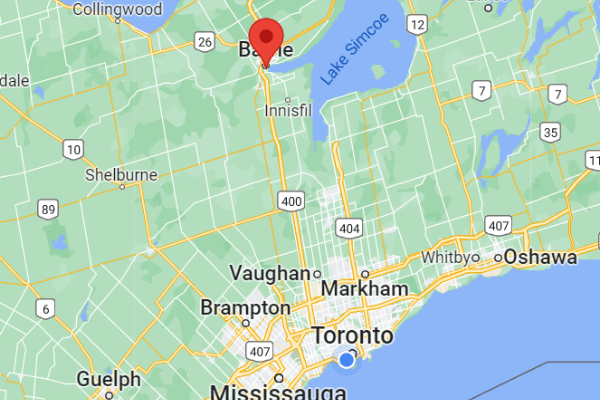
Looking to lower your living costs in Ontario? Exploring Barrie neighbourhoods is a good place to start. Located 80 km north of Toronto, this community of over 167,000 residents is a popular destination for new arrivals. Average 1-bedroom rents range from $1,750 to $1,900, making it much more affordable than Toronto while offering reliable transit to the Greater Toronto Area.
📌What You Need to Know
Save on Rent: Choose Barrie over Toronto to access lower housing costs and more space.
Prepare Early: Gather rental application documents, consider shared housing, and use verified platforms to avoid rental scams.
Select the Right Area: Focus on Painswick for commuting, Holly for family life, or the East End for student housing.
Budget Accordingly: Plan for monthly prices ranging from $1,500 for entry-level units to $2,800+ for premium homes.
Enjoy the Lifestyle: Access strong community networks, scenic parks, and nearby outdoor recreation.
Average Rent Comparison: Barrie vs. Toronto (1-Bedroom)
🧮 Newcomer Tip: Spending more than 30%–35% of your income on housing can strain your monthly budget. Check if Barrie rent fits your budget with the Prepare for Canada Rent Affordability Calculator.
Key Takeaways for Newcomers:
Lower Than Toronto Core: Renting a 1-bedroom apartment in Barrie saves newcomers approximately $120 per month compared to Toronto’s core ($2,221 vs. $2,103).
Close to the National Average: Barrie’s asking rent is close to the national average ($2,035/month across all property types).
High Demand Along GO Lines: Strong interest from GTA commuters has kept 1-bedroom apartments near Barrie’s GO Train stations in high demand throughout 2026.
Before You Rent in Barrie: Affordability & Rental Tips
Finding the right neighbourhood is only part of the rental journey. As a newcomer, understanding how the Canadian rental application process works will help you secure housing easily:
Lower Your Costs with Secondary Suites: If you are looking to save money, basement suites or shared rooms in established areas offer some of the most budget-friendly rental options in Barrie.
Consider Short-Term Housing First: If you need flexibility when you arrive, short-term rentals or home-sharing let you explore different areas before signing a long-term lease. Read our guide on how to find short-term rentals in Canada to secure temporary housing for your first weeks.
Avoid Rental Scams: Use verified platforms like Rentals for Newcomers to search for housing. Never transfer money before viewing a property in person or through a verified virtual tour, and always sign a standard Ontario lease.
Prepare Rental Documents Early: Barrie landlords typically ask for photo ID, proof of income or employment letters, credit reports, and personal references. Have these documents ready to help your application stand out.
📄 Newcomer Rental Application Guide
Ready to apply? Learn what documents Canadian landlords expect and how to present a winning application as a newcomer. Download the Free Rental Application Guide:
Barrie Neighbourhoods and Rentals Costs at a Glance
Choosing neighbourhoods like the East End or Painswick can save newcomers hundreds of dollars each month. You still get easy access to Highway 400 and direct GO Transit trains to Toronto. Here is a comparison of average rental costs and neighbourhood features in Barrie:
NEIGHBOURHOOD/AREA
1-BEDROOM AVG.
2-BEDROOM AVG.
NOTES
Canadian National Average*
~$2,035
~$2,420
Baseline benchmark across Canada (Rentals.ca National Rent Report)
East End
$1,500 – $1,850
$1,900 – $2,300
Most affordable; student & healthcare hub (Georgian College & RVH); secondary & basement suites. View East End Listings ↗
City Centre (Downtown)
$1,750 – $2,050
$2,100 – $2,400
High-density urban living; highly walkable; Kempenfelt Bay views; close to Allandale Waterfront GO. View City Centre Listings ↗
Allandale
$1,850 – $2,150
$2,200 – $2,500
Historic charm mixed with modern condos; direct access to Allandale Waterfront GO Station for Greater Toronto Area (GTA) commuters. View Allandale Listings ↗
Painswick
$1,750 – $1,950
$2,150 – $2,500
Rapidly growing south-end hub; Barrie South GO Station corridor; extensive retail on Big Bay Point Rd. View Painswick Listings ↗
Ardagh
$1,850 – $2,150
$2,200 – $2,550
West-end nature hub; adjacent to Ardagh Bluffs trails; mix of modern condos and quiet subdivisions. View Ardagh Listings ↗
Holly
$1,900 – $2,250
$2,300 – $2,700
Suburban family favorite; top-rated schools; close to Hwy 400 & Holly Recreation Centre. View Holly Listings ↗
Sunnidale
$1,500 – $1,800
$1,950 – $2,300
Mature tree canopy near Sunnidale Park; detached homes and ground-level secondary basement suites. View Sunnidale Listings ↗
Bayshore
$1,800 – $2,100
$2,200 – $2,500
Quiet south-end community near lakefront parks; single-family rental homes and quiet streets. View All Barrie Listings ↗
Innis Shore
$2,000 – $2,400
$2,400 – $2,850
Spacious south-east end living; scenic waterfront proximity near Wilkin’s Beach; newer home developments. View Innis Shore Listings ↗
*Data source: Urbanation Canadian Rental Market Analysis (September 2026)
Which Barrie Neighbourhoods Are Best for Newcomers?
The best Barrie neighbourhoods for newcomers offer a mix of affordable rent, nearby stores, and convenient transit. Your ideal choice depends on your lifestyle and priorities, such as commuting, family parks, or living near the lake. Here are top areas to explore.
1. East End
Best for: Georgian College students, healthcare workers, and budget-conscious renters
Transit: Direct bus connections to Georgian College campus and downtown terminals
Vibe: Historic, student-friendly, and community-focused
Why Newcomers Like It: Affordable shared rooms and secondary suites, plus proximity to college facilities.
The East End is an established neighbourhood in Barrie. It is the city’s main hub for students and healthcare workers, home to Georgian College and Royal Victoria Regional Health Centre (RVH). The area features quiet, tree-lined streets and older brick houses. It offers Barrie’s most affordable rental options, including shared student rooms, basement apartments, and family homes.
Best for: Young professionals, singles, international students, and car-free renters
Transit: Central Barrie Transit bus terminal; walking distance to Allandale Waterfront GO
Vibe: Urban, active, and scenic
Why Newcomers Like It: High walkability to shops and dining, access to waterfront parks, and car-free convenience.
City Centre is downtown Barrie, overlooking Kempenfelt Bay. The area offers high-rise apartments and condos near jobs, restaurants, and shops. You can easily walk to most places, so you do not need a car. Living here helps newcomers save money on transportation while staying close to the waterfront and the GO Train.
Best for: GTA commuters, character home lovers, and waterfront renters
Transit: Direct train service from Allandale Waterfront GO Station; quick Highway 400 access
Vibe: Historic, charming, and highly connected
Why Newcomers Like It: Direct train access to downtown Toronto, historic charm, and scenic waterfront parks.
Allandale is a quiet, historic neighbourhood on Kempenfelt Bay. It offers classic homes, green streets, and beautiful lake views. The Allandale Waterfront GO Station sits right in the neighbourhood. Commuters can easily travel to Toronto while enjoying a peaceful lakeside lifestyle.
Best for: Commuters, young families, and renters seeking suburban convenience
Transit: Direct GO Train service from Barrie South GO Station; quick access to Highway 400
Vibe: Suburban, active, and family-friendly
Why Newcomers Like It: Direct commute into downtown Toronto, multiple local schools, and shopping plazas.
Painswick is a popular south Barrie neighbourhood for families and working adults. Living near the Barrie South GO Station makes it easy to commute to Toronto by train or highway. The area has newer housing, local parks, a public library, and nearby grocery stores and shops along Big Bay Point Road. This makes it a convenient and practical choice for newcomers.
Best for: Outdoor enthusiasts, active individuals, and low-maintenance condo renters
Transit: Bus links to downtown terminals and GO train stations; convenient highway corridors
Vibe: Active, scenic, and suburban
Why Newcomers Like It: Direct access to over 17 km of trails at the Ardagh Bluffs and affordable modern condo options.
Ardagh is a west-end neighbourhood located right next to the Ardagh Bluffs Natural Area. It is ideal for outdoor enthusiasts who want trails right outside their door. Renters can choose between newer condos and single-family houses. These homes offer modern features and low-maintenance living at practical prices.
Best for: Growing families and renters looking for quiet residential suburban streets
Transit: Barrie Transit bus routes connecting to downtown hubs; quick highway access
Vibe: Family-focused, modern, and quiet
Why Newcomers Like It: Top-rated public schools, modern home layouts, and family-friendly community amenities.
Holly is a popular neighbourhood in southwest Barrie. It is well known for its friendly community. The area features spacious townhomes and larger family houses. These homes are great for bigger or extended families moving to Canada. Residents live close to local parks, the Holly Recreation Centre, and major highways.
Best for: Families seeking established communities, quiet surroundings, and large yards
Transit: Barrie Transit routes to Allandale Waterfront GO; fast access to Highway 400
Vibe: Peaceful, residential, and tree-lined
Why Newcomers Like It: Mature tree canopy, expansive parkland at Sunnidale Park, and a stable, quiet residential feel.
Sunnidale is a quiet neighbourhood in north Barrie with large yards and mature trees. The neighbourhood offers hiking trails, sports fields, and a scenic arboretum. Because the neighbourhood is mostly single-family houses, renters usually look for secondary suites and basement apartments.
Best for: Renters wanting a quiet, residential setting close to waterfront parks
Transit: Direct bus routes along main corridors; reasonable highway connections
Vibe: Calm, residential, and scenic
Why Newcomers Like It: Low-traffic streets, quiet neighbourhood parks, and quick access to Kempenfelt Bay.
Bayshore is a quiet south Barrie neighbourhood with single-family homes. The area sits near local shopping plazas and lakefront parks. It offers a calm, family-friendly setting with a short drive from downtown Barrie.
Best for: Nature lovers, families, and renters seeking waterfront access
Transit: Bus connections to central hubs; short drive to Barrie South GO Station
Vibe: Scenic, spacious, and community-oriented
Why Newcomers Like It: Proximity to Kempenfelt Bay beaches, scenic walking trails, and modern school facilities.
Innis Shore is located in southeast Barrie along Kempenfelt Bay. It is one of the most scenic areas in the city. Residents can easily visit Wilkin’s Beach and enjoy local walking trails. The Barrie South GO Station is just a 10- to 15-minute drive away. This neighbourhood is a great choice for active families who love nature.
Heading out to view rentals in Barrie? Take our free checklist to identify issues and ask landlords the right questions.
FAQs about Renting in Barrie
What types of rental housing are available in Barrie?
Newcomers can find high-rise apartments and condos in City Centre and Allandale, basement suites and room rentals in the East End, and single-family rental homes or townhouses in suburban areas like Holly, Painswick, and Innis Shore. Read more about types of housing in Canada.
Is Barrie affordable for renters compared to Toronto?
Yes. Rental prices in Barrie are lower than in Toronto. This allows newcomers to get larger living spaces for less monthly rent.
Is Barrie a good city for commuting to Toronto?
Yes. Both Allandale Waterfront GO and Barrie South GO stations have direct train service to Toronto’s Union Station. From Union Station, you can easily connect to the subway, streetcars, and buses across Toronto using the Toronto TTC Public Transportation System.
What is public transit like in Barrie?
If you’re settling in a central or well-served neighbourhood (City Centre, Allandale, Painswick near GO), transit is reasonably good for commuting and daily errands. You may need a car if you live in newer or more peripheral suburbs.
What makes Barrie attractive to newcomers?
Barrie offers a great mix of affordable living, local jobs, and outdoor activities. It is a growing city near the Greater Toronto Area (GTA) with a strong economy. Newcomers love the scenic waterfront, outdoor trails, and diverse rental options. Read our Living in Barrie guideto learn more about jobs, culture, and daily life.
Which Barrie neighbourhoods are best for families?
Family-friendly neighbourhoods include Painswick, Innis Shore, Holly, and Sunnidale. They feature top schools, community parks, and spacious homes.
Final Thoughts on Renting in Barrie Neighbourhoods
Barrie offers a range of rental options for newcomers landing in Ontario. Whether you need the student-friendly room rentals of the East End, the commuter convenience of Painswick and Allandale, or the family spaces of Holly and Innis Shore, Barrie provides a supportive community connected to the Greater Toronto Area.
Planning your move to Canada? To help you decide whether living in Toronto aligns with your goals, this guide breaks down what you need to know about starting life here, from local housing trends and top industries to lifestyle and community culture. As Canada’s largest financial hub and the most diverse city in the world, Toronto, Ontario, remains a premier destination for newcomers. Moving to a new country is a massive milestone, and choosing the right community to plant roots requires researching how different cities stack up.
What You Need to Know
Enjoy a Diverse Community and Global Job Market: Living in Toronto offers a welcoming, diverse community and great career options, but it comes with a high price tag.
Navigate Finding a Job and a Home: Tap into massive career hubs like finance, technology, and healthcare, but be ready for rent and housing prices that sit above the national average.
Access Robust Newcomer Support Services: Connect with a large network of settlement agencies and multicultural groups built to help you settle in smoothly.
Use North America’s Largest Transit Networks: Travel easily without a car using the extensive TTC subway, streetcar, and bus systems, alongside regional GO Transit trains.
Immerse Yourself in World-Class Culture: Dive into a legendary mix of global festivals, major professional sports teams, and a world-class food and arts scene.
📊 City Comparison Reference
For newcomers weighing their options across the Greater Toronto Area (GTA) and surrounding regions, this comparison highlights key benchmarks.
City Comparison Table
City
Average Rent (2-Bedroom, 2026)
Avg. Commute to Toronto (Downtown)
Top 3 Neighbourhoods for Newcomers
Toronto
$2,055 – $2,800/month
15–30 mins (via TTC/Transit)
High Park, North York, Liberty Village
Mississauga
$2,448 – $2,499/month
30–45 mins (via GO Train)
City Centre, Meadowvale, Malton
Brampton
$2,200 – $2,291/month
45–60 mins (via GO Train)
Mount Pleasant, Bramalea, Sandringham
💡 Newcomer Tip: Unsure which GTA city fits your budget best? Read our comprehensive city guides on Living in Mississauga and Living in Bramptonto compare your options.
Quick Facts About Living in Toronto: 2026
Metric
2026 Data
Comparison Note
City Population
~3.3 Million (6.55M in the GTA)
Largest city in Canada, 4th largest in North America
*Avg. 2-Bedroom Rent Rent
$2,055 – $2,800/month
High demand, though stabilizing due to increased rental supply
Average House Price
Condos: $627,000
Detached: $1,330,000
Falling slightly, but still represents one of Canada’s premium real estate markets
Top Industries
Financial Services, Technology, Healthcare, Film & Entertainment, Green Energy
Canada’s business capital; second-largest financial center in North America
Primary Transit System
Toronto Transit Commission (TTC)
Interconnected subway, streetcar, and buses; links to regional GO Transit
An aerial view of downtown Toronto looking south toward the Toronto Islands and the scenic shores of Lake Ontario.
Toronto sits right on the north shore of Lake Ontario. Today, it is a bustling business hub and the capital city of Ontario. The city’s history dates back to 1750, when it was set up as a French trading post called Fort Rouillé. It officially became the City of Toronto in 1834. Over the years, the city grew significantly by joining together with its surrounding areas. Its biggest change happened in 1998, when Toronto merged with the surrounding boroughs of:
East York
Etobicoke
North York
Scarborough
York
Known as the “city of neighbourhoods,” Toronto boasts more than 240 distinct communities, each offering its own cultural identity, architectural style, and community feel. It is recognized globally as one of the most welcoming and economically stable environments for starting a new chapter.
What Are the Top Industries for Jobs in Toronto?
Towering office buildings in the heart of Toronto’s Financial District showcase the immense scale of the city’s job market.
Toronto is the financial heart of Canada and home to roughly 40% of the country’s business headquarters. Because of its massive scale and highly educated workforce, it acts as a global magnet for innovation and enterprise.
Top Industries Driving the Local Job Market:
Financial Services & Banking (home to Canada’s “Big Five” banks)
Technology & Software Engineering (North America’s fastest-growing tech market)
Healthcare, Biotechnology, and Life Sciences
Film, Television, and Digital Media
Education & Academia
Tourism, Hospitality, and Food & Beverage
Major employers with headquarters or corporate hubs in the city include Scotiabank, RBC, CIBC, TD Bank, BMO, Salesforce, Questrade, and the University of Toronto, as well as 9 of the country’s top 10 law and accounting firms.
💡 Employment Trends: As of early 2026, Toronto’s job market is highly diverse. While the tech sector has experienced regional stabilization, fields like healthcare, education, green energy, and professional financial services show consistent, strong demand for skilled newcomer talent.
Tips for Newcomers Seeking Jobs in Toronto
Build a Canadian Network: Connect with local immigrant professional associations and bridge-to-employment programs run by the Toronto Region Immigrant Employment Council (TRIEC).
Use Specialty Recruiters: Connect with agencies such as Randstad Canada, IQ Partners, and Motion Recruitment to access the city’s robust corporate and tech sectors.
Enhance Your LinkedIn Profile: Highlight transferable skills that align with Canadian industry standards.
The 2026 Cost of Living in Toronto: Housing & Rent
High-rise condo developments in neighbourhoods like Liberty Village offer modern, transit-connected housing options for newcomers moving to Toronto.
Is Housing Expensive in Toronto?
Yes. Toronto has some of Canada’s highest housing costs. However, moving away from the downtown core into boroughs such as Scarborough, Etobicoke, or North York offers more affordable rental and purchase opportunities without sacrificing transit access.
Toronto Rent by Borough (2026 Estimates)
Rental rates vary by size, building age, and proximity to subway lines. Here is a look at average rents according to Prepare for Canada’s 2026 tracking:
💡Ready to begin your housing search? Learn more about how to conduct your rental search as a newcomer.
Practical Tips for Renting in Toronto
Understand Rent Control: In Ontario, rent control only applies to older residential buildings occupied before November 15, 2018. This means landlords must follow provincial rent increase guidelines (a maximum of 2.1% in 2026). There is no rent control for buildings built after 2018, and landlords can raise the rent by any amount.
Ask About Incentives: With the 2026 market balancing out, many landlords in Toronto are offering one month of free rent or utility credits to secure stable tenants.
Have Your Documents Ready: Landlords in Toronto move quickly. Prepare your employment letters, references, and proof of funds beforehand.
In 2026, real estate buyers are seeing slightly lower prices and more inventory compared to previous years. This presents more opportunities for newcomers with strong budgets.
Here is how the Toronto real estate market benchmarks by property type:
Property Type
Average Sold Price (2026)
Market Trend (Year-over-year)
Condo Apartment
$627,000
-8.9%
Townhouse
$931,000
-6.1%
Semi-DetachedHome
$1,030,000
-4.9%
Detached Home
$1,330,000
-8.3%
(Data Source: WOWA/TRREB Local Market Analysis)
Thinking of buying? Check out our guide for newcomers who are first-time home buyers to learn about mortgages, hidden closing costs, and land transfer taxes.
Community Support for Newcomers in Toronto, ON
According to Statistics Canada, 47% of Toronto’s population identifies as immigrants. The city is one of the most culturally diverse hubs on the planet. Over 150 languages are spoken daily, and strong local ethnic communities mean you can find familiar grocery stores, cultural groups, and places of worship.
Key Newcomer Insights
Top Countries of Origin for Recent Immigrants:India, China, and the Philippines remain the three largest sources of recent arrivals to the Toronto area.
Linguistic Diversity: While English is the dominant language of work and daily life, the most widely spoken non-official languages at home across the city are Mandarin, Cantonese, Tagalog, Spanish, and Tamil.
Managing your personal finances is vital to living in Toronto and building a stable life. To simplify your transition, major banks across the city offer newcomer packages, such as the Scotiabank StartRight™ Program.
Through this program, you can open a Canadian bank account online before you even leave your home country. Once you land, visit a local branch to activate your account, get a newcomer credit card (often without Canadian credit history), and access savings accounts or specialized mortgages. Meeting with a personal banking advisor early will help you budget during your initial settlement and plan for long-term goals such as buying a home.
Driving & Transit: Commuting While Living in Toronto
Public Transit
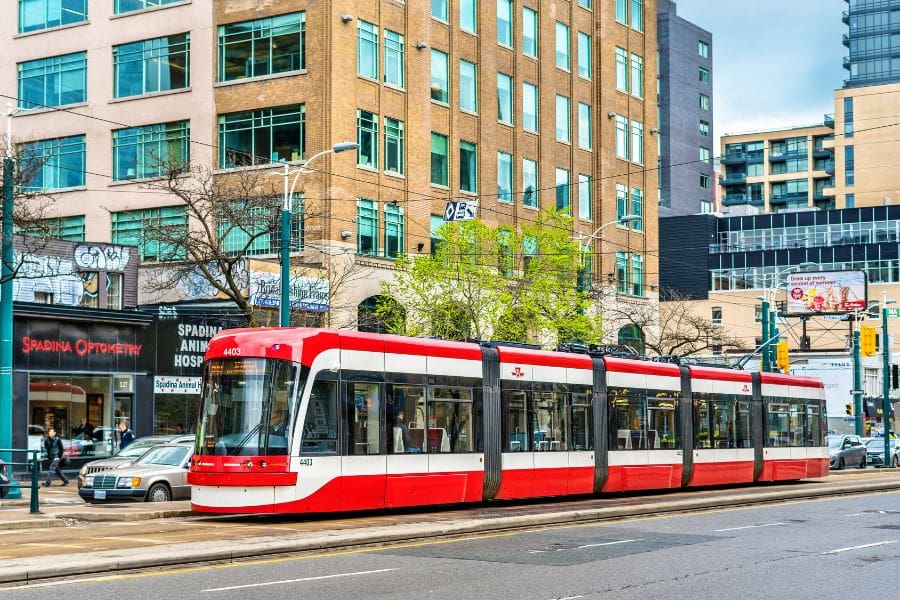
Toronto’s iconic TTC streetcar system is North America’s largest light-rail network, offering a convenient way to travel downtown without a car.
Many Toronto residents choose to live entirely car-free due to the efficiency of the transit grid.
Toronto Transit Commission (TTC) operates an extensive network of subways, buses, and streetcars (the largest light-rail network in North America).
GO Transit operates trains and buses for regional travel throughout the GTA with service departing from Union Station, downtown.
Air Travel
Toronto Pearson International Airport (YYZ): Located in Mississauga, Pearson is Canada’s largest and busiest airport. The airport is 5.3 kms from Toronto with flights connecting residents to global destinations.
Billy Bishop Toronto City Airport (YTZ): Located on the Toronto Islands, this downtown airport is convenient for regional travel to eastern Canada and the northeastern United States.
Driving & The 2026 Commuter Reality
Peak-hour traffic on the Gardiner Expressway shows the busy commuter reality of driving in and out of downtown Toronto.
Toronto has some of the busiest roadways in North America, with Highway 401 carrying over 400,000 vehicles daily. There are six major highways:
Highway 401: The major east-west highway in the city’s north end.
The Don Valley Parkway (DVP) / Highway 404: The major north-south highway east of downtown Toronto. This six-lane highway connects downtown Toronto directly to Highway 401.
Gardiner Expressway & QEW (The South Waterfront): The major east-west highway in the city’s south end. It serves as the primary route to Mississauga, Oakville, Hamilton, and the Niagara region.
Highway 427: On the far west side of Toronto, this north-south highway connects the QEW and Gardiner Expressway directly to Highway 401 and the 407 toll route. It provides direct access to Toronto Pearson International Airport.
Highway 400: Intersecting with Highway 401 in North York, this highway runs north out of the GTA with access to the city of Barrie, central Ontario, and the province’s famous “cottage country”.
407 ETR (Express Toll Route): Running across the top of the GTA, this Express Toll Route highway bypasses heavy city traffic.
Driver Licensing for Newcomers
Newcomers must visit an authorized DriveTest centre or the ServiceOntario Bay Street location in Toronto to exchange an international or out-of-province driver’s licence for a valid Ontario driver’s licence.
Winter Driving & Lakefront Weather
Putting good winter tires on your car is essential for Ontario weather. Because Toronto sits on Lake Ontario, the winter weather is humid and regularly brings heavy, wet snow, slush, and icy freezing rain. Read more in our guide, Winter Driving in Canada: 7 Essential Tips for Newcomers.
Healthcare & Medical Services
💡 Newcomer Tip: You should apply for provincial medical coverage immediately upon landing in Toronto. To find out what documents you need, follow our guide for newcomers, How to Apply for an Ontario Health Card.
Provincial Health Insurance: The Ontario Health Insurance Plan (OHIP)
OHIP covers essential medical care for residents. Use this breakdown to see your waiting period and eligibility based on your status:
Resident Category
Waiting Period
OHIPEligibility & Coverage Notes
Newcomers (International PRs)
No Waiting Period
Permanent Residents moving directly from outside Canada are eligible for immediate coverage starting on the day of arrival. You must apply for a health card as soon as you settle.
Moving from Another Province
Up to3 Months
Your “old” provincial plan covers you for the first 3 months in Ontario. OHIP coverage kicks in on the first day of the third month following your move (e.g., if you move July 10, coverage begins on October 1).
Work Permit Holders
No Waiting Period
Eligible for immediate coverage upon approval, provided you have a valid work permit and are working full-time for an Ontario employer for a minimum of 6 months.
International Students
Generally Ineligible
Public OHIP does not automatically cover international students. Students must instead use the mandatory University Health Insurance Plan (UHIP) or equivalent private plans provided by their school.
Canadian Citizens/PRs(Returning)
No Waiting Period
Returning residents get immediate coverage upon approval. However, to keep your health card active, you must physically reside in Ontario for at least 153 days in any 12 months.
How to Find a Family Doctor When Living in Toronto
Health Care Connect: Register for this provincial program to be placed on a priority list. A care coordinator will connect you with a local family doctor or nurse practitioner accepting new patients. You can register online at the Ontario.ca Find a Family Doctor page. You must have a valid Ontario health card number to register.
The College of Physicians and Surgeons of Ontario (CPSO): Use the “Find a Doctor” search tool on the CPSO website to filter local Toronto doctors by language, neighbourhood, and active clinic status.
Health Connect Ontario (Dial 811): Call 811 to speak directly with a registered nurse for free, 24/7 non-emergency health advice.
Medical Emergency: For any immediate, life-threatening medical emergency, always dial 9-1-1.
Major Hospitals in Toronto
Hospital
Primary Specialty
Key Focus for Newcomers
Toronto General Hospital
Cardiology, Organ Transplants
Ranked one of the top hospitals in the world; outstanding 24/7 emergency care.
Sunnybrook Health Sciences
Trauma, Oncology, Brain Sciences
Canada’s largest trauma center; specialized regional cancer care.
SickKids (Hospital for Sick Children)
World-Class Pediatric Care
Renowned global leader in child healthcare, research, and complex surgeries.
Schools & Learning: A Guide for Families & Students
How Do I Register My Child for School in Toronto?
💡 Newcomer Tip: If your child is entering the Canadian system for the first time, you must register through the school board’s Welcome Centre. The centre will assess your child’s language skills to make sure they get the right English as an Additional Language (EAL) support from day one. Read more in our guide, Schooling in Canada | A Look at the Education System.
Toronto offers high-quality, mandatory education for children aged five to 16. The city has four primary school boards:
Toronto District School Board (TDSB): Secular, English-language instruction across 583 schools.
Toronto Catholic District School Board (TCDSB): Publicly funded Catholic instruction in English across 195 schools.
Conseil scolaire Viamonde: Secular, full French-language instruction.
Toronto schools offer widespread access to French Immersion, Advanced Placement (AP), and International Baccalaureate (IB) programs, alongside the expanding provincial $10-a-day licensed childcare spaces.
What Are the Best Colleges and Universities in Toronto?
Toronto is a national leader in higher education. Its public schools are designated learning institutions (DLIs), meaning graduates may be eligible to apply for a Post-Graduation Work Permit (PGWP).
School
Best For
Primary Campus Location
University of Toronto (U of T)
Ranked #1 in Canada; world-renowned for medicine, tech, and research
Downtown (St. George), Scarborough, Mississauga
York University
Home to the prestigious Schulich School of Business and Osgoode Hall Law School
North York (Keele)
Toronto Metropolitan University (TMU)
Renowned programs in journalism, engineering, and business innovation
Downtown (Yonge & Dundas)
OCAD University
Canada’s largest and oldest specialized art and design institution
Downtown (Grange Park)
Seneca College
Exceptional graduate employment rates; specialized aviation and technology diplomas
North York, Markham
Humber College
Hands-on polytechnic education; strong business, creative writing, and media programs
Etobicoke
George Brown College
Top-tier culinary arts, hospitality, and construction management programs
Downtown
Centennial College
Highly diverse campus; specialized engineering and healthcare programs
Scarborough
What Are the Pros and Cons of Living in Toronto?
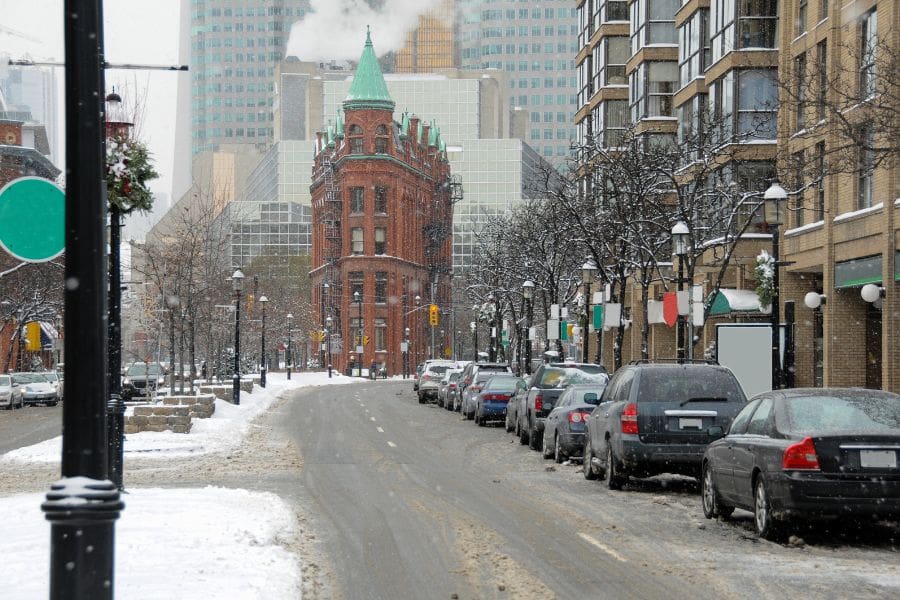
Toronto’s historic Flatiron building looks beautiful in the snow, but newcomers should be prepared to navigate winter slush and freezing temperatures.
To help you weigh your options, here is a look at the pros and cons of living in Toronto.
Feature
Pros (The Benefits)
Cons (The Challenges)
Money & Jobs
Unrivaled Job Market: Canada’s business capital with robust career paths in finance, tech, and medicine.
High Cost of Living: Daily items, groceries, and services carry a high price tag.
Housing
Diverse Housing Types: From sleek downtown high-rises to charming Victorian family homes in distinct boroughs.
Expensive Property Market: Some of the highest rental and real estate prices in the country.
Lifestyle
Global Entertainment Hub: Home to professional sports teams, incredible dining, and cultural events.
Heavy Traffic Gridlock: Long commute times and heavy traffic congestion when driving.
Nature
Beautiful Urban Green Space: Over 1,600 public parks, walking trails, and gorgeous beaches along Lake Ontario.
Cold, Snowy Winters: Humid winter cold, slush, and icy road conditions to manage for several months.
Culture and Day-to-Day Life in Toronto, ON
An interactive dive show at Ripley’s Aquarium of Canada, located just steps from the CN Tower in downtown Toronto.
The Heart of the City
Toronto is an urban explorer’s dream. The city features iconic destinations like the CN Tower, Ripley’s Aquarium, the Royal Ontario Museum (ROM), and the Art Gallery of Ontario (AGO). From shopping at the Toronto Eaton Centre to exploring the historic Distillery District and Kensington Market, there is always something to do.
Parks & Nature: Despite its high-density skyline, Toronto offers beautiful natural landscapes. High Park features stunning cherry blossoms and hiking trails, the Scarborough Bluffs present dramatic lakeside cliffs, and the Toronto Islands offer a tranquil escape just a short ferry ride from the downtown core.
Sports & Entertainment: Toronto is a passionate sports city, home to the:
Maple Leafs (National Hockey League)
Raptors (National Basketball Association)
Blue Jays (Major League Baseball)
Toronto FC (Major League Soccer)
Argonauts (Canadian Football League)
It is also a global music and cinema hub, hosting the world-famous Toronto International Film Festival (TIFF), high-energy concerts at Scotiabank Arena, and Broadway-level theatrical productions in the Entertainment District.
Newcomer Community & Cultural Events
Toronto prides itself on delivering inclusive cultural programming and welcoming networks for everyone who settles here. If you want to explore the vibrant communities where these traditions live year-round, check out our guide on the best cultural neighbourhoods in Toronto.
Multicultural Festivals: Toronto hosts exciting, city-wide celebrations like the Toronto Caribbean Carnival (Caribana) every summer, one of North America’s largest cultural street festivals. Newcomers can also explore popular community events such as Taste of the Danforth (celebrating Greek culture), Chinatown Festival, and the Roncesvalles Polish Festival.
MAC Eid Festival:Celebrate Eid al-Fitr and Eid al-Adha at one of Canada’s largest Muslim gatherings.
Indigenous Connection: The city is located on the traditional territory of several nations, including the Mississaugas of the Credit, the Anishnabeg, the Chippewa, the Haudenosaunee, and the Wendat peoples. You can explore this history by visiting the Royal Ontario Museum (ROM) and attending traditional Pow Wows and educational events.
💡 Moving to Toronto soon? Use our step-by-step checklist to track your arrival tasks and ensure a smooth landing.
Final Thoughts: Is Living in Toronto Right for You?
The famous glowing Toronto sign at Nathan Phillips Square represents the city’s diverse, bright, and welcoming spirit.
Toronto is an incredible home for career-focused people and young families. The city is full of energy, highly diverse, and economically stable. It also offers top-tier schools and endless job opportunities.
Yes, living here is very expensive. However, the chance to jumpstart your career is unmatched. Plus, the welcoming community networks and rich culture make living in Toronto highly rewarding for newcomers.
🏠 Ready to start your housing search? Browse Toronto rentals on Rentals for Newcomers today!
FAQs About Living in Toronto
Is it easy to live in Toronto without a car?
Yes! In fact, many downtown residents prefer to live without a car. The TTC subway, bus, and streetcar systems are highly integrated, making it simple to commute, shop, and travel. You can also easily connect to GO Transit for regional travel across the GTA.
How do school boundaries work, and can my child attend any school in the city?
Your child must attend a school based on your home address (known as your school catchment area). Research local school rankings and boundaries before signing a lease or purchasing a home in a specific neighbourhood.
Is Toronto safe for young families?
Yes, Toronto is consistently ranked one of the safest major metropolitan areas in North America. To put this into perspective, Statistics Canada reports that Toronto’s overall Crime Severity Index (CSI) sits at 59.4, significantly lower than the national average of 77.9.
While it is a massive city with typical urban dynamics, its residential boroughs (like North York, Etobicoke, and Scarborough) feature excellent safety standards, well-maintained parks, and tight-knit community networks.
What are the most affordable neighbourhoods in Downtown Toronto?
While downtown carries a premium price tag, budget-conscious renters can find more affordable options slightly east or west of the central core:
The Village (Church & Wellesley): Located just east of Yonge Street, this vibrant neighbourhood offers a large inventory of mid-rise apartment buildings. Because many units were occupied before 2018, they fall under Ontario’s strict rent-control protections.
Cabbagetown: This historic, quiet neighbourhood sits on the east side of downtown. It offers a distinct community feel with low-rise brick walk-ups and basement apartments that consistently trend below the downtown rental baseline.
Chinatown & Kensington Market: Spanning the west side of the core, this dense, artistic hub is ideal for students and newcomers. Renting a room in a shared house or an apartment above a commercial storefront provides some of the lowest housing costs in Old Toronto.
Planning your move to Canada? To help you decide whether living in Mississauga aligns with your goals, this guide breaks down what you need to know about starting life here, from local housing trends and top industries to lifestyle and community culture. As one of Canada’s most dynamic and diverse urban hubs, Mississauga, Ontario, has established itself as a top destination for newcomers. Moving to a new country is a massive milestone, and choosing the right community to plant roots requires researching how different cities stack up.
What You Need to Know
Enjoy a Diverse Community and Strong Job Market: Experience a welcoming environment with extensive housing options, balancing the higher living costs that come with a major city.
Navigate Finding a Job and a Home: You can find great career opportunities in fields such as manufacturing and healthcare, but keep in mind that renting or buying a home here costs more than in smaller cities.
Access Robust Newcomer Support Services: Connect easily with local resources and settlement agencies designed to help immigrants adapt quickly to Canadian life.
Use Convenient and Growing Transit Options: Travel locally using the reliable MiWay bus network or regional GO trains, though many residents still choose to own a car for daily convenience.
Immerse Yourself in a Vibrant Lifestyle: Experience multicultural festivals and inclusive events that make Mississauga a deeply welcoming place to plant roots.
📊 City Comparison Reference
For newcomers weighing their options across the Greater Toronto Area (GTA) and surrounding regions, this comparison highlights key benchmarks.
City Comparison Table
City
Average Rent (2-Bedroom, 2026)
Avg. Commute to Toronto (Downtown)
Top 3 Neighbourhoods for Newcomers
Mississauga
$2,448 – $2,499/month
30–45 mins (via GO Train)
City Centre, Meadowvale, Malton
Toronto
$2,907/month
15–30 mins (via TTC/Transit)
High Park, North York, Liberty Village
Brampton
$2,200 – $2,291/month
45–60 mins (via GO Train)
Mount Pleasant, Bramalea, Sandringham
💡 Newcomer Tip: Unsure which GTA city fits your budget best? Read our comprehensive destination reviews on Living in Toronto and Living in Bramptonto compare your options.
Quick Facts About Living in Mississauga: 2026
Metric
2026 Data
Comparison Note
City Population
~766,000
7th largest city in Canada, 4th largest in Ontario
*Avg. 2-Bedroom Rent Rent
$2,499/month
Balanced market with high choice in the condo sector
Average House Price
Condos: $644,800
Detached: $1,362,200
Highly competitive entry market; premium single-family market relative to smaller Canadian cities
Top Industries
Manufacturing, Transportation & Logistics, Retail, and Healthcare
Key regional employment hub with over 500,000 active jobs
Primary Transit System
Miway
Connects locally and directly with regional GO Transit and Toronto TTC
Climate
Continental
Features warm summers (avg 27°C) and snowy winters (avg -10°C)
A golden twilight over Mississauga’s residential neighbourhoods. Lake Ontario and the Toronto skyline are in the distance.
Nestled on the scenic shores of Lake Ontario in Peel Region, Mississauga is a vibrant city next door to Toronto, a 24 km drive west of Toronto’s downtown core. What started long ago as a small farming community has grown into a bustling, successful city full of job opportunities. Today, it is famous for being one of the most welcoming, diverse, and friendly places in Canada to plant your roots and start a new chapter.
Jobs & Employment: What Living in Mississauga Offers
The modern office towers at the Sussex Centre reflect Mississauga’s commercial core and strong job market.
What are the top industries for jobs in Mississauga?
Mississauga has a strong economy because it is home to Canada’s busiest airport (Pearson International) and has direct access to the country’s main highways. This makes the city a top choice for major companies in manufacturing, technology, and design.
Top Industries Driving the Local Job Market:
Pharmaceuticals and Life Sciences
Information & Communication Technology (ICT)
Supply Chain, Transportation & Logistics
Food & Beverage Manufacturing
Banking, Finance, and Insurance
Major Fortune 500 employers with an active footprint in the city include Amazon, Google, Microsoft, Walmart, and Pepsi.
💡 Employment Trends: As of early 2026, Mississauga has a diverse job market. While corporate office jobs in technology have slowed down across the region, companies in shipping, manufacturing, and healthcare continue to show high demand for skilled newcomers.
Tips for Newcomers Seeking Jobs in Mississauga
Build a Canadian Network: Connect with local immigrant professional associations and bridge-to-employment programs run by Peel Region community centers.
Leverage Local Recruiting Firms: Agencies like Randstad Canada, Robert Half, Resolve Recruit Inc., and AppleOne Employment Services actively place talent in specialized corporate sectors.
Target Major Employment Zones: Focus your search on corporate business parks situated near the Airport Corridor, Meadowvale, and the Hurontario Highway strip.
The 2026 Cost of Living in Mississauga: Housing & Rent
Mississauga’s diverse housing market offers established low-rise family neighbourhoods and a rapidly growing high-rise urban core.
Is Housing Expensive in Mississauga?
Yes, housing in Mississauga sits above the Canadian national average. However, it is a highly competitive, slightly more affordable alternative to downtown Toronto. Following an influx of new construction completions, the 2026 market offers renters more flexibility and choice than seen in previous years.
Mississauga Rent by Neighbourhood (July 2026)
Rental rates fluctuate by building type and lifestyle amenities. Renting a modern condo costs more, while older, purpose-built buildings provide greater value.
Here is a look at average rents according to our current 2026 tracking:
💡Ready to begin your housing search? Learn more about how to conduct your rental search as a newcomer.
Practical Tips for Renting in Mississauga
Understand Rent Control: In Ontario, buildings occupied for residential purposes before November 15, 2018, are subject to a strict provincial rent increase guideline (capped at 2.1% for 2026). Buildings built after 2018 have no rent caps.
Ask About Incentives: With the 2026 market balancing out, many landlords in the City Centre are offering one month of free rent or utility credits to secure stable tenants.
Secure Short-Term Housing First: It is much safer to look for a permanent, long-term rental in person once you can tour Mississauga’s unique neighbourhoods.
In 2026, buyers have the upper hand in the real estate market. Because there are plenty of homes to choose from, buyers don’t have to rush into a decision and can take their time finding the right place.
Here is how the Mississauga real estate market benchmarks by property type:
Property Type
Average Sold Price (As of June 2026)
Market Trend (Year-over-year)
Condo Apartment
$525,333
-8.9%
Condo Townhouse
$726,749
-5.1%
Freehold Townhouse
$883,038
-6.7%
Semi-Detached
$908,389
-8.4%
Detached Home
$1.482,130
+2.7%
(Data Source: Toronto Regional Real Estate Board/TRREB Local Market Analysis)
Tips for Newcomers Buying a Home in Mississauga
Connect with Local Experts: Find a licensed real estate agent to help you navigate Ontario’s purchasing laws and understand how to find, finance, and close on a home.
Get Pre-Approved: Secure mortgage pre-approval from your bank to show financial strength when placing offers.
Consider Budget-Friendly Neighbourhoods: Look into areas such as Cooksville, Malton, or Applewood. These pockets offer lower entry-level prices than luxury neighbourhoods like Lorne Park or Credit Mills.
Factor in Closing Costs: In Ontario, you are responsible for land transfer taxes, legal fees, and home inspection expenses upon purchase.
Community Support for Newcomers in Mississauga, ON
According to Statistics Canada, more than 53% of Mississauga’s residents were born outside of Canada. This diversity creates a uniquely global city.
South Asian residents make up about 25.4% of the population (over 180,000 people), and Chinese residents make up around 7.3% (~52,000 people). There are also growing Black, Arab, and Filipino communities. This means people living in Mississauga can easily find local support networks, cultural groups, and grocery stores that sell familiar foods from back home.
• LINC Classes with Childminding: Free English classes with on-site childcare. • Mental Health & Well-being: Culturally sensitive crisis counseling. • International Student Support: Helping students with housing and employment advice.
• Official Language Assessments: The official gateway to test your English before taking classes. • Corporate Bridging Programs: Helping internationally trained professionals get licensed in Canada. • Mentoring Networks: Connecting immigrants directly with Canadian employers.
Banking & Personal Finances in Mississauga, ON
Managing your personal finances is vital to living in Mississauga and building a stable life. To simplify your transition, major banks across the city offer newcomer packages, such as the Scotiabank StartRight™ Program.
Through the program, you can open a Canadian bank account online before you even leave your home country. Once you land, visit a local branch to activate your account, get a newcomer credit card (often without Canadian credit history), and access savings accounts or specialized mortgages. Meeting with a personal banking advisor early will help you budget during your initial settlement and plan for long-term goals such as buying a home.
Driving & Transit in Mississauga: Commuting While Living in Mississauga
Mississauga’s local transit network and bus routes connect residential neighbourhoods to the downtown core and regional transit hubs.
Public Transit
MiWay operates Mississauga’s local transit network. This bus network travels across the city, stopping near shops, schools, and neighbourhoods.
GO Transit operates regional transit on multiple rail paths (such as the Lakeshore West and Milton corridors). The GO Train travels to downtown Toronto’s Union Station in 30 to 45 minutes. Plus, the transit system is growing with the upcoming Hazel McCallion LRT on Hurontario Street and future connections directly to the Toronto subway grid.
Air Travel
Toronto Pearson International Airport (YYZ): Located inside the city borders of Mississauga, Pearson is Canada’s largest and busiest airport. It is 15 – 25 minutes north of Mississauga’s City Centre (Square One) with flights connecting residents to global destinations.
Driving & The 2026 Commuter Reality
Toll-Free Expressways: Mississauga connects directly to several major free highways, including Highways 401, 403, 410, and 427.
Toll Route Option: To avoid heavy traffic in the Greater Toronto Area, drivers can use Highway 407 (ETR), a fast, fully automated toll highway.
Driver Licensing: Newcomers must visit an authorized DriveTest centre or the ServiceOntario Bay Street location in Toronto to exchange an international or out-of-province driver’s licence for a valid Ontario driver’s licence.
Winter Readiness: Putting good winter tires on your car is highly recommended for Ontario weather. Because Mississauga sits right on Lake Ontario, the winter weather is humid and regularly brings heavy, wet snow, slush, and icy freezing rain. Read more in our guide, Winter Driving in Canada: 7 Essential Tips for Newcomers.
Healthcare & Medical Services
💡 Newcomer Tip: You should apply for provincial medical coverage immediately upon landing in Mississauga. To find out what documents you need, follow our guide for newcomers, How to Apply for an Ontario Health Card.
Provincial Health Insurance: The Ontario Health Insurance Plan (OHIP)
OHIP covers essential medical services for Mississauga residents. Permanent Residents moving directly from outside Canada are eligible for immediate coverage starting on the day of arrival, with no traditional three-month waiting period.
While essential care is free at the point of service, the public plan does not fully cover routine dental work, prescription eyeglasses, or ambulance transfers. Because of these gaps, many people choose to buy private extended health insurance or use employer benefit plans to help cover the extra costs.
Resident Category
Waiting Period
OHIPEligibility & Coverage Notes
Newcomers (International PRs)
No Waiting Period
Permanent Residents moving directly from outside Canada are eligible for immediate coverage starting on the day of arrival. You must apply for a health card as soon as you settle.
Moving from Another Province
Up to3 Months
Your “old” provincial plan covers you for the first 3 months in Ontario. OHIP coverage kicks in on the first day of the third month following your move (e.g., if you move July 10, coverage begins on October 1).
Work Permit Holders
No Waiting Period
Eligible for immediate coverage upon approval, provided you have a valid work permit and are working full-time for an Ontario employer for at least 6 months.
International Students
Generally Ineligible
Public OHIP does not automatically cover international students. Students must instead use the mandatory University Health Insurance Plan (UHIP) or equivalent private plans provided by their school.
Canadian Citizens/PRs(Returning)
No Waiting Period
Returning residents get immediate coverage upon approval. However, to keep your health card active, you must physically reside in Ontario for at least 153 days in any 12 months.
How to Find a Family Doctor When Living in Mississauga
Health Care Connect: Register for this provincial program to be placed on a priority list. A care coordinator will connect you with a local family doctor or nurse practitioner accepting new patients. You can register online at the Ontario.ca Find a Family Doctor page. You must have a valid Ontario health card number to register.
The College of Physicians and Surgeons of Ontario (CPSO): Use the “Find a Doctor” search tool on the CPSO website to filter local Mississauga doctors by language, neighbourhood, and active clinic status.
Health Connect Ontario (Dial 811): Call 811 to speak directly with a registered nurse for free, 24/7 non-emergency health advice.
Medical Emergency: For any immediate, life-threatening medical emergency, always dial 9-1-1.
Major Hospitals in Mississauga
Trillium Health Partners operates Mississauga’s hospital network:
Hospital
Primary Specialty
Key Focus for Newcomers
Mississauga Hospital(Central/South)
Stroke Care, Neurosurgery, & Regional Cardiac Center
Features one of the busiest 24/7 emergency departments in Canada and specialized critical care units.
Credit Valley Hospital(Northwest)
Regional Cancer Care, Genetics, & Maternal/Child Health
Equipped with a full 24/7 emergency department and highly rated labour, delivery, and pediatric units.
Queensway Health Centre(Etobicoke Border)
Day Surgery & Specialized Outpatient Care
Houses a major Urgent Care Centre for non-life-threatening illnesses and advanced rehabilitative services.
Schools & Learning: A Guide for Families & Students
Elementary & High School
The city has over 230 elementary and secondary schools across four boards:
Peel District School Board: Secular, English-language instruction.
Dufferin-Peel Catholic District School Board: Publicly funded Catholic instruction in English.
Conseil scolaire Viamonde: Secular, full French-language instruction.
Conseil scolaire de district catholique Centre-Sud: Catholic French-language instruction.
Specialized & Newcomer Support: French Immersion programs are widely accessible. High school students can enroll in specialized Advanced Placement (AP) or International Baccalaureate (IB) programs.
💡 Newcomer Tip: If your child is entering the Canadian system for the first time, you must register through the school board’s Welcome Centre. The centre will assess your child’s language skills to make sure they get the right English as an Additional Language (EAL) support from day one. Read more in our guide, Schooling in Canada | A Look at the Education System.
Post-Secondary Schools
University of Toronto Mississauga (UTM): A premier campus of the University of Toronto system, hosting over 15,000 students. It is highly regarded for its programs in innovation, management, biotechnology, and communication.
Sheridan College (Hazel McCallion Campus): Located in the heart of downtown Mississauga, this modern campus specializes in business education, architectural technology, and creative commercial programs that link with local corporate partners.
Pros and Cons of Living in Mississauga
The scenic Port Credit Harbour highlights Mississauga’s extensive waterfront paths, beautiful parks, and active lakeside lifestyle.
To help you weigh your options, here is a look at the major upsides and downsides of living in Mississauga.
Feature
Pros (The Benefits)
Cons (The Challenges)
Money & Jobs
Thriving Corporate Hub: Home to over 60 Fortune 500 headquarters, there are strong career paths in tech, finance, and pharmaceuticals.
High Daily Expenses: Living costs are high, and everyday items and services carry a premium price.
Housing
Built for Families: Neighbourhoods offer great schools and community centers, with stabilizing 2026 rent trends offering more options.
Expensive Property Market: Housing prices sit above the national average, making it hard to buy a home on a single income.
Lifestyle
Diverse Community: Over 53% of residents were born outside Canada, creating a rich, welcoming social fabric.
Heavy Traffic Gridlock: Peak rush-hour congestion is intense, and the sprawl makes a car highly necessary
Nature
Beautiful Waterfront Parks: Features over 3,100 hectares of green space, great biking trails, and stunning Lake Ontario beaches at spots like Jack Darling Memorial Park.
Unpredictable Winters: Winter weather brings icy road conditions, slush, and heavy snowfall to manage.
Culture and Day-to-Day Life in Mississauga, ON
Mississauga offers extensive green spaces and tree-lined neighbourhoods.
The Heart of the City
People in Mississauga take pride in their hometown and treat newcomers with genuine warmth. The city has a thriving arts scene, featuring premier cultural hubs like the Art Gallery of Mississauga. The state-of-the-art Living Arts Centre hosts diverse musical and theatrical performances year-round.
Nature and Natural Landscapes: Mississauga offers a beautiful, interconnected open space system with over 3,100 hectares of public parkland for those who enjoy an active outdoor lifestyle. Jack Darling Memorial Park is one of the city’s most popular lakefront destinations.
Celebration Square: Spanning the heart of the downtown core, this open-air civic square acts as the city’s social anchor. It features a sprawling lawn, a giant media screen, a summer wading pool, and a winter ice rink. This space offers a connection to community life through free outdoor movie nights and cultural festivals.
Local Sports and Entertainment: Local culture is heavily tied to sports and local entertainment. Mississauga is home to the Raptors 905 of the NBA G League, which plays in the Mississauga Sports and Entertainment Centre (formerly Paramount Fine Foods Centre). Catching a game offers newcomers an exciting and high-energy way to connect with local fans and get a taste of Canadian sports culture
Diverse Places of Worship: Reflecting its multicultural population, Mississauga features inclusive places of worship representing almost all global faiths. This includes historic Christian parishes, the majestic ISKCON Mississauga Temple, the Sayeda Khadija Mosque, and prominent regional Gurdwaras.
Newcomer Community & Cultural Events
Mississauga prides itself on delivering inclusive cultural programming and welcoming networks for everyone who settles here.
Multicultural Festivals: Mississauga hosts massive, city-wide celebrations like Carassauga — A Festival of Cultures every spring. As Ontario’s largest multicultural festival, it features pavilions throughout the city with traditional international food, music, live dance, and crafts from different countries. Newcomers can also explore popular celebrations like Muslimfest or the Bollywood Monster Mashup at Celebration Square.
Indigenous Connection: Newcomers can connect with the rich Indigenous history (Treaty Lands and Territory of the Mississaugas of the Credit First Nation) by visiting the Bradley Museum or attending traditional public Pow Wows and gatherings.
💡 Moving to Mississauga soon? Use our step-by-step checklist to track your arrival tasks and ensure a smooth landing.
Final Thoughts: Is Living in Mississauga Right for You?
A peaceful sunset over a Mississauga marina. The city is just a short distance from the busy streets of nearby Toronto.
If you want a safe, diverse city with great schools, plenty of jobs, and easy access to Toronto, Mississauga is an excellent choice. Even though housing costs more than in smaller cities or more rural Canadian markets, the great career options and newcomer support make it worth it for families and professionals.
MiWay transit provides reliable, affordable bus transit linking main neighbourhoods, schools, and transit hubs. However, Mississauga is a geographically large, sprawling city. Many residents living in Mississauga find that owning a vehicle is more convenient for grocery runs, family activities, and regional travel.
How do school boundaries work, and can my child attend any school in the city?
When living in Mississauga, your child must attend the specific school assigned to your residential address (known as your “catchment area”). You cannot choose a school outside of your catchment area. Newcomer families who want the best schools often check which school is assigned to a neighbourhood before renting or buying a home.
Is Mississauga safe for young families?
Yes, Mississauga is consistently rated as one of the safest large cities in Canada. With an overall Crime Severity Rate of just 56.36 (baseline score is fixed at 100), Mississauga and the surrounding regions sit well below the national average and most major Canadian metropolitan areas. Its residential neighbourhoods feature low crime rates, well-lit public parks, modern community recreation facilities, and exceptional school systems.
Ottawa, Ontario, is the prestigious and stable heart of Canada. Known as “The Capital,” it offers a unique blend of historical significance, a booming tech sector, and a high quality of life. If you are wondering whether living in Ottawa is the right city for you, this 2026 guide covers vital information about Ottawa rent prices, jobs, and lifestyle in a city that balances big-city opportunities with a community-focused feel.
Before moving, research:
Job opportunities in your field: Ensure your skills match Ottawa’s public service and high-tech labour markets.
Housing costs: Ottawa offers more value than Toronto, but prices vary between urban centers and the suburbs like Kanata and Orleans.
Cost of living in Ottawa: Budget for groceries, utilities, and transportation.
Culture and daily life: Understand the city’s bilingual nature and its “four-season” outdoor lifestyle to adapt faster.
This research will help you make informed decisions and start your life in Canada on the right foot.
Quick Facts About Living in Ottawa: 2026
Metric
2026 Data
Comparison Note
City Population
~1,100,000 (City) / 1.5M (Metro)
4th largest metro area in Canada
*Avg. 1-Bedroom Rent
$1,950
~25% higher than the national average
Benchmark Home Price
$793,000
Stabilizing after 2024-2025 growth
Top Industry
Public Service & High-Tech
“Silicon Valley North” (Kanata)
Climate
Humid Continental
Known for world-class skating in winter
*While this is an average, the market moves fast. You can see live Ottawa listings right now at Rentals for Newcomers.
About Ottawa, Ontario
Ottawa is uniquely positioned in Eastern Ontario, bordering Gatineau, Quebec. Together, they form the National Capital Region (NCR). This creates a distinctive bilingual environment where 45% of the population is functionally bilingual. In 2026, Ottawa is a global leader in SaaS, Cybersecurity, and Life Sciences, attracting professionals wanting “big city” careers with “small town” safety and commute times.
While Ottawa is a top choice for newcomers, it is important to see how its rental market and employment sectors compare with other major Canadian hubs. Check out our comprehensive guide to the best cities in Canada for immigrants to see how Ottawa’s cost of living stacks up nationally.
Jobs in Ottawa: 2026 Outlook
💡 Employment Trends: According to Prepare for Canada’s 2026 employment analysis, based on the March 2026 labour force data from Statistics Canada, the unemployment rate is 6.2% (Ottawa-Gatineau). While the economy has seen fluctuations, Ottawa’s unemployment rate remains relatively steady largely due to the stability of the public sector.
What are the top industries for jobs in Ottawa?
Key Sectors: Federal Public Service, Technology (SaaS & Wireless), Healthcare, and Life Sciences.
Top 5 Occupations (2026)
SaaS & Software Developers (Kanata Tech Sector)
Public Policy Analysts & Administrators (Federal Government)
Cybersecurity Specialists
Healthcare Professionals (The Ottawa Hospital & Queensway Carleton)
Skilled Trades (Supporting massive transit and residential expansion)
Major Employers: Government of Canada, Shopify, Nokia, Leonardo DRS, and the University of Ottawa
Tips for Newcomers Seeking Jobs in Ottawa
The Federal Public Service and a high-growth technology ecosystem (known as “Silicon Valley North”) drive the Ottawa job market. Many roles in the capital require specific security clearances or bilingualism; preparing early and networking are even more critical here than in other Ontario cities.
Search Local & National Job Boards: Start with the Canada Job Bank or the City of Ottawa’s career portal. For specialized roles, check the careers pages of Ottawa’s “Big Three” anchor employers:
The Government of Canada (GC Jobs): The region’s largest employer.
The Ottawa Hospital / CHEO: Leaders in healthcare and life sciences research.
The Kanata North Tech Park: A major anchor, housing over 500 companies and 33,000 tech employees.
Connect with Free Settlement Agencies: Don’t wait until you arrive. Many agencies offer pre-arrival services to help you tailor your resume to Ontario standards and understand the local labour market.
Attend Welcoming Ottawa Week (WOW):Held every June (22nd-30th in 2026), this city-wide initiative features job fairs, networking events, and direct access to employers and community leaders.
Ottawa offers a “middle ground” for Ontario. It is much more affordable than Toronto but more expensive than neighbouring cities like Kingston or Montreal. As of May 2026, the average rent for a 1-bedroom apartment is $1,778.
The 2026 Ottawa Rental Market: Costs & Process
Renting is often the first step for newcomers arriving in the capital. According to the Rentals for Newcomers 2026 Market Watch, while the early 2020s saw high competition and rising costs, the Ottawa market has become more balanced. With thousands of new units completed and more supply on the market, landlords are now more likely to offer incentives such as “one month of free rent” to attract reliable tenants.
Budgeting for Living in Ottawa: May 2026 Rental Costs
Living in Ottawa in May 2026 requires a monthly budget of approximately $3,200 to $4,500 for a single professional or $6,500 to $9,000 for a family of four. This includes the median Ottawa rent price of $1,778 for a one-bedroom apartment, plus roughly $650 for groceries, $162 for utilities, and $125 for a monthly transit pass.
This table shows the median asking rents. According to Rentals for Newcomers’ latest pricing guide, these figures represent the benchmark you should use when planning your monthly housing budget.
Unit Type
Median Monthly Rent
Year-over-Year Trend
Studio Apartment
$1,475
➖ Stable
1-Bedroom Apartment
$1,778
📉 Down 0.3%
2-Bedroom Apartment
$2,258
➖ Stable
3-Bedroom/Townhouse
$2,535
📈 Up 1.2%
👉 The surge in new apartment completions has led many landlords to offer move-in bonuses. To see current prices and incentives, check out active rental listings now.
Navigating the Canadian rental market as a newcomer, often without a Canadian credit history or local references, can feel like a puzzle. We’ve put together two essential resources: The Newcomer’s Rental Application Guide, a step-by-step checklist that will help you stand out to landlords, and our upcoming webinar, Renting Your First Home in Canada.
🏠 Where to Search for Rentals
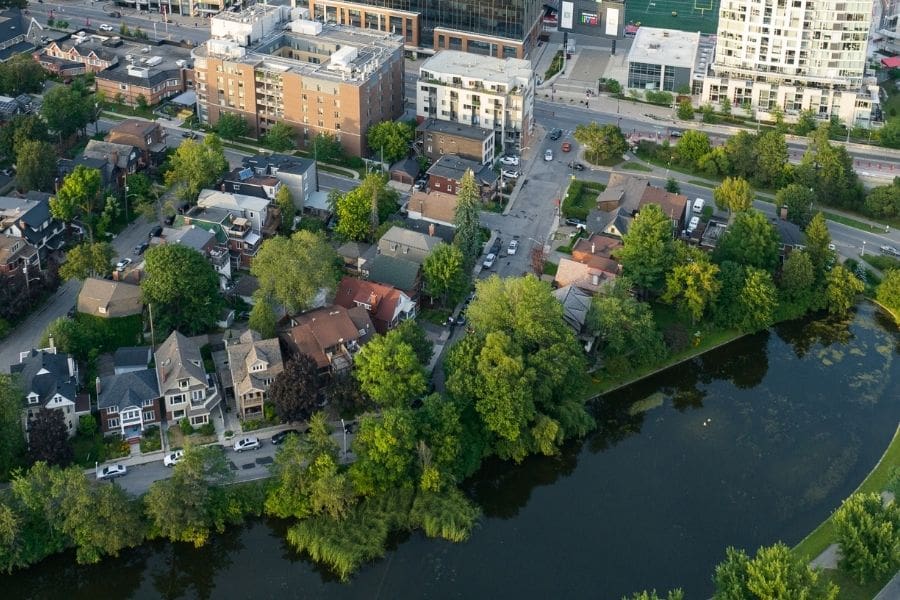
An aerial view of The Glebe neighbourhood, showing Ottawa’s unique mix of historic houses, modern apartments, and integrated green spaces near the Rideau Canal.
While the city average provides a budget, your lifestyle will dictate where you live. For a deep dive into the specific vibes and prices of each area, see our full guide: Best Ottawa Neighbourhoods for Renting.
For Tech Professionals: Look at Kanata or Nepean (close to “Silicon Valley North”). Search Nepean listings now.
For Families:Barrhaven and Orléans offer more space and are close to schools.
💡 Expert Tip: While the median for a 1-bedroom is $1,950, Rentals for Newcomers suggests exploring areas like Vanier or Cyrville, where quality units can often be found for $100–$200 below the city average.
The “Across the River” Choice: Living in Ottawa vs. Gatineau
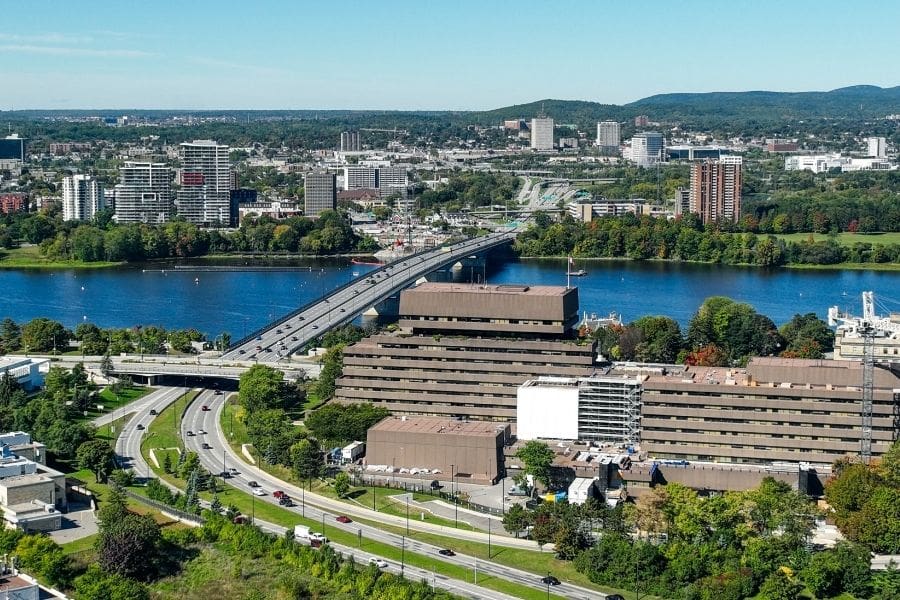
An aerial view of the Macdonald-Cartier Bridge connecting Ottawa and Gatineau. This major crossing is a daily route for thousands of commuters navigating the National Capital Region in 2026
When researching rentals, you will likely notice that prices in Gatineau (the city directly across the river in Quebec) are much lower than in Ottawa. While rent is often 15% to 20% cheaper in Gatineau, keep in mind that Quebec has higher provincial income taxes than Ontario.
For many newcomers, the extra tax you pay can actually be more than the money you save on rent. Additionally, cross-border commuting can be difficult, as traffic between Ottawa and Gatineau is heavy during rush hour.
Look for Landlord Incentives: Because the market is “softer” in 2026, many newer buildings offer move-in bonuses. Ask, “Are there any move-in incentives or flexible rent options for new residents?”
Understand Rent Control:
Controlled: If the building was first lived in before November 15, 2018, the landlord can only raise your rent by the provincial guideline (set at 2.1% for 2026).
Uncontrolled: Newer buildings (post-2018) do not have a legal cap on rent increases. So, budget carefully if you choose a brand-new condo.
Mandatory Tenant Insurance: Most Ottawa landlords require proof of insurance before they give you the keys. Budget for renters’ insurance.
Prepare a “Tenant Resume”: Since you may not have a Canadian credit score yet, bring proof of your savings, a letter from your employer, and references from your home country to build trust with landlords.
Book a short-term rental before you arrive in Canada, and search for a permanent or long-term rental upon arrival.
🏠 Find your first home: Use the Rentals for Newcomers search tool to find apartments specifically vetted for new arrivals. Find up-to-date listings and prices!
Buying a Home in Ottawa
Ottawa offers a great middle ground for newcomers. It is more affordable than Toronto or Vancouver, and it has a strong, stable housing market. As of May 2026, there are more homes for sale than in previous years, and prices aren’t rising as quickly. This makes it a good time for buyers to look for a home.
Here is how Ottawa home prices look:
Property Type
Benchmark Price (May 2026)
Market Trend
All Homes (Average)
$692,584
📈 Up 1.0%
Detached Houses
$845,000
📉 Down 0.8%
Townhouses
$562,5000
📈 Up 0.8%
Condo Apartments
$401,650
📉 Down 5.8%
Tips for newcomers buying a home in Ottawa
Work with a Local Real Estate Agent: A licensed agent can help you find the right neighbourhood, explain the paperwork, and handle the final sale.
Get a “Mortgage Pre-approval”: Talk to your bank to find out exactly how much money they will lend you. Having this letter ready makes your offer much stronger when you find a house you love.
Look in Growing Areas: Consider neighbourhoods like Vanier (close to downtown), Barrhaven (very popular with families), or Orléans (great value and a strong French-speaking community).
Most major banks offer newcomer programs that help you open an account before you arrive, get a credit card, and start building your credit history. By visiting a local bank branch, you can also learn about financial products such as lines of credit, savings accounts, and mortgages. You can even meet with a personal banking advisor who can help you budget for life in Ottawa and plan for long-term goals like buying a home.
Community Support for Newcomers in Ottawa, ON, Canada
The city offers a strong settlement network with several agencies to provide tailored support.
Key Settlement Services in Ottawa
Organization
Best For
Signature Programs & Perks
YMCA – YWCA Ottawa
First Arrivals
The first stop for Language Assessment (CLB).
Ottawa Community Immigrant Services Organization (OCISO)
Offers the “Multicultural Liaison Officer” program in schools to help newcomer children adjust.
Hire Immigrants Ottawa
Career
Connects internationally trained professionals with local employers.
World Skills Employment Centre
Career & Skills
Focus on getting newcomers into the Ottawa tech and government workforce.
Centre de services communautaires Vanier
Francophones
Bilingual Settlement: Comprehensive health and social services for the French-speaking newcomer community.
Ready to Start Your New Life in Ottawa?
Moving to a new country involves many moving parts. To make sure you don’t miss a step, from getting your Social Insurance Number (SIN) to enrolling your children in school, we’ve created a comprehensive guide just for you.
Driving & Transit in Ottawa, Ontario, Canada
Navigating the City: Transit & Living in Ottawa
LRT (O-Train): Line 1 (Confederation Line) runs east-west, while Line 2 (Trillium Line) runs north-south. Line 2 has recently expanded to serve the South and the Ottawa International Airport (YOW).
The Queensway (Hwy 417): The main artery. In 2026, peak-hour traffic can be heavy; newcomers are encouraged to live near their work sector (e.g., Kanata for tech, Centretown for gov).
Licensing: Newcomers must visit a DriveTest Centre to exchange their out-of-province or international license for an Ontario license.
Air and Rail Travel
Ottawa Macdonald-Cartier International Airport (YOW): Located about 20 minutes from downtown, YOW is the primary gateway for the National Capital Region.
The “Porter Hub” Advantage: In 2026, Porter Airlines officially made Ottawa its main secondary hub. This means newcomers have access to more domestic flights (such as Windsor, Sudbury, and Charlottetown) and frequent “sun” routes to Mexico and the Caribbean than in previous years.
VIA Rail: Ottawa is a major stop on the busy Windsor-Quebec City Corridor, making train travel a popular alternative to driving.
Healthcare & Medical Services
Provincial Health Insurance: The OHIP Guide
The Ontario Health Insurance Plan (OHIP) covers medically necessary services, including visits to family doctors and specialists, as well as most hospital care and surgical procedures. OHIP provides peace of mind for people establishing residency in the city.
Resident Category
Waiting Period
OHIP Eligibility & Coverage Notes
Newcomers (from Outside Canada)
No Waiting Period
Coverage begins the first day you establish residence in Ontario.
Moving from Another Province
3 Months
Your “old” provincial plan covers you for the first 3 months. OHIP begins on the 1st day of the 3rd month.
Work Permit Holders
No Waiting Period
Eligible if working full-time for an Ontario employer for at least 6 months. Requires an employer letter confirming your role and start date.
International Students
Not Eligible
Automatically enrolled in the University Health Insurance Plan (UHIP) at the University of Ottawa and Carleton.
Canadian Citizens/PRs
No Waiting Period
Must be physically present in Ontario for 153 days in any 12 months to maintain coverage.
📍 Where to Apply: Apply immediately at a ServiceOntario location to process your health card application. Popular locations for applications are the Ottawa City Hall branch (Centretown) and the Westgate Shopping Centre.
How to Find a Family Doctor in Ottawa
Once you have your OHIP card, your next priority is to find a primary care provider.
Health Care Connect: The primary provincial tool for finding a doctor. You register online, and a “Care Connector” will work to match you with a family doctor or nurse practitioner accepting new patients. Due to a provincial shortage, the wait for a family doctor in Ottawa currently averages 14-18 months.
Walk-in Clinics: Use walk-in clinics or the AppleTree Medical Group for immediate needs.
Health811 (in Ottawa and across Ontario): This is your 24/7 bilingual phone nursing triage service. By dialling 811, you can speak with a registered nurse for medical advice or help finding local health services.
Urgent Care vs. Emergency: Locals use Urgent Care Centres, such as the Orleans Health Hub or St. Vincent Hospital, for issues like stitches, sprains, or minor infections. This keeps Emergency Rooms (at The Ottawa Hospital and Montfort) clear for life-threatening crises.
Major Hospitals in Ottawa
Ottawa is a national leader in specialized medicine, research, and bilingual healthcare. The city’s medical services are primarily divided into three major networks: The Ottawa Hospital (TOH), Montfort Hospital (the province’s flagship Francophone teaching hospital), and specialized centers like CHEO and the University of Ottawa Heart Institute.
Hospital
Primary Specialty
Key Focus for Newcomers
The Ottawa Hospital (Civic Campus)
Trauma & Neuroscience
The regional center for adult trauma and the home of the University of Ottawa Heart Institute, Canada’s largest cardiovascular center.
CHEO (Children’s Hospital of Eastern Ontario)
Pediatrics & Youth
One of Canada’s leading pediatric hospitals. It features a 24/7 Pediatric ER and specialized mental health services for youth under 18.
The Ottawa Hospital
General & Specialized
A multi-campus network that serves as the region’s primary provider for adult trauma and specialized research.
Montfort Hospital (Hôpital Montfort)
Bilingual Community Care
The primary point of care for Francophone residents, and a key community teaching hospital in the East End.
Queensway Carleton Hospital (QCH)
Acute Care & Orthopedics
The primary hospital for the West End (Kanata/Nepean). Known for its Surgical Centre and being the first point of contact for the tech-sector corridor.
Royal Ottawa Mental Health Centre
Mental Health Research
One of Canada’s most prestigious psychiatric hospitals and research facilities, specializing in complex mental health and recovery.
Schools & Learning: A Guide for Families & Students Living in Ottawa
Ottawa offers high-quality education at all levels. Whether you are looking for a school for your child or a university for yourself, here is a clear breakdown of how the system works in 2026.
Elementary & High School
In Ottawa, education is free for residents. Unlike most cities, you can choose from four different school boards based on the language you speak and your religious preference:
English Public (OCDSB): The largest board. Classes are in English, but they offer popular “French Immersion” programs where students learn several subjects in French.
French Public (CEPEO): For families who speak French as their first language. All classes are taught in French.
English Catholic (OCSB): These schools include religious education but are open to students of all faiths.
French Catholic (CECCE): French-language education with a Catholic focus.
💡 Newcomer Tip: If your child is new to Canada, you must start at a Family Welcome Centre. They will assess your child’s English and math skills to make sure they are placed in the right grade with the right support. You can also ask for a Multicultural Liaison Officer (MLO), who can help your family in your native language. Read more in our guide, Schooling in Canada | A Look at the Education System.
Child Care (Daycare)
Thanks to a national program, daycare costs have dropped significantly. As of early 2026, the average cost in Ottawa is about $19 per day, with the government working toward a $10-per-day goal. However, it may be difficult to secure a daycare spot, and there may be a waitlist.
Colleges & Universities
Ottawa is a “University Town.” These schools have strong connections to government and technology jobs.
University of Ottawa (uOttawa): Famous for being the world’s largest bilingual (English-French) university. It is a top choice for Law, Medicine, and Social Sciences.
Carleton University: Located near the river, it is best known for Journalism, Public Affairs, and Engineering.
Algonquin College: Located in the West End, this is the place to go for “hands-on” training in skilled trades, technology, and nursing.
La Cité collégiale: The largest French-language college in Ontario, specializing in technical and creative careers.
Pros and Cons of Living in Ottawa
Ottawa is famous for its snowy winters. While the city is well-equipped to handle heavy snowfall, newcomers should prepare for a ‘four-season’ lifestyle that includes world-class snow removal and a lively winter culture.
This table looks at the pros and cons of moving to Ottawa in 2026.
Feature
Pros (The Benefits)
Cons (The Challenges)
Lifestyle
National Cultural Hub: Access to Canada’s best museums, galleries, and major events like Canada Day and Winterlude.
“Early to Bed” Reputation: While the culinary scene is growing, the city is generally quieter at night compared to Toronto or Montreal.
Housing
Stability & Choice: While expensive, the market is less volatile than Toronto, offering a mix of urban condos and spacious suburban family homes.
The Affordability Squeeze: Rent and home prices remain high relative to the national average, requiring a strong household income.
Nature
Greenbelt & Waterways: Amazing access to Gatineau Park, the Ottawa River, and the Rideau Canal for year-round outdoor recreation.
Extreme Winters: Ottawa is one of the coldest capitals in the world; winter lasts from November to April with significant snowfall.
Economy
Recession-Proof Jobs: A massive public service sector and a global tech hub (Kanata) provide high-paying, stable career paths.
The Bilingual Barrier: Many high-level career opportunities, especially in government, require proficiency in both English and French.
Transit
Expanding LRT Network: The 2026 completion of Stage 2 LRT is improving connectivity to the airport and suburban hubs.
Ongoing Reliability Issues: The light rail system has faced historical “growing pains” that can make commuting frustrating.
Community
Safe & Family-Oriented: Consistently ranked as one of the safest and best cities in Canada to raise children.
Bilingual Complexity: Navigating two provincial systems (Ontario/Quebec) if you choose to live in Gatineau but work in Ottawa.
Culture & Community: Embracing the Ottawa Lifestyle
Arts, Culture & Entertainment: The Heart of the Capital
Standing 30 feet tall, the ‘Maman’ spider sculpture greets visitors at the National Gallery of Canada. For many Ottawa residents, it has become a symbol of the city’s bold and creative spirit.
In 2026, Ottawa is much more than a government city. It is a cultural destination where national history meets a modern, diverse arts scene. With recent upgrades to major venues such as the National Arts Centre, the city hosts world-class concerts, Broadway shows, and international events all year. Check out Ottawa’s Event Calendar for current activities.
Museums & History:
Ottawa is home to Canada’s most famous museums. You can explore the National Gallery of Canada for world-class art or visit the Canadian Museum of History (just across the river) to learn about the country’s past. For something unique, the Canada Aviation and Space Museum and the Canadian War Museum are “must-sees.”
Cultural Celebrations:
Ottawa’s biggest party is Canada Day (July 1st), where the whole city turns into a festival. Other major events include the Canadian Tulip Festival in May and Winterlude in February. Winterlude is famous for its massive ice sculptures and for turning the city into a winter playground. If you’re looking to explore beyond the capital, check out our Canadian Winter Festivals Guide.
Professional Sports:
You can cheer for the Ottawa Senators (NHL) at the Canadian Tire Centre. If you prefer football, the Ottawa Redblacks (CFL) play at the lively Lansdowne Park. Soccer fans also gather at the same stadium to support Atlético Ottawa (CPL).
Active Living: Parks, Trails, and the Ottawa Lifestyle
Skaters enjoy the Rideau Canal Skateway in 2026. Stretching through the heart of the city, the ‘World’s Largest Skating Rink’ saw over one million visits during the 2025–2026 season. Photo: Courtesy of Destination Ontario.
Ottawa is one of the greenest cities in Canada. Living in Ottawa means you are never far from a park or a trail.
The Rideau Canal: The city’s most famous landmark. In the summer, you can walk, bike, or boat along it. In the winter, the Rideau Canal Skateway becomes the world’s largest rink, stretching nearly 8 kms through the heart of the city.
Gatineau Park: Just a 15-minute drive from downtown, this massive park is perfect for hiking, camping, and seeing beautiful fall colours.
The Ottawa River: For those seeking adventure, the river is world-famous for whitewater rafting and kayaking. You can even try the world’s only interprovincial zipline, which lets you fly across the water from Ontario into Quebec.
ByWard Market: This is the city’s oldest public market. It is a great place to walk around, grab a “BeaverTails” pastry, and shop for local food and crafts.
Newcomer Community & Cultural Events
Ottawa is very welcoming to people from all over the world. The city celebrates its diversity with many community festivals.
Multicultural Festivals: Throughout the summer of 2026, you can visit events like the Latin Sparks Festival, Greek Fest, and Festival L’Outaouais en Fête.
Welcoming Ottawa Week (WOW): Every June (June 22–30 in 2026), the city holds special events to welcome newcomers. These include storytelling nights, soccer matches, and community picnics designed to help you meet new people and feel at home.
Final Thoughts: Is Living in Ottawa Right for You?
Residents gather at a scenic lookout facing the Ottawa skyline. In 2026, Ottawa’s strength lies in its diversity, offering a welcoming environment for newcomers from all walks of life.
Choosing Ottawa, Ontario, in 2026 means choosing a city that offers a high quality of life and great stability. It is much more than just a government town; it is a leading tech hub and a safe, bilingual community that is perfect for families.
Ultimately, living in Ottawa remains one of the most balanced choices for newcomers in 2026. While the ‘sticker shock’ of Ottawa rent prices can be daunting at first glance, the city’s high average salaries and stable employment market often provide a better long-term return than more volatile hubs like Toronto or Vancouver. By doing your research today, you’re already one step ahead in the housing puzzle.
Not for most tech or service jobs. However, for federal government roles, the ability to speak French and English is often a requirement for promotion and permanent status.
How cold does it get in Ottawa?
Ottawa is the 7th coldest capital city in the world. Expect deep snow from December to March. On the plus side, the city is built for the cold, with underground tunnels (pedway) and world-class snow removal.
How do I find a family doctor?
Use the Health Care Connect registry. This is the provincial “waiting list” for people without a primary care provider.
Is it a good place to raise a family?
Absolutely. Ottawa consistently ranks as the safest major city in Canada and has some of the highest-rated public schools in the province.
Hamilton, Ontario, Canada, is the rising star of the Golden Horseshoe. Known as “The Ambitious City,” it offers a unique blend of grit, heritage, and a rapidly diversifying economy. If you are researching whether Hamilton, Ontario, Canada, is the right city for your move, this 2026 guide covers vital information about living in Hamilton, housing, and jobs, in a city undergoing a massive transformation.
Before moving, it’s vital to research:
Job opportunities in your field: Ensure your skills match the Hamilton labour market.
Housing costs: Hamilton is a primary affordability valve for the Greater Toronto and Hamilton Area (GTHA).
Cost of living: Budget for groceries, utilities, and transportation.
Culture and daily life: Adapt faster and enjoy your new community.
Doing this research will help you make informed decisions and start your life in Canada on the right foot.
Quick Facts About Living in Hamilton: 2026
Metric
2026 Data
Comparison Note
City Population
~600,000 (City) / 820,000 (Metro)
9th largest metro area in Canada
*Avg. 1-Bedroom Rent
$1,825
-25% lower than Toronto
Benchmark Home Price
$776,847
Prices stabilizing after 2025 correction
Top Industry
Health Sciences & Biotech
Transitioning from steel to “Eds and Meds”
Climate
Humid Continental
Famous for “Waterfall Season” in the Spring
*While this is an average, the market moves fast. You can see live, neighbourhood-specific listings for Hamilton right now at Rentals for Newcomers.
About Hamilton, Ontario
A hub of innovation and nature: From the McMaster Innovation Park to over 100 waterfalls within city limits.
Hamilton serves as the industrial and healthcare heart of Southern Ontario. Located at the western tip of Lake Ontario, the city is geographically divided by the “Mountain” (the Niagara Escarpment), creating a unique upper- and lower-city dynamic. In 2026, the city is a national leader in Green Steel and medical research, attracting a wave of “urban refugees” from Toronto looking for more space without sacrificing culture.
Jobs in Hamilton, Ontario
What are the top industries for jobs in Hamilton?
Key Sectors: Health Care, Advanced Manufacturing, Education, and Film/Digital Media.
5. Specialized Manufacturing (EV Battery Tech & Green Steel)
Major Employers: Hamilton Health Sciences, McMaster University, ArcelorMittal Dofasco, and the City of Hamilton.
💡 Employment Trends: As of March 2026, Hamilton’s unemployment rate sits at 6.5%, trending lower than the provincial average. This stability is driven by the $3.4B Light Rapid Transit (LRT) project and the ongoing “Green Steel” transition, which have created a surge in high-paying construction and engineering roles.
Tips for Newcomers Seeking Jobs in Hamilton
Hamilton’s job market is uniquely tied to the GTHA economy, making networking and specialized settlement support essential for a quick entry into the workforce.
Search Local & National Job Boards: Use Canada Job Bank or the Hamilton Economic Development portal. For specialized roles, check the careers pages of the “Big Three” employers: Hamilton Health Sciences, McMaster University, and ArcelorMittal Dofasco.
Connect with Free Settlement Agencies: Don’t wait until you arrive. Many agencies offer pre-arrival services to help you tailor your resume to Ontario standards and understand the local labour market.
Attend Newcomer Events: Events like the annual Hamilton Newcomer Day (held every April) are vital for meeting employers and service providers face-to-face.
The 2026 Cost of Living in Hamilton: Housing & Rent
Is housing expensive in Hamilton?
Hamilton is a primary “affordability valve” for the Greater Toronto and Hamilton Area. As of April 2026, the average rent for a 1-bedroom apartment is $1,825, which is roughly $700 per month cheaper than a similar unit in downtown Toronto. If you’re deciding between the high-energy lifestyle of the provincial capital and Hamilton, see our guide on Living in Toronto: Everything You Need to Know for a comparison.
Hamilton Rent by Neighbourhood (April 2026)
Renting is often the first step for newcomers. You’ll discover a range of neighbourhoods and housing types to suit different lifestyles and budgets.
While the average for a 1-bedroom unit is $1,825, looking in older residential areas may offer larger monthly savings.
Neighbourhood
Avg. 1-Bedroom Rent
Vibe for Newcomers
East End
$1,550
Most Affordable: Best for families and garden space
Corktown
$1,875
Commuter Hub: Steps to GO Transit; historic and walkable
Westdale
$1,925
Student/Academic: Near McMaster; vibrant and rowdy
The Mountain
$1,750
Suburban Comfort: Quiet streets, great for newcomers with cars
North End
$1,850
Rapid Growth: Near the water; massive redevelopment underway
🏠 Start Your Rental Search with Confidence
The Hamilton market moves quickly! We recommend using the Rentals for Newcomers search tool to find apartments specifically vetted for new arrivals. Find up-to-date listings and prices!
Hamilton landlords now offer rent-free months to fill new buildings.
Target New Downtown Condos for Perks: In early 2026, the vacancy rate has climbed to 3.6%, and the city has over 1,400 new rental units. This is where you’ll find the best incentives; Look for “One Month Free Rent” or “Reduced Move-in Fees” specifically in the Core and West Harbour areas.
Set a realistic budget: Hamilton rents are currently in a “softening” phase, but remain higher than the national average.
Mandatory Renter’s Insurance: Most Hamilton landlords now require proof of a tenant insurance policy before handing over the keys. Budget for renter’s insurance.
Book a short-term rental before you arrive in Canada, and search for a permanent or long-term rental upon arrival.
💡Renting in Hamilton Tip: You’ll need tenant insurance to protect your belongings and most property owners will require it. Read more about why newcomers need tenant insurance.
Buying a Home in Hamilton
A city of neighbourhoods: Hamilton’s 2026 housing market offers a diverse range of suburban and urban options within its iconic leafy landscape.
Hamilton offers an advantage for newcomers looking to stay within the GTHA while avoiding Toronto’s high price points. As of April 2026, the market has shifted toward a “Buyer’s Market” with more inventory and a notable plateau in pricing, making it a strategic time to enter the market.
Here is how Hamilton benchmarks as of April 2026.
Property Type
Benchmark Price (April 2026)
Market Trend
Composite (All Homes)
$721,075
Down 8.7% Year-over-Year
Detached Homes
$807,952
Down 7.7% Year-over-Year
Townhouses
$630,671
Down 7.3% Year-over-Year
Condo Apartments
$388,264
Down 13.3% Year-over-Year
Tips for newcomers buying a home in Hamilton
Connect with licensed real estate agents to help you understand how to find, finance, and close on a home.
Get pre-approved for a mortgage to strengthen your offer.
Consider areas like Crown Point and Corktown, which offer accessible entry points for detached homes and condos.
Community Support for Newcomers in Hamilton, ON, Canada
There are many newcomer agencies in Hamilton, with each playing a distinct role in your first year of arrival.
Key Settlement Services in Hamilton
Organization
Best For
Signature Programs & Perks
YMCA Immigrant Services
First Arrivals
Language Assessment: The mandatory starting point for all English classes. Mentorship: Professional matches for internationally trained workers.
Immigrants Working Centre (IWC)
Career & Skills
WorkLink: Sector-specific language training for Retail, Childcare, and Manufacturing. WES Gateway: Help with credential recognition for displaced documents.
Wesley Newcomer Services
Refugees & Housing
Resettlement Assistance: Temporary housing and intensive orientation for Government-Assisted Refugees. Housing Search: Dedicated case workers to help you find your first apartment.
Hamilton Public Library (HPL)
Learning & Community
Newcomer Learning Centre: Free one-to-one English tutoring and Conversation Circles. Human Library: One-to-one chats with established locals to learn about Canadian culture.
YWCA JOIN Program
Women & Youth
Gender-Based Support: Specialized employment and wellness workshops for newcomer women and 2SLGBTQIA+ youth.
Centre de Santé Communautaire
Francophones
Bilingual Settlement: Comprehensive health and social services for the French-speaking newcomer community.
Ready to Start Your New Life in Hamilton?
Moving to a new country involves many moving parts. To make sure you don’t miss a step, from getting your Social Insurance Number (SIN) to enrolling your children in school, we’ve created a comprehensive guide just for you.
Banking & Personal Finances in Hamilton, ON
Most major banks offer newcomer programs that help you open an account before you arrive, get a credit card, and start building your credit history. By visiting a local bank branch, you can also learn about financial products such as lines of credit, savings accounts, and mortgages. You can even meet with a personal banking advisor who can help you budget for life in Hamilton and plan for long-term goals like buying a home.
Managing your personal finances is a vital part of living in Hamilton, ON, Canada. To prepare, check out our guide, Canadian Financial Tips Before You Move to Canada to help you budget for life in Ontario and plan for long-term goals.
Driving & Transit in Hamilton, Ontario, Canada
Commuting with a view: Highway 403 offers a scenic passage through the lush wetlands of Cootes Paradise.
Driving & Transit in Hamilton
The Linc & Red Hill: These are Hamilton’s primary internal expressways. In 2026, expect “Construction Season” to add 15 minutes to any cross-town trip.
Winter Driving: Driving between the “Lower City” and “The Mountain” involves steep access points (called “Mountain Cuts”). During winter, these inclines become extremely hazardous. Read more in our guide, Winter Driving in Canada: 7 Essential Tips for Newcomers
Licensing: Newcomers must visit a DriveTest Centre to exchange their out-of-province or international license for an Ontario license.
Public Transit
The 2026 Commuter Reality
The LRT (Light Rail Transit): Hamilton is currently in peak construction for the B-Line LRT. While this means heavy traffic on Main and King Streets, the project is scheduled for completion in 2027/2028.
GO Expansion: GO provides frequent, reliable service to Toronto’s Union Station. 2026 marks the arrival of 15-minute all-day, two-way service between West Harbour GO and Toronto Union Station, making Hamilton a viable “bedroom community” for tech workers.
Air and Rail Travel
John C. Munro Hamilton International Airport (YHM): Located about 15 – 20 minutes from downtown, YHM is a major gate for affordable domestic travel. It has become a primary alternative to Toronto Pearson for domestic travelers.
VIA Rail: Hamilton residents typically use the Aldershot GO/VIA station or the West Harbour GO Station for national rail connections.
Healthcare & Medical Services
Provincial Health Insurance: The OHIP Guide
The Ontario Health Insurance Plan (OHIP) covers Hamilton residents for medically necessary services, including visits to family doctors and specialists, as well as most hospital care and surgical procedures. The system provides peace of mind for people establishing residency in the city.
Resident Category
Waiting Period
OHIP Eligibility & Coverage Notes
Newcomers (from Outside Canada)
No Waiting Period
Coverage begins the first day you establish residence in Ontario. Apply immediately upon arrival.
Moving from Another Province
3 Months
Your “old” provincial plan covers you for the first 3 months. OHIP begins on the 1st day of the 3rd month.
Work Permit Holders
No Waiting Period
Eligible if working full-time for an Ontario employer for at least 6 months. Requires an employer letter.
International Students
Not Eligible
Must enroll in the University Health Insurance Plan (UHIP) or equivalent through McMaster or Mohawk College.
Canadian Citizens/PRs
No Waiting Period
Must be physically present in Ontario for 153 days in any 12 months to maintain status.
📍 Where to Apply: In Hamilton, you can visit the ServiceOntario locations downtown (at the corner of King and MacNab) or on the Mountain (Upper James St.) to process your health card application.
How to Find a Family Doctor When Living in Hamilton
Once you have your OHIP card, your next priority is to find a primary care provider. In Hamilton, Ontario, the provincial government and local health teams manage registries to connect residents with available physicians.
Health Care Connect: The primary provincial tool for finding a doctor. You register online, and a “Care Connector” will work to match you with a family doctor or nurse practitioner in Hamilton who is accepting new patients.
Walk-in Clinics: For non-urgent medical attention, Hamilton has dozens of walk-in clinics (such as the Dundurn Walk-In or John Street Clinic) that do not require an appointment.
Health811: This is your 24/7 bilingual phone nursing triage service. By dialling 811, you can speak with a registered nurse for medical advice or help finding local health services.
Urgent Care vs. Emergency: Locals use Urgent Care Centres (located at the Main Street West and King Street East campuses) for issues like stitches, sprains, or minor infections. This keeps Emergency Rooms (at Hamilton General and St. Joseph’s) clear for life-threatening crises.
Major Hospitals in Hamilton
Hamilton is a provincial powerhouse for specialized medicine. The city’s hospitals are divided into two main networks: Hamilton Health Sciences (HHS) and St. Joseph’s Healthcare.
Hospital
Primary Specialty
Key Focus for Newcomers
Hamilton General
Trauma & Cardiac
The regional center for heart surgery and the city’s main adult trauma unit.
McMaster Children’s
Pediatrics
One of Canada’s top children’s hospitals is located on the university campus. Features a 24/7 pediatric ER.
St. Joseph’s (St. Joe’s)
Mental Health & Kidney
Located on the Mountain, the regional center for cancer treatment and major bone/joint surgeries.
Juravinski Hospital
Cancer & Orthopedics
The regional center for cancer treatment and major bone/joint surgeries.
Schools & Learning: A Guide for Families & Students
Hamilton offers a robust and diverse education system, ranging from historic neighbourhood elementary schools to world-class research universities. For families already living in Hamilton, the choice between public and catholic boards is the first key step.
Elementary & High School
Heritage meets high-rise: Central Public School is a landmark of downtown Hamilton’s historic architecture and family-friendly urban living.
Public School Boards: Education is free, and residents choose between the Hamilton-Wentworth District School Board (HWDSB) and the Hamilton-Wentworth Catholic District School Board (HWCDSB).
Specialized Programs:French Immersion is widely available. High school students can access International Baccalaureate (IB) and Advanced Placement (AP) streams at select locations.
Early Childhood: In 2026, Hamilton continues to expand $10-a-day licensed childcare spaces under the Canada-Wide Early Learning and Child Care
program to support working families.
💡 Newcomer Tip: If your child is entering the Canadian system for the first time, you must register through the Welcome Centre (Assessment Centre). The centre will assess your child’s language proficiency to ensure they receive the appropriate support from day one. Read more in our guide, Read more in our guide, Schooling in Canada | A Look at the Education System.
Post-Secondary Schools
Established in 1887, McMaster University is a world-renowned research hub and a cornerstone of Hamilton’s 2026 economy.
McMaster University: A global Top 100 university known for its world-class Medical School and Engineering.
Mohawk College: The primary hub for nursing, tech, and skilled trades; essential for the local job market.
Pros and Cons of Living in Hamilton
Webster’s Falls: Just one of the 100+ stunning waterfalls that earn Hamilton its title as the Waterfall Capital of the World.
This table highlights the benefits and challenges of choosing Hamilton in 2026, balancing GTHA connectivity and a lower cost of living with the intensifying urban construction and seasonal humidity.
Feature
Pros (The Benefits)
Cons (The Challenges)
Lifestyle
Cultural Renaissance: A world-class culinary scene and a “festival for every week” (Supercrawl, Festival of Friends).
Urban Growing Pains: Rapid growth has led to visible challenges with housing affordability and social services downtown.
Housing
The GTHA Relief Valve: While prices are rising, Hamilton remains roughly 25% more affordable than Toronto.
The Pricing Plateau: Inventory is high, but higher mortgage rates mean buyers need a strong financial “cushion.”
Nature
The Waterfall Capital: Access to 100+ waterfalls and the Bruce Trail within a 15-minute drive from downtown.
Humid Continental Climate: Summers are increasingly hot and humid (expect 30°C+), while the Mountain gets heavy lake-effect snow.
Economy
Healthcare & Tech Hub: Stable job growth in the “Eds and Meds” sectors and a booming creative industry.
Industrial Transition: The shift to “Green Steel” is positive but has caused some short-term labor market volatility.
Transit
GO Expansion: New 15-minute two-way service makes commuting to Toronto faster and more reliable.
The “Hammer” Construction: LRT utility work and two-way street conversions mean significant road delays in the lower city.
Community
Authentic Grit: Consistently ranked as one of the friendliest, most “unpretentious” cities in Ontario.
Rapid Gentrification: Some long-term residents are concerned about the rising cost of living in historically affordable areas.
Culture and Day-to-Day Life in Hamilton, ON
Arts, Culture & Entertainment: The Soul of the City
In 2026, Hamilton is no longer just “near Toronto”; it’s a destination in its own right. With the massive $300 million renovation of the TD Coliseum complete, the city is attracting A-list global tours and major national events.
Museums & History: Immerse yourself in the Art Gallery of Hamilton (AGH), the oldest and largest public art museum. For history buffs, Dundurn Castle offers a glimpse into 19th-century life; the Canadian Warplane Heritage Museum (home to one of only two airworthy Lancasters in the world) offers a thrilling look at aviation history.
Cultural Celebrations: Hamilton’s flagship event is Supercrawl, a massive arts and music street festival that takes over James Street North every September. Other “must-sees” include FrancoFEST (the city’s largest celebration of Francophone culture in June) and the Festival of Friends, one of Canada’s oldest and largest free outdoor music festivals.
Professional Sports: Feel the “Oskee Wee Wee” spirit as you cheer on the Hamilton Tiger-Cats (CFL) at the modern Tim Hortons Field. Soccer fans pack the same stadium for Forge FC (CPL) matches, while the Hamilton Honey Badgers (CEBL) provide high-energy professional basketball.
Outdoor Activities in Hamilton
The Escarpment is Your Backyard: From rock climbing to hiking the Bruce Trail, Hamilton offers outdoor adventures for all ages.Photo courtesy of Destination Ontario.
Hamilton offers a “Cliffside” outdoor lifestyle. With the Niagara Escarpment cutting through the city, nature is always just a few minutes away when you live in Hamilton.
The Waterfront & Bayfront Park: This is Hamilton’s “Front Porch.” In the summer, it’s a hub for the Waterfront Trolley, roller skating at the outdoor rink, and harbour cruises. In the winter, the shoreline trails offer beautiful, crisp walks with views across the harbour to the Burlington skyway.
The Waterfall Capital of the World: Hamilton is home to over 100 waterfalls. Webster’s Falls and Tews Falls offer stunning views and access to the world-famous Bruce Trail, Canada’s oldest and longest marked hiking path.
Royal Botanical Gardens (RBG): As Canada’s largest botanical garden, the RBG features over 2,400 acres of nature sanctuaries and 27 kilometers of walking trails. In winter, its indoor Mediterranean and tropical collections provide a warm escape from the Southern Ontario cold.
Newcomer Community & Cultural Events
Hamilton’s identity is built on its welcoming “Ambitious City” spirit, celebrated through diverse community programming.
Multicultural Festivals: Look for the Hamilton World Music Festival at Gage Park, and It’s Your Festival, which celebrates the city’s multi-ethnic roots every Canada Day weekend. The Hamilton International Village also hosts various street festivals celebrating the local businesses and cuisines of the city’s diverse residents.
Indigenous Connection: Newcomers can visit the Hamilton Regional Indian Centre (HRIC) and participate in the annual Hamilton Pow Wow to learn about the Haudenosaunee and Anishinaabe histories of the “Dish With One Spoon” territory.
Newcomer Day: Every April, the city hosts Hamilton Newcomer Day at City Hall, a massive event featuring a citizenship ceremony, a community services fair, and cultural performances to officially welcome those who have recently chosen to call “The Hammer” home.
Final Thoughts: Is Living in Hamilton Right for You?
Choosing to live in Hamilton, Ontario, in 2026 means choosing a city that is finally finding its balance. It is no longer just “Toronto’s gritty cousin”; it is a distinct, high-growth hub that offers a path to homeownership that bigger cities cannot match. If you can handle the current construction dust, the reward is a front-row seat to Ontario’s most ambitious urban renewal project.
In 2026, it depends. If you live in Corktown or Westdale, you can thrive with a bike and an HSR (bus) pass. However, for those living on “The Mountain” or commuting to nearby Burlington/Oakville, a car is essential.
What is the “Industrial Sector” like in 2026?
It’s going green. ArcelorMittal Dofasco has transitioned away from coal to Electric Arc Furnaces, significantly reducing the visible “black smoke” Hamilton was once known for.
How do I find a family doctor?
Use the Health Care Connect registry. Hamilton has a higher-than-average ratio of doctors due to the McMaster Medical School, making wait times slightly shorter than in rural Ontario.
Is Hamilton a good place to live?
Yes, Hamilton is a good place to live in Ontario. It has a diverse population, a growing culinary culture, access to affordable housing, and world-class health care. The economy is growing, providing good jobs in Hamilton for newcomers.
Is Hamilton a cheap place to live?
Hamilton can be more expensive than other cities in Canada. However, it is more affordable than Toronto and other larger cities within proximity in Ontario.
If you’re planning to rent in London, Ontario, choosing the right neighbourhood is one of the most important decisions you’ll make as a newcomer. London, Ontario neighbourhoods vary widely in price, transit access, safety, and rental availability, but the city remains one of the most affordable places to rent in southwestern Ontario.
This guide breaks down the best London, Ontario neighbourhoods for renting, with a strong focus on affordability, transit access, and newcomer-friendly housing. You’ll also find a neighbourhood comparison table and tips to help you confidently rent in London, Ontario.
Why Rent in London, Ontario as a Newcomer?
Compared to Toronto and the Greater Toronto Area, rent in London, Ontario, is significantly more affordable. The city offers a large supply of purpose-built rental apartments, shorter commute times, and strong public transit corridors. For newcomers arriving without a car, London, Ontario’s affordable neighbourhoods, large supply of purpose-built rentals, and strong public transit corridors, make settling faster and less stressful.
With a strong job market and respected institutions like Western University and Fanshawe College, London offers many budget-friendly neighbourhoods where newcomers can rent safely and comfortably while settling into life in Canada.
This short drone video gives you a bird’s-eye view of the city — from the Thames River and downtown core to residential neighbourhoods newcomers often choose for affordability and transit access.
Video courtesy of Our Retired Life. Aerial footage of London, Ontario showcasing neighbourhoods, green spaces, and the Thames River.
This interactive map shows London neighbourhoods and helps newcomers compare rental areas based on location, transit access, and nearby amenities before renting in London, Ontario.
London, Ontario Neighbourhoods Map: Where to Rent
Each London, Ontario neighbourhood offers different rental prices, types of housing, and lifestyles. Using a London, Ontario neighbourhood map can help newcomers quickly identify areas close to work, schools, public transit, and shopping while staying within budget.
Quick Look: Most Affordable London, Ontario Neighbourhoods for Newcomers
Here’s a quick snapshot of the most affordable London, Ontario neighbourhoods for newcomers based on rental price, transit access, and lifestyle:
First-time renters: Southcrest, Carling Heights
Families: White Oaks, Summerside, Argyle
Students & young professionals: Old North, Argyle
Safety & affordability: Westmount, White Oaks.
Neighbourhood Profiles
Is Southcrest a Good Neighbourhood to Rent in London, Ontario?
Southcrest – Affordable Rentals with Green Space
Overview: Southcrest is a south London neighbourhood known for affordable apartment buildings and access to large parks.
Best For: First-time renters, families, newcomers on a budget
Transit: Strong bus routes along Wharncliffe Road and Baseline Road
Vibe: Residential, practical, community-oriented
Rental Range: Mostly lower- to mid-priced apartments
Southcrest Park and the surrounding ravine system offer green space, walking paths, and recreational facilities. Older apartment buildings often provide larger units at lower rents, making Southcrest one of the best London, Ontario neighbourhoods for newcomers looking to rent affordably.
White Oaks neighbourhood in London, Ontario, features family-friendly streets, parks, and affordable rental options for newcomers.
Is White Oaks a Good Neighbourhood for Newcomers to Rent?
White Oaks – Best Value for Families
Overview: White Oaks is a diverse, family-friendly neighbourhood with one of the highest concentrations of rental housing in the city.
Best For: Families, newcomers without a car, long-term renters
Transit: Excellent bus connections centred around White Oaks Mall
Vibe: Busy, diverse, family-focused
Rental Range: Lower-priced apartments and townhouses
White Oaks Mall serves as a major transit and shopping hub. Libraries, community centres, and parks make this area especially appealing for newcomers planning to rent in London, Ontario.
Is Carling Heights a Good Area to Rent in London?
Carling Heights – Central and Budget-Friendly
Overview: Carling Heights is a centrally located neighbourhood offering affordable rents close to downtown London.
Best For: Downtown workers, students, budget-conscious renters
Rental Range: Lower- to mid-range apartments and older homes
Its central location and flexible housing options make Carling Heights a strong choice for newcomers seeking affordable rent in London, Ontario, with short commute times.
London Transit bus serving the Argyle neighbourhood, providing convenient access to shopping, schools, and downtown.
Is Argyle a Good Neighbourhood for Affordable Rent?
Argyle – Affordable and Transit-Connected
Overview: Argyle is a large east London neighbourhood known for affordability and strong transit connections.
Best For: Students, service workers, newcomers without vehicles
Transit: Excellent access along Dundas Street East
With Argyle Mall and Dundas Street nearby, renters have easy access to groceries, services, and employment. This makes Argyle one of the most practical London, Ontario neighbourhoods for renting on a budget.
Is Summerside a Good Neighbourhood to Rent in London, Ontario?
Summerside – Newer Homes at Lower Prices
Overview: Summerside is a newer neighbourhood in southeast London offering modern rentals at relatively affordable prices.
Best For: Young families, newcomers seeking newer housing
Transit: Limited but improving bus service
Vibe: Suburban, quiet, family-oriented
Rental Range: Mid-range townhomes and newer apartments
Summerside appeals to newcomers who want newer construction, schools, and parks while keeping rent in London, Ontario, within a reasonable range.
Is Westmount a Good Neighbourhood to Rent in London, Ontario?
Westmount – Affordable with Nature Access
Overview: Westmount offers a wide range of rental options and easy access to shopping and parks along the Thames River.
Best For: Families, newcomers seeking green space
Transit: Good bus routes and shopping access
Vibe: Established, residential, relaxed
Rental Range: Lower- to mid-range apartments, condos, duplexes
Located near Springbank Park, Westmount combines affordability with access to nature, making it one of the most balanced London, Ontario, neighbourhoods for renting.
The Old North area is ideal for international students attending Western University.
Is Old North a Good Area to Rent Near Western University?
Old North – Affordable for Students & Newcomers
Overview: Old North is a historic neighbourhood near Western University with a strong rental market.
Best For: International students, young professionals
Transit: Frequent bus routes to campus and downtown
Vibe: Academic, lively, walkable
Rental Range: Mid-range apartments and shared houses.
Compare London, Ontario Neighbourhoods for Renting
NEIGHBOURHOOD
BEST FOR
TYPICAL RENT RANGE
TRANSIT ACCESS
Southcrest
First-time renters, families
Lower-priced apartments
Good bus access
White Oaks
Families, car-free renters
Lower-cost apartments & townhomes
Excellent
Carling Heights
Downtown workers, students
Lower-mid range
Frequent
Argyle
Students, service workers
Lower-priced walk-ups & townhomes
Excellent
Summerside
Young families
Mid-range
Limited but improving
Westmount
Families, nature lovers
Lower – mid range
Good
Old North
Students, young professionals
Mid-range
Frequent
Renting your first home in Canada | Options & solutions for newcomers
Searching for your first home in Canada? Join this exclusive session for key insights on housing market conditions, affordable options, and renting without credit history. Tailored for newcomers settling in the next six months, register now for valuable tips and a free guide!
London consistently ranks among the most affordable mid-sized cities in Ontario. Average rents remain significantly lower than in Toronto, allowing newcomers to reduce their monthly housing costs while building financial stability.
LOCATION
*AVERAGE RENTAL
*Canadian National Average
$2,074
Toronto, Ontario
$2,521
London, Ontario
$1,917
*As of November 2025, asking rents for all property types averaged $2,074, the lowest level since June 2023.
*Estimated rental prices as of November 2025
London remains one of the most affordable mid-sized cities in Ontario, making it an attractive option for newcomers seeking to save on housing costs.
FAQs Newcomers Ask About Renting in London, Ontario
Which London, Ontario, neighbourhoods are best for newcomers?
Southcrest, White Oaks, Carling Heights, Argyle, Summerside, Westmount, and Old North are among the best London, Ontario, neighbourhoods for newcomers seeking affordable rent and transit access.
What are the safest affordable neighbourhoods in London?
Neighbourhoods such as White Oaks, Westmount, Summerside, and parts of Southcrest are widely considered safe and family-friendly while remaining affordable compared to central or luxury areas.
Is rent in London cheaper than in Toronto?
Yes. Average rent in London is much lower than in Toronto, allowing newcomers to save thousands of dollars per year while maintaining access to education, healthcare, and employment opportunities.
Do I need a car to live in London?
Not necessarily. Many London, Ontario, neighbourhoods offer strong public transit, especially White Oaks, Argyle, Old North, and Carling Heights.
Are there good areas for students to rent in London, Ontario?
Yes, neighbourhoods like Old North, Argyle and Carling Heights are popular among students due to their proximity to universities and transit.
Can newcomers rent-to-own a home in London, Ontario?
Yes, some newcomers explore rent-to-own options as a pathway to homeownership in Canada. While traditional renting is common, rent-to-own programs allow you to apply part of your rent toward a future home purchase. Learn more about how newcomers can take this route in our full guide: Can Newcomers Rent to Own a Home in Canada.
Action Plan for Newcomers Renting in London
Research affordable neighbourhoods before arriving
Set a realistic budget including rent, groceries, transportation, and utilities
Focus on areas with strong transit if you don’t own a car
Prepare documents landlords may request (ID, proof of income, references)
Consider an older apartment building for better value
London’s combination of affordability, education, healthcare, and employment opportunities makes it an excellent city for newcomers looking to rent, settle, and build a future in Canada.
🏠 Ready to find your new home in London? Use Rentals for Newcomers to explore available options and secure the right place for you.
If you are moving to Canada, choosing the right city is key! The City of London, Ontario, is one of many Canadian cities to consider. However, it’s vital to research the local job market, housing options, and city before you arrive. The city you choose to settle in can determine your success in Canada. Specifically, you want to ensure there are good job opportunities so you can continue your career. And you want to ensure that housing and the cost of living are affordable to build financial success. Discover what it’s like to live in London and start your research!
About London, Ontario
The City of London in Southwestern Ontario is midway between Windsor and Toronto. It is situated on the Thames River and is nestled between Lake Huron and Lake Erie.
For newcomers, the city offers affordable housing, low crime rates, world-class education, healthcare facilities, and culture. It’s known as the “Forest City” for its more than four million trees, lush green space, and beautiful parks. If you’re looking for the urban lifestyle of a big city with the appeal and charm of a smaller community, the City of London is a great place to live and raise a family.
London is known as the “Forest City.”
London, Ontario was settled in 1793 by Lord Simcoe on behalf of the Commonwealth. It was supposed to be the future capital city of Upper Canada. It officially became a city in 1855.
How Many People Live in London, Ontario?
The city has close to 422,000 residents, and more than 550,000 residents in the census metropolitan area (CMA). The CMA includes the city and surrounding areas of St. Thomas, Thames Centre, Middlesex Centre, Strathroy-Caradoc, Adelaide Metcalfe, Central Elgin, and Southwold.
Rapid growth places London within the top five fastest-growing communities in Canada. It’s the fifth-largest city in Ontario and serves as a regional hub for nearby communities. London offers big city amenities with small-town charm.
How to Find a Job & Build a Career in London
London’s Local Economy
London is a hub of higher education, medical research, technology, and manufacturing. Its location within southwestern Ontario makes it a key supply chain and transportation hub for the province.
The strength of the manufacturing sector, rich agricultural lands, and proximity to the United States border make it an important economic region. London attracts foreign direct investments in advanced manufacturing, food processing, information technology, and other knowledge-based industries.
London’s key sectors are:
Agri-Food
Advanced Manufacturing
Digital Media and Technology
Film and Television
Health and Life Sciences.
Major Employers in London
This city is home to several major employers, including:
London Health Sciences Centre
St. Joseph’s Health Care
Western University
Fanshawe College
Canada Life
3M Canada
Goodlife Fitness
Nestle Canada Inc.
Career Pathways in London
London has an extensive education and healthcare industry, a large financial services presence, and an emerging digital media and technology industry.
You can search for job opportunities and connect with local recruiters, including Aerotek, PHM Search, and Ladder HR Solutions.
The London Housing Market
London offers newcomers a diverse, welcoming, and safe place to call home. The housing market is experiencing significant growth.
Is Housing Expensive in London, Ontario?
London is one of the most affordable housing markets in Ontario and Canada.
Finding a Place to Rent in London
Rentals for Newcomers is a trusted site to research rental prices before you arrive in Canada. When you arrive, you can connect with landlords to view rentals in person. Discover what newcomers need to know about renting in Canada.
Rental prices in London fall below the provincial average. Prices for a one-bedroom have dropped by 5% year-over-year and 3% for a two-bedroom apartment. This makes London rental prices some of the most affordable in the province and in Canada.
The average home price was $605,560, and 2.8% lower than in October, 2024 2024. However, it’s lower than the provincial average of $833,376. With lower housing costs, you can afford more space for your family.
You’ll discover a range of property types for sale. Roughly 55% are single-detached homes, and the remainder are townhouses and condo apartments. Almost two-thirds of residents own homes.
Rapid population growth is driving the increase. However, you can search for more affordable housing in surrounding communities such as Strathroy and St. Thomas.
In London, driving is straightforward. There are no major highways that run through the city. Highways 401, 402, and 403 provide quick and easy access to Toronto, Brampton, and Niagara. It’s about a one-hour drive to the Sarnia-Port Huron US border. Drivers must have a valid Ontario driver’s licence.
London Public Transit
Commuting is easy with London Transit. London has a lower-than-average commute time of 22 minutes compared to 26 minutes for the rest of Canada. London’s rapid transit system eases traffic flow along major corridors to connect people to places faster and easier.
Licensed taxi companies and Uber are also available.
Walking and cycling are easy, given the city’s layout and many bike routes. You’ll find on-street routes, off-street routes, and multi-use pathways.
Go Transit offers daily transportation to the Greater Toronto Area (GTA). The London International Airport offers domestic and international flights.
Community Support for Newcomers
This city continues to become more diverse and supports newcomers through many ethnocultural groups and settlement organizations such as the:
London-Middlesex Local Immigration Partnership
London Cross Cultural Learner Centre
LUSO Community Services
YMCA of Southwestern Ontario.
For more information, please visit London’s immigration portal, a one-stop-shop for newcomers to London.
Language Support in London
Several organizations offer language support in the city. You can connect with any of these organizations if you would like to enhance your language skills: London Language Institute, Canadian ESL Centre, College Boreal, and St Patrick Adult and Continuing Education.
Personal Finance & Banking
All local banks and financial institutions have programs to help newcomers open a bank account and get a credit card. Visiting a local bank branch and meeting with a financial advisor can help you build financial success.
London, Ontario, offers high-quality schools to meet your needs. You’ll find primary, secondary, and post-secondary schools that provide superior education. This is importan,t especially if you are moving to Canada with young children.
Elementary and High School Education
If you have young children, selecting a school close to home will be important. Children must attend a school within the district where they reside. The city has two English-language school boards and two French-language school boards:
London District Catholic School Board
Thames Valley District School Board
Conseil scolaire catholique Providence
Conseil scolaire Viamonde
More than 20 private schools are geared to cultures and religions including the Al-Taqwa Islamic School, London Community Hebrew Day School, and other English as a second language schools.
Western University is among the top higher education schools globally.
Post Secondary Institutions
London is home to two post-secondary schools, Western Univesity and Fanshawe College.
Western University is ranked among the top 1% of higher education institutions globally. It offers more than 480 degree, graduate, and postdoctoral programs in Medicine, Business, Law, Dentistry, Engineering, and Healthcare. The school has over 40,000 students including more than 5,800 international students from around the world.
Western University is home to the Ivey Business School, King’s College, Huron College, and Brescia College. Ivey Business School is one of the top business schools known for its case-study learning method.
Fanshawe is one of Ontario’s largest colleges offering over 200 degree, diploma, certificate, and apprenticeship programs. It provides Applied Arts, Business, Health Care, Human Services, Hospitality, and Technology programs to over 43,000 students.
Other community colleges include Westervelt College, St. Peter’s Seminary, Medix, Ontario Institute of Audio Recording Technology, and triOS College.
Where To Get Medical Care in London, Ontario
One of Canada’s largest acute-care teaching institutions is the London Health Sciences Centre (LHSC). LHSC includes University Hospital, Victoria Hospital, St. Joseph’s Hospital, and Children’s Hospital. London also has many medical centers and research institutes.
Three hospitals provide emergency care with one urgent care center in London. There are more than 20 walk-in medical clinics, and you can visit the Middlesex-London Health Unit for information and help.
In case of a police, fire, or fire or medical emergency call 9-1-1. This number is the same no matter where you live in Canada.
The Ontario Health Insurance Plan (OHIP) covers medical care and services. However, not all services are covered. You can buy private health insurance to cover prescription medication and services not covered by OHIP.
Your health is important and you’ll need to find a doctor taking new patients. Visit Health Care Connect, to search for doctors. However, you may be placed on a waitlist, so begin your search soon after you arrive in London.
What is Day-to-Day Life Like in London?
Things to Do in London
Whether you are into sports, nature, music, or cultural events, there is something for the entire family to enjoy. Victoria Park in the downtown core hosts many cultural festivals. You can check out the farmers market at the Western Fairgrounds. Or, walk along the Thames River, picnic in Springbank Park, or enjoy the water slides at Eastpark. In the winter, you can enjoy the public skating rink and holiday lighting display. There is something for everyone.
Public Spaces & Attractions
London has a vibrant culture enhanced by its museums, theatres, special events, and libraries. It is known for the annual Western Fair and hosts over 120 special events each year including festivals such as Sunfest, Ribfest, and Home County Music & Art Festival.
Restaurants & Nightlife
London has diverse restaurants throughout the city. For nightlife, you can head downtown to Richmond Row or by the Market or grab a bite at local eateries in Wortley Village and other neighbourhoods.
Nature & Natural Landscapes
The “Forest City” has many pathways, acres of rolling parkland, and more than 200 parks and areas to walk, jog, and cycle. Bolar Mountain is the place to be for winter activities. The City of London, Ontario is a short drive to Lake Huron and the beautiful beaches of Grand Bend or Port Stanley.
Sifton Bog offers a nature getaway within steps of the city.
Sporting Events & Concerts
London is home to the London Knights of the Ontario Hockey League (OHL), the London Lightning of the National Basketball League of Canada (NBL), and the Western Mustangs Football team.
The City of London is a prime destination for concerts. It hosts music festivals including Rock The Park and Trackside, and is home to Budweiser Gardens, London Music Hall, Centennial Hall, Rum Runners, and other venues.
Culture & Diversity In London
Diversity
Approximately 20% of London’s population was born outside of Canada. More than 170 languages are spoken, including Arabic, Spanish, Mandarin, and Portuguese. More than 3,000 new immigrants come to the city each year and the largest source of new people is international migration, according to Statistics Canada.
London is rooted in English, Scottish, Irish, German, Dutch (6.3%), Italian (5.0%), and Polish (4.4%) heritage.
The most common cultural groups are East Asian (3.9%), Arab (3.6%), South Asian (3.1%), Black (3.0%), Latin American (2.4%), and Southeast Asian (1.2%). Aboriginals make up 2.6% of the population. Spanish and Arabic are the languages spoken most often after English.
St. Peter’s Cathedral Basilica
Places of Worship
London has many churches, synagogues, mosques, and temples including the:
Islamic Centre of Southwest Ontario
Hindu Cultural Centre
London Jewish Federation.
About two-thirds of the population are Christian. Islam is the second most common faith. You can find places of worship in London by clicking here.
Skiers are enjoying the winter weather at Bolar Mountain.
The Weather in London
London has a temperate climate with large seasonal contrasts. There are four distinct seasons: winter, spring, summer, and fall. On average, the weather is comfortable, allowing for outdoor activities year-round.
Summer months are hot and humid with an average temperature in July of 26°C.
Winters are cold with seasonal snowfall averaging 200 cm. The typical temperature in January is -6.3 °C. While winter can be cold, you can enjoy many outdoor activities when you dress for it.
Common Questions Immigrants Ask About Living in London
Is the City of London, Ontario Good for Immigrants?
London is an ideal city for newcomers. Immigrant communities are growing, it has a strong economy with good paying in-demand jobs and affordable housing. This makes it a good place to build roots and financial success.
What are the Pros and Cons of Living in London, Ontario?
The City of London is home to world-class healthcare and education. Housing is more affordable than many cities in Ontario and Canada. It offers big-city amenities with a small-town feel.
But there are some drawbacks. While you can use public transit, most people rely on a car to get around. It also has fewer job opportunities than cities like Vancouver or Toronto. However, there is also less competition for jobs. But it’s vital to research the job market to ensure there is a demand for jobs that match your skills and experience.
Is London a Safe Place to Raise a Family?
Yes! London is safe. The Crime Severity Index was 64.34 in 2023 and below the national average. London Police Service provides crime prevention and other programs to keep people safe. This makes it an ideal city for young families moving to Canada.
Are you moving to Canada? Thousands of immigrants come to the country every year. There are newcomers dispersed from coast to coast. One of the biggest decisions newcomers must make is where they choose to live. While Barrie is lesser-known than a large city like Toronto, it’s a popular alternative to living in the Greater Toronto Area. Where you choose to live will have a direct impact on your career options, financial success, housing costs, and overall lifestyle.
To find a lower cost of living and more affordable housing, many people consider Ontario cities outside of Toronto. Researching your options will help you choose the best city for you and your family.
Are you interested in learning more about the city of Barrie, Ontario? Our guide provides the thorough information you need to know about living in Barrie.
About Barrie, Ontario
Barrie, Ontario, is a beautiful waterfront city on the shores of Kempenfelt Bay, the western side of Lake Simcoe. It is a growing area that has become a popular destination for new immigrants and people moving out of Toronto as part of a recent interprovincial migration trend.
Barrie, Ontario on the shores of Lake Simcoe and 1 hour from Toronto
People are attracted to the region for several reasons. It is a bedroom community of Toronto located about 90 km north of the city with a one-hour commute. The lower housing prices and cost of living are appealing. There is large employment growth, and it has a good transit system. The city is also ideal for people who love the outdoors because of the swimmable beaches and nearby ski hills. There are many great hiking paths, great skiing, and many watersports.
Over the past few decades, it has evolved from a small town to an up-and-coming city. Barrie was first settled during the War of 1812 as a supply depot for British soldiers. The city was named after Sir Robert Barrie, an officer in the British Navy. Over the years, it has evolved from a village (1854) to a town (1870) and became a city in 1959.
How Many People Live in Barrie, Ontario?
The population of Barrie has grown rapidly over the past few years. The city has recently made the list of the top 5 most-moved-to cities in Canada. With a population of 142,000 residents (City of Barrie, 2025), the government of Ontario projects the city could grow to 300,000 residents by 2051. This is based on increased immigration and intra-provincial migration.
How to Find a Job & Build a Career in Barrie
Barrie’s Local Economy
The economy in Barrie is in a growth phase. As more people move out of the big city, businesses are choosing to invest in Barrie. The projected 70% population growth by 2041 brings new jobs and opportunities. Estimates project that more than 30,000 new jobs will be created over the next 20 years.
Some of the biggest growth sectors are arts, entertainment, and recreation, manufacturing, finance and insurance, healthcare, and construction.
The top sectors in Barrie are:
Manufacturing
Security and cloud services
Technology
Food and beverage
Life sciences
Retail
Tourism.
Major Employers in Barrie
Barrie is home to several corporate headquarters, including:
Coca Cola
Hydro One
Scotiabank
The Royal Victoria Regional Health Centre
Georgian College.
Career Pathways in Barrie
There are many ways to explore career opportunities. You can search the Government of Canada Job Bank or other online job boards. You can also use local recruitment agencies such as Randstad Canada, IS2 Workforce Solutions, TalentWorld, and AppleOne Employment Services.
It’s vital to consider where to live within the city. Ideally, you want to choose a neighbourhood that is close to work, schools, and other amenities.
Is Housing Expensive in Barrie, Ontario?
The housing market is more affordable than in other cities in the Greater Toronto Area, but with housing prices on the rise, the gap is shrinking. The lack of supply and not enough new builds are driving up the cost.
Finding a Place to Rent in Barrie
Renters in Barrie can choose from detached homes, condos, apartments, and townhouses in unique neighbourhoods. To get a sense of the character and rental prices of each neighbourhood, check out Best Barrie Neighbourhoods for Newcomers to Rent.
There are a few ways you can look for rental units. You can search online, use realtor websites, or you can use Rentals for Newcomers to search for available rental units in Barrie. Here, you can also find current rental prices in Barrie.
When renting, it’s a good idea to get to protect your family, belongings, and finances.
Buying a home in Barrie has become more expensive. For example, prices have increased by over 30% in the past year, and are predicted to increase by as much as 15% in 2022. The average price for a detached house in Barrie is $980,000. The average price for a townhome is $853,000, and the average cost for a condo is $626,000.
Barrie is a commuter city. Many people drive to work within the city or to other locations across the Greater Toronto Area. A strong road system serves Barrie. There are several highways in the area, including Highway 400, the major highway that connects to Toronto. Highway 26 is the primary highway that runs through the city and leads to Collingwood. Other highways in the area include Highways 27, 90, and 93.
All drivers must have an Ontario driver’s licence. To get a licence, you need to complete the graduated licencing process. For information on driving in Canada and how to get a licence, read 10 Facts Newcomers Must Know About Driving in Canada.
Barrie Public Transit
Barrie Transit provides public transit and bus routes throughout the city. As well, you can take advantage of the daily GO Train and Bus service to downtown Toronto and other cities in the region. And, using public transit is a convenient, affordable, and simple way to travel within Barrie and across the region. Get more information about Barrie Transit fares.
Allandale GO Station. Photo: City of Barrie
There are no major airports in the city. The closest is Lake Simcoe Regional Airport.
Community Support for Newcomers
Barrie and Simcoe County offer support services to new immigrants who move to the community. You can get information about living and working in the community.
Some of the settlement agencies include the YMCA of Simcoe/Muskoka Immigrant Services, The Learning Centre, Georgian College, and Bradford Immigration & Community Services (BICS).
Language Support in Barrie
Many community agencies offer free language classes. In Barrie, you can take courses at The Learning Centre, Georgian College, and through the YMCA Immigrant Services. Or, you can also take courses with the Simcoe County District School Board in the Adult English as a Second Language program.
Personal Finance & Banking
Having a strong financial plan is important for new immigrants. Newcomers have access to banks, credit unions, and other financial institutions where they can open a bank account, get a credit card, or a line of credit, and apply for a mortgage. Most banks and financial institutions offer specific products and programs for new immigrants. Visit a local branch to open an account. You will need proof of residence and proper identification.
The Government of Ontario manages the school system, including elementary, high school, and post-secondary education.
Elementary and High School Education
Barrie offers residents several elementary and high school education options. You have the choice to attend the public or Catholic school board. It also has two French school boards and several private schools. You can enrol your children at a school with one of the following:
Simcoe County District School Board
Simcoe Muskoka Catholic District School Board
Conseil scolaire catholique MonAvenir
Conseil scolaire Viamonde.
Post Secondary Institutions
Located in Barrie is Georgian College of Applied Arts and Technology. It offers over 130 full-time career-focused programs. There are over 13,000 full-time students, including 4,500 international students from over 85 countries.
Georgian College ofApplied Arts and Technology
Where to Get Medical Care in Barrie, Ontario
Top-quality health care is something we value as Canadians. In Barrie, you can get urgent care through the Royal Victoria Regional Health Centre. You can also go to walk-in clinics throughout the city to receive care for non-urgent needs.
In case of an emergency call 9-1-1. This number is the same no matter where you live in Canada.
The Ontario Health Insurance Plan (OHIP) provides residents with health care coverage. Learn how to apply for an OHIP card.
You can also pay for additional to help cover the costs of prescription drugs and services that are not covered by OHIP. Some employers offer third-party health insurance through their employer benefits packages.
Finding a family doctor is vital. You can search for a family doctor who is taking on new patients through Health Care Connect. You can call 1-800-445-1822 or visit www.ontario.ca/findadoctor.
What is Day-to-Day Life Like in Barrie?
Things to Do in Barrie
As a waterfront community, Barrie offers many year-round activities for residents. You can enjoy the beaches in the summer and head over to nearby ski clubs in the winter. And it is only a short drive to many other outdoor adventures. Downtown Barrie is at the heart of it all.
Public Spaces & Attractions
The city offers many local attractions, including the Simcoe County Museum, Fort Willow, Centennial Park, and Bear Creek Eco Park. If you are into the arts and theatre, check out Five Points Theatre or Maclaren Art Centre. Be sure to check out the iconic Spirit Catcher sculpture.
Left: Blue Mountain, Top Right: Spirit Catcher Sculpture by the waterfront, Bottom Right: Horseshoe Resort
Restaurants & Nightlife
Downtown Barrie is the place to go to dinner or enjoy entertainment and cultural activities. The city hosts many festivals such as Kempenfest, Barrie Waterfront Festival, Winterfest, and the Barrie Film Festival.
Nature & Natural Landscapes
Located on Lake Simcoe, Barrie provides residents with the opportunity to walk along the waterfront, go boating and enjoy the beach life in the summer months. Be sure to check out the beaches at Minet’s Point, The Gables, Tyndale, Centennial, and Johnson’s Beach.
In the winter, Horseshoe Resort, Snow Valley and Blue Mountain are great for skiing, snowboarding, and tubing. Or check out nature at Arboretum Sunnidale Park.
Sporting Events & Concerts
Barrie is home to the Barrie Colts of the Ontario Hockey League, and other minor sports teams. If you want to catch a concert, check out Sadlon Arena or Burl’s Creek Event Grounds, which is home to the popular country music festival Boots and Hearts.
Culture & Diversity in Barrie
Diversity
Barrie is not traditionally known as a diverse city, but it is on the path to becoming more diverse. There are about 20,000 immigrants in the city. 7.6% of the population are minorities and 5% are Aboriginal. The city has a large francophone community with close to 10,000 residents being bilingual.
The largest minority groups are Black (2.7%), South Asian (2.2%), Chinese (1.2%) and Latin American (1.1%).
Worship
Barrie is mainly a Christian community. Around two-thirds of residents identify as Catholic, United, or Anglican. About 30% of the population has no religious affiliation. About 1-2% of the population identify with another religion.
The Weather in Barrie
Barrie has a climate like the rest of southern Ontario. They experience warm and humid summers and cold winters. It is a humid continental climate. The region experiences heavy thunderstorms in the spring and summer.
In the winter, the city gets significant snowfall, largely because it is close to Georgian Bay and Lake Ontario. The average temperature is -8.1°C in January and +21.0°C in July.
Common Questions Immigrants Ask About Living in Barrie
Is Barrie Ontario a Good Place to Live for Immigrants?
Barrie is a mid-sized city that offers a slower-paced lifestyle than living in a large city such as Toronto. Though Barrie is known for being more traditional, it is becoming a more diverse city. Barrie was named the safest city in Ontario to live in. If you are into the outdoors and cottage lifestyle, it’s a great place to consider.
What are the Advantages and Disadvantages of Living in Barrie?
It’s vital to consider the pros and cons of a city before choosing where to live. On the plus side, Barrie is a great location, with a growing job market, a safe community and offers many great seasonal activities. On the downside, it’s less diverse than a city such as Toronto and other potential issues such as road congestion, challenging winters, and rising housing costs.
Is Barrie, Ontario, Expensive?
Barrie is more affordable than many cities in the Greater Toronto Area, but housing prices are rising as the city has become a prime location for interprovincial migration. Many Toronto residents are moving to Barrie. As a result, the cost of housing is rising.
Brampton is one of Canada’s fastest-growing cities and a top choice for newcomers and international students. With a population of more than 791,000 (Statistics Canada, 2024), it is Ontario’s 3rd largest city). It’s known for its diversity, affordability compared to Toronto, and strong community spirit.
If you plan to rent in Brampton, here’s what you need to know about affordability, commuting, and the best neighbourhoods.
Is Brampton Affordable for Renters?
Yes, Brampton is generally cheaper than Toronto and Mississauga for housing.
Average rent (2025): About $2,300 for a one-bedroom and $2,800 for a two-bedroom (Rentals.ca, Aug. 2025).
Detached houses and larger homes dominate in Brampton, but you’ll also find townhouses and basement apartments at lower costs.
Families often choose Brampton because it offers more space for less rent compared to Toronto.
👉 Solution for newcomers: If you don’t have a Canadian credit history, consider applying with a co-signer, offering prepaid rent, or showing proof of income to strengthen your rental application.
How Long is the Commute from Brampton to Toronto?
Brampton is 40 km northwest of Toronto, making it a popular commuter city.
By GO Train: Around 40–50 minutes from Brampton GO to Toronto’s Union Station.
By car: About 45–60 minutes via Highways 401, 407, or 410 (traffic-dependent).
Airport access: Brampton is only 15 minutes from Toronto Pearson International Airport (YYZ).
👉 Solution for newcomers: If you’ll be working or studying in Toronto, choose a neighbourhood near a GO Station for easier commuting.
Brampton Rental Range Key
RENTAL TIER
1-BEDROOM RANGE
2-BEDROOM RANGE
BUDGET$ (Older units or shared housing, often outside premium areas)
$1,700 – $2,000
$2,000 – $2,400
MID-RANGE$$ (Good condition, average location)
$2,000 -$2,300
$2,400 -$2,800
UPPER-MID$$$ (Newer builds, near GO, renovated)
$2,300 -$2,600
$2,800 – $3,200
PREMIUM$$$$ (Large/new homes, top schools/amenities)
$2,600 – $3,000
$3,200 – $3,600
LUXURY$$$$$ (Executive home, prime pockets (e.g. Castlemore)
Main rental neighbourhoods in Brampton, Ontario. Explore areas like Downtown Brampton, Snelgrove, Bramalea, Castlemore, Heart Lake, and Mount Pleasant.
Best Brampton Neighbourhoods for Newcomers
Brampton has many neighbourhoods that offer great rental opportunities for newcomers, whether you’re looking for affordable housing, student-friendly areas, or access to green space and transit. Here are the top picks:
1. Downtown Brampton: Best for walkability and transit
Downtown is the historic heart of Brampton, revitalized with theatres, cultural venues, and lively dining options. It’s also the city’s main transit hub, making it one of the most connected places to live.
Ideal for: Students, young professionals, and newcomers without access to a car.
Access: Direct GO Train service to Toronto (40–50 minutes); Brampton Transit hub.
Vibe: Historic yet modern, cultural, and walkable.
Rental range: $$ – $$$ (aparments/condos)
Why newcomers like it: Affordable apartments, great transit links, and plenty of events make it an easy place to start life in Canada.
2. Bramlea: Best for affordability & shopping
Bramalea was one of Canada’s first planned communities and is now a bustling, diverse neighbourhood. It’s known for Bramalea City Centre Mall, strong community services, and affordable rental options.
Ideal for: Budget-conscious renters, students, and families.
Access: Well-connected by Brampton Transit and close to Highway 410.
Vibe: Energetic, convenient, and urban.
Rental range: $ – $$ (apartments/townhouses)
Why newcomers like it: Lower rent compared to many GTA areas, plus easy shopping and nightlife.
Renting your first home in Canada | Options & solutions for newcomers
Searching for your first home in Canada? Join this exclusive session for key insights on housing market conditions, affordable options, and renting without credit history. Tailored for newcomers settling in the next six months, register now for valuable tips and a free guide!
3. Heart Lake: Best for families and nature lovers
Heart Lake is built around its namesake conservation area, offering plenty of trails, green space, and outdoor activities. It balances suburban living with access to nature.
Ideal for: Families, outdoor enthusiasts, and renters seeking affordability.
Access: Quick drive to Highway 410; local Brampton Transit routes.
Why newcomers like it: Parks, schools, and affordability make it attractive for families settling in Brampton.
4. Mount Pleasant: Best for young families & commuters
Mount Pleasant is one of Brampton’s newest and fastest-growing neighbourhoods, designed around the GO Station that connects directly to Toronto. It offers modern homes and amenities in a suburban setting.
Ideal for: Young families, couples, and commuters.
Access: Mount Pleasant GO Station to Union Station; good road connections.
Vibe: Modern, family-friendly, and community-focused.
Why newcomers like it: A fresh start in newer housing with direct Toronto access and family services.
5. Snelgrove: Best for upscale living & small-town feel
On the northwestern edge of Brampton, Snelgrove has a quieter, village-like feel with local businesses and upscale homes. It’s ideal for those who want more privacy and space while staying close to city amenities.
Ideal for: Professionals and established families.
Access: Close to Highway 410 for commuting.
Vibe: Quiet, upscale, and suburban.
Rental range: $$$ – $$$$ (detached homes)
Why newcomers like it: Offers stability, green space, and a calmer pace of life.
6. Vales of Castlemore: Best for luxury homes
Vales of Castlemore is a culturally diverse, prestigious area known for large executive homes and family-oriented living. It combines green space with a strong sense of community.
Ideal for: Larger families and higher-income renters.
Access: Northeast Brampton, with highway connections and nearby conservation areas.
Why newcomers like it: Many immigrant families choose Castlemore for its schools, space, and community feel.
Brampton Neighbourhoods at a Glance
NEIGHBOURHOOD
IDEAL FOR
RENTAL RANGE (approximately)
Downtown Brampton
Students, professionals, commuters
$1,800–$2,400 (1–2 BR)
Bramalea
Budget-conscious renters
$1,600–$2,200 (apartment)
Heart Lake
Outdoor enthusiasts, families
$2,000–$2,800 (townhouse/semi)
Mount Pleasant
Young families, Toronto commuters
$2,200–$2,900 (townhouse)
Snelgrove
Families seeking quiet living
$2,500–$3,200+ (detached)
Vales of Castlemore
Large families, high-income newcomers
$3,000–$4,500+ (detached)
FAQs about Renting and Living in Brampton
Is Brampton cheaper to rent in than Toronto?
Yes. Brampton rents are generally lower than Toronto. On average, a one-bedroom in Brampton costs about $2,300, compared to $2,600+ in Toronto (Rentals.ca, Aug. 2025).
What is the safest neighbourhood in Brampton for families?
Heart Lake and Mount Pleasant are popular family choices, known for schools, parks, and safe, family-friendly communities.
Is Brampton a good place for international students?
Yes. Many international students live in Brampton because of its affordability, diversity, and transit connections to Toronto campuses and Sheridan College in nearby Mississauga.
What Brampton neighbourhood is best for newcomers without a car?
Downtown Brampton is the best choice for newcomers without a car because it has a GO Station, bus hub, and walkable access to shops, dining, and services.
Final Thoughts on Renting in Brampton
Brampton is one of Canada’s most welcoming cities for newcomers, offering a balance of affordability, space, and community compared to Toronto. With a diverse population, strong transit connections, and neighbourhoods ranging from budget-friendly Bramalea to upscale Castlemore, there’s a community for every lifestyle and budget.
For newcomers, the key is to match your priorities with the right neighbourhood:
No car? Choose Downtown Brampton for transit and walkability.
Tight budget? Look at Bramalea or Heart Lake.
Commuting to Toronto? Consider Mount Pleasant with its GO Station.
Want space and privacy? Explore Snelgrove or Vales of Castlemore.
Wherever you settle, Brampton offers a strong support network for immigrants, cultural diversity, and housing options to make your start in Canada easier.
Once you’ve chosen a neighbourhood that matches your budget and lifestyle, check out our Living in Brampton guide to learn more about jobs, culture, and life in the city.
Still searching for a rental in Brampton? Visit Rentals for Newcomers to search and compare prices.
Looking to rent in Sudbury as a newcomer to Canada? Greater Sudbury offers affordable rentals, a welcoming multicultural community, and easy access to nature. With a population of about 166,000 (Statistics Canada) and over 165 ethnic groups (City of Greater Sudbury), it’s one of Ontario’s most diverse cities. More than 40% of residents speak French, far above the provincial average of 2.4%, making it especially appealing to bilingual newcomers. Here’s your guide to the best Sudbury neighbourhoods for renting, complete with who they suit best, how to get around, the local vibe, and what you can expect to pay.
To learn more about the city, our guide to living in Sudbury, Ontario, covers the job and housing markets, lifestyle, and what to expect as a newcomer!
BUDGET (Older units or shared housing, often outside premium areas)
Under $1,100
Under $1,400
MODERATE (Affordable neighbourhoods with decent amenities)
$1,100-$1,500
$1,400-$1,900
MID-RANGE (Popular areas with good transit, services, and newer rentals)
$1,500-$1,800
$1,900-$2,200
UPPER RANGE (Premium locations, new builds, or close to lakes/parks)
Over $1,800
Over $2,200
Main rental neighbourhoods in Sudbury, Ontario. Explore areas like Downtown, New Sudbury, South End, Minnow Lake, Flour Mill, Donovan, Gatchell, and Bell Park.
Where Should Newcomers Rent in Sudbury?
Sudbury has many neighbourhoods that offer great rental opportunities for newcomers, whether you’re looking for affordable housing, student-friendly areas, or access to green space and transit. Here are the top picks:
1. Downtown Sudbury: Best for walkability and urban living
Downtown is the cultural and business heart of the city, offering easy access to jobs, transit, and services. You’ll find rental apartments, restaurants, grocery stores, and cultural centres all within walking distance.
Good for: Newcomers without a car, professionals, job seekers, and people who want nightlife and cultural events.
Access: Primary transit hub, close to government services, shops, restaurants, and employment.
Vibe: Energetic and diverse, with a mix of business, culture, and entertainment.
Why newcomers like it: Everything’s within walking distance; lots of cultural events and cafes.
2. New Sudbury: Best for students and shopping
This Sudbury neighbourhood is home to Cambrian College and Collège Boréal. It’s ideal for students and young families, and the New Sudbury Centre, the largest mall in Northern Ontario, is nearby. Rental types include apartments, townhomes, and single detached homes.
Good for: Students, young families, and budget-conscious renters.
Access: Multiple GOVA Transit routes serve the area.
Vibe: Busy and convenient, with easy access to education, retail, and services.
Why newcomers like it: Convenience of having everything nearby, from groceries to healthcare.
Renting your first home in Canada | Options & solutions for newcomers
Searching for your first home in Canada? Join this exclusive session for key insights on housing market conditions, affordable options, and renting without credit history. Tailored for newcomers settling in the next six months, register now for valuable tips and a free guide!
The South End is surrounded by lakes and parks, offering a high quality of life and access to top institutions such as Health Sciences North and Laurentian University. South End rentals are more expensive but provide lakeside living. Greater Sudbury has 300+ lakes within the city limits.
A mother and son are kayaking on Lake Ramsay near Science North.
Rental types in this Sudbury neighbourhood include lakeside homes, townhouses, and newer apartments.
Good for: Families, healthcare workers, and newcomers who love lakeside living.
Access: Near Health Sciences North, Science North, shopping, and conservation areas.
Vibe: Family-friendly, scenic, and active, with a high standard of living.
Why newcomers like it: Strong schools, parks, and shopping within walking or short driving distance.
Sudbury has 300+ lakes within its city limits.
4. Minnow Lake: Best for outdoor activities on a budget
One of Sudbury’s oldest neighbourhoods, Minnow Lake, offers proximity to downtown and scenic trails along Lake Ramsey, and the Kingsway shopping district, often at more affordable rental prices.
Rental types include a mix of older single-family homes and low-rise apartments.
Good for: Active newcomers, those seeking trails and beaches, and pet owners.
Access: Close to Moonlight Beach and off-leash dog parks.
Vibe: Relaxed and outdoorsy, with a small-town feel but close to amenities.
Why newcomers like it: Lakeside living at reasonable prices, plus outdoor recreation year-round.
5. Flour Mill: Best for Francophone newcomers
This historic neighbourhood has deep French-Canadian roots and is a hub for the francophone community in Sudbury. Rental types include affordable apartments and older homes.
Good for: French-speaking newcomers, families seeking French-language schools, and renters seeking affordable housing.
Access: Close to downtown by car or bus.
Vibe: Historic and community-oriented, with strong French-Canadian roots.
Rental range: Budget to Moderate (1-bedroom under $1,500; 2-bedroom under $1,900).
Why newcomers like it: Lower rents and a strong sense of community make it easier to get established.
6. Gatchell: Best for community feel and Italian heritage
Known for its Italian-Canadian roots, Gatchell offers a close-knit community and affordable rental options near the popular Delki Dozzi Park, community pool, parks, and Dynamic Earth science centre. Rental types include older homes from the 1920s-40s on compact lots.
Good for: Budget renters and newcomers seeking a close-knit, multicultural neighbourhood.
Access: GOVA operates bus routes that connect Gatchell to the city center and other areas.
Vibe: Quiet, neighbourly, with a proud Italian heritage.
Why newcomers like it: Quiet streets, established community, and easy downtown access
7. Kingsmount-Bell Park: Best for scenic living near downtown
Located beside Lake Ramsey, this neighbourhood combines scenic lake access with proximity to downtown, making it both relaxing and convenient. Bell Park offers beaches and walking trails.
Good for: Families, students, and nature enthusiasts seeking access to the city.
Access: Moderate (bus, bike paths, walkable to downtown)
Vibe: Picturesque and relaxed with a mix of housing styles.
Rental range: Upper range (1-bedroom over $1,800; 2-bedroom over $2,200).
Why newcomers like it: Beautiful surroundings, recreational access, and a peaceful atmosphere.
8. Donovan: Best for heritage and affordability
One of Sudbury’s oldest neighbourhoods, Donovan has a village-like charm and is home to many long-time residents and new immigrants alike. Rental types include small lot homes, heritage buildings, and affordable apartments.
Good for: Budget-conscious renters, newcomers seeking heritage and culture.
Access: Moderate (car-friendly, near Deerfoot Trail)
Vibe: Village-like, multicultural, and community-focused.
Rental range: Approx. $950–$1,300 for a 1-bedroom; $1,200–$1,600 for a 2-bedroom.
Why newcomers like it: Lower rents and a strong sense of community make it easier to get established.
FAQs about Renting in Sudbury
What is the average rent in Sudbury?
Average rent is about $1,250 for a 1-bedroom and $1,650 for a 2-bedroom (Q2 2025, Rentals.ca). That’s 35–50% lower than Toronto or Ottawa.
What neighbourhood is the most affordable to rent in Sudbury?
Donovan, Gatchell, and Flour Mill offer more affordable rental options.
Which Sudbury neighbourhood is best for international students?
New Sudbury is best if you are attending Cambrian College or Collège Boréal.
What is public transit like in Sudbury?
GOVA Transit operates 25+ routes connecting most major neighbourhoods through the primary transit hub downtown Sudbury.
Final Thoughts on Best Sudbury Neighbourhoods for Newcomers
Sudbury offers a variety of rental options for newcomers, from budget-friendly apartments in Donovan and Gatchell to premium lakeside living in areas like Ramsey Lake and the South End. You can use the rental range key to match your budget with the right neighbourhood. Choose based on what matters most: fast transit, a family-friendly area, or a lively urban vibe. Understanding the rental tiers will help you select the best Sudbury neighbourhood for your unique needs.
Once you’ve chosen a neighbourhood that matches your budget and lifestyle, check out our Living in Sudbury guide to learn more about jobs, culture, and life in the city.
We use cookies to enhance your experience, analyze site traffic, and support marketing. Some are essential, while others are optional. By clicking "Allow All," you consent to all cookies. You can "Disable All" or adjust your choices in "Cookie Settings." Update preferences anytime in our Privacy Policy.
We and our partners use information collected through cookies and similar technologies to improve your experience on our site, analyse how you use it and for marketing purposes. Because we respect your right to privacy, you can choose not to allow some types of cookies. However, blocking some types of cookies may impact your experience of the site and the services we are able to offer. In some cases, data obtained from cookies is shared with third parties for analytics or marketing reasons. You can exercise your right to opt-out of that sharing at any time by disabling cookies.
These cookies and scripts are necessary for the website to function and cannot be switched off. They are usually only set in response to actions made by you which amount to a request for services, suchas setting your privacy preferences, logging in or filling in forms. You can set your browser to block oralert you about these cookies, but some parts of the site will not then work. These cookies do not store any personally identifiable information.
Analytics
These cookies and scripts allow us to count visits and traffic sources, so we can measure and improve the performance of our site. They help us know which pages are the most and least popular and see how visitors move around the site. All information these cookies collect is aggregated and therefore anonymous. If you do not allow these cookies and scripts, we will not know when you have visited our site.
Embedded Videos
These cookies and scripts may be set through our site by external video hosting services likeYouTube or Vimeo. They may be used to deliver video content on our website. It’s possible for the video provider to build a profile of your interests and show you relevant adverts on this or other websites. They do not store directly personal information, but are based on uniquely identifying your browser and internet device. If you do not allow these cookies or scripts it is possible that embedded video will not function as expected.
Google Fonts
Google Fonts is a font embedding service library. Google Fonts are stored on Google's CDN. The Google Fonts API is designed to limit the collection, storage, and use of end-user data to only what is needed to serve fonts efficiently. Use of Google Fonts API is unauthenticated. No cookies are sent by website visitors to the Google Fonts API. Requests to the Google Fonts API are made to resource-specific domains, such as fonts.googleapis.com or fonts.gstatic.com. This means your font requests are separate from and don't contain any credentials you send to google.com while using other Google services that are authenticated, such as Gmail.
Marketing
These cookies and scripts may be set through our site by our advertising partners. They may be used by those companies to build a profile of your interests and show you relevant adverts on other sites. They do not store directly personal information, but are based on uniquely identifying your browser and internet device. If you do not allow these cookies and scripts, you will experience less targeted advertising.
Facebook Advanced Matching
Facebook Advanced Matching can improve ads attribution and conversion tracking. It can help us reach better-targeted custom audiences through our ads. When possible, we will share with Facebook hashed information like your name, phone, email, or address.
Facebook CAPI
Facebook Conversion API Events (CAPI) help us better understand how you interact with our websites. They allow us to measure the impact of our ads on the website's conversions and they improve ads targeting through custom audiences. When possible, we might share with Facebook information like name, email, phone, address.