Join the ScotiabankStartRight® Program designed for Newcomers‡ and get up to $2,300* in value in the first year.
Deciding to move to Canada is life-changing. A new country brings about new opportunities and a new way of life. Richmond Hill, Ontario is one of the many cities in the Greater Toronto Area to consider.
But before you choose a new city to call home, it’s important to carefully research your options. There are many cities in Canada and they are all unique. So smart things to consider include career options, the regional location, the housing market, and the overall lifestyle a city can offer. Where you live will affect both your financial success and overall quality of life in Canada.
Is Richmond Hill at the top of your list of cities you are considering? Prepare for Canada can guide you with helpful information.
About Richmond Hill, Ontario
Richmond Hill is a diverse city that is located in York Region. The region includes nine municipalities: Aurora, East Gwillimbury, Georgina, King, Markham, Newmarket, Vaughan, Whitchurch-Stouffville, and the City of Richmond Hill. York Region is also part of the Greater Toronto Area (GTA) and is about 36 km from Toronto. The village of Richmond Hill was incorporated in 1872. It received town status in 1957 and city status in 2019.
Richmond Hill has seen significant growth since the 1990s. Thanks to its strong economy, job opportunities, and the quality of life it provides, it attracts thousands of young and skilled immigrants each year.
How Many People Live in Richmond Hill, Ontario?
202,000 people live in Richmond Hill, according to the 2021 Census. This is an increase of 3.6% since 2016. The city is the third-largest in York Region and the 27th largest in Canada. Over 60% of the population are visible minorities. This is well over 100,000 residents.
How to Find a Job & Build a Career in Richmond Hill
Richmond Hill’s Local Economy
The city has a diverse economy that is made up of small businesses and corporate headquarters. It is becoming known for IT and high technology with over one thousand businesses in this industry.
Other leading industries you’ll find here are:
Insurance and Finance
Professional Services
Healthcare.
OpenText Building in Richmond Hill
Major Employers in Richmond Hill
The city has a wide range of employers in many industries. Some of its top employers include:
Apotex
BMW
OpenText
Compugen
Mackenzie Richmond Hill Hospital.
Career Pathways in Richmond Hill
You can search for jobs on the City of Richmond Hill website. Working with a recruitment agency is also a common way to search for employment. Top recruitment agencies include Randstad Canada, AppleOne Employment Services, and Robert Half.
The Richmond Hill Housing Market
Richmond Hill continues to grow, much like other parts of the York Region. It offers newcomers a variety of housing options. You can choose to rent or buy when you move to the city. Main neighbourhoods include:
Oak Ridges
Bayview North
Doncrest
Elgin Mills
Headford
Hillsview
Mill Pond
Richvale
Bayview Hill.
Richmond Hill continues to grow, much like other parts of the York Region, offering newcomers a variety of housing options.
Is Housing Expensive in Richmond Hill, Ontario?
Housing in the city is expensive. It is one of the most expensive cities in Ontario to rent or buy. It is a highly desirable place to live, which can make finding affordable options more challenging.
Finding a Place to Rent in Richmond Hill
Compared to other cities in the GTA, Richmond Hill is an affordable place to rent. But it is still expensive overall. According to Zumper, the median cost to rent a one-bedroom is $2,173 for a one-bedroom. It is $2,700 for a two-bedroom and $3,190 for a three-bedroom unit. Housing availability can be an issue, and with low vacancy rates come rising rental costs.
🏠 Check out Rentals for Newcomers to search for available rental units and current prices in Richmond Hill.
Buying a Home in Richmond Hill
It is expensive to purchase a home in Richmond Hill. Prices have increased by 12% in the past year, and they continue to climb. The average price to buy a home is $1.5 million as of April 2022 according to real estate website Zolo.
The average price for a 3-bedroom townhouse is $1.3 million and the average price for a condo is $734,000. Find out more about buying your first home in Canada: First Time Home Buyer: Newcomer Tips
Driving & Public Transit
Driving in Richmond Hill, Ontario
Highway driving is part of daily life in Richmond Hill. It’s common for residents to commute to work in other parts of the GTA. There are several major highways in the area. They are Highway 404/ Don Valley Parkway, Highway 7, Highway 407 toll expressway, and Highway 401. Heavy traffic is common in these areas.
All residents are required to have a valid Ontario driver’s licence. The province uses a graduated licencing system. Learn more about licencing requirements on the Ministry of Transportation (MTO) website.
Get more information about driving in Canada:
Driving in Canada: 10 Essential Facts to Know
Getting Your Ontario Drivers License
Driving Test in Canada: A Full Guide
Tips for Winter Driving to Ensure Your Safety
Richmond Hill Public Transit
York Region Transit (YRT)/Viva has 120 routes across the nine municipalities of the York Region and offers easy access to the transit systems in the neighbouring City of Toronto, Peel Region, and Durham Region. To plan your trip with YRT/Viva, visit their website.
Toronto Transit Commission (TTC) has routes that operate in the York Region and bring passengers to some of the Toronto subway stations. GO Transit offers trains and bus services from Union Station in Toronto to York Region. For fare information when using the TTC and GO Transit connecting services click here.
Community Support for Newcomers
As a city with a diverse population, it offers a wide selection of support for newcomers. All new immigrants have access to programs that help to settle in the city. Among many of the services, you can get help to look for work, find housing, and improve your language skills.
York Region’s Local Immigration Partnership (LIP) offers support to newcomers. Welcome Centre Immigration Services has seven locations in York Region, including in Richmond Hill. You can get general information in fifteen languages.
Language Support
You can take language classes through Settlement.org, Welcome Centre Immigrant Services, Immigration Settlement Services, and many other community groups.
Personal Finance & Banking
Setting up a bank account and getting your finances in order upon moving to Richmond Hill is an important step in getting settled. All local banks and credit unions offer services specifically for new immigrants. They can help you open a bank account, get a credit card, apply for loans, and get a mortgage.
Get more banking tips for newcomers:
Top 10 Financial Steps to Take Before You Leave for Canada
Move to Canada | Transferring Cash & Valuables
Open a Bank Account Before Arriving in Canada
Richmond Hill’s Education System
Richmond Hill has many education options for children and adults. There are two main school boards – York Regional District School Board and York Catholic District School Board.
While the city does not have a post-secondary institution, you can get access to top colleges and universities throughout the GTA. Parents have access to many preschool and daycare options. There are before and after school programs, and private, public, and community childcare programs across the city.
Elementary and High School Education
Residents have access to public, Catholic, and private school education. The York Regional District School Board has twenty-seven elementary and five high schools. The York Catholic District School Board has thirteen catholic elementary and two high schools. There are also four private primary schools and five private high schools.
Post Secondary Institutions
There are no colleges or universities in Richmond Hill. But there are satellite campuses of York University, University of Toronto, and Seneca College located in York Region.
Read more about education in Canada:
Schooling in Canada | A Look at the Education System
Higher Education Offers Benefits to Newcomers
Mackenzie Richmond Hill Hospital offers emergency care along with core and specialized health care services.
Where To Get Medical Care in Richmond Hill, Ontario
Most basic health care services in Ontario are publicly funded. Richmond Hill residents are covered by the Ontario Health Insurance Plan (OHIP). Prescription medications and some other medical services are not covered by OHIP, but you can buy private health insurance.
Mackenzie Richmond Hill Hospital offers a full-service emergency department, and core and specialized services to provide the health care you need. In case of a medical emergency (when there is a life-threatening condition) call 9-1-1.
York Region Emergency Medical Services works 24 hours per day and uses up to thirty-three ambulances, nine rapid response vehicles and four special response vehicles.
How to Find a Family Doctor
When you arrive, finding a family doctor will be important so that you can receive primary medical care. Family doctors can prescribe medication and refer their patients to specialists and hospitals. Not all family doctors accept new patients, so if you have difficulty finding a healthcare provider, you can enroll in the Ministry of Health Health Care Connect Program.
If you need medical care, but still don’t have a doctor, you can go to a walk-in clinic. Get more information about health care in Canada: Steps to Access Free Health Care in Canada
What is Day-to-Day Life Like in Richmond Hill?
Things to Do in Richmond Hill
Richmond Hill’s location within the GTA offers newcomers many different things to do. Whether you enjoy the outdoors, culture, the arts, or sports, there is something for everyone.
Hillcrest Mallis a large shopping destination with over 130 stores.
Public Spaces & Attractions
The city offers residents a variety of attractions to explore. Some of the most popular are the David Dunlop Observatory, Hillcrest Mall, Richmond Hill Heritage Centre, and the Hillcrest Farmer’s Market.
Restaurants & Nightlife
Richmond Hill has a variety of neighbourhoods that offer cuisine from many cultures. Yonge Street is the best spot to discover many unique restaurants, pubs, and bars.
Nature & Natural Landscapes
There are many outdoor spaces for nature lovers. You can go for a hike at Oak Ridges Trail or Rouge River Headwaters Walk, check out Wilcox Lake, Saigeon Trail walkways above wetlands and Oak Ridges Corridor Conservation Reserve.
Nature enthusiasts can explore Rouge River Headwaters Walk.
Sporting Events & Concerts
Even though the city doesn’t have any professional sports teams, it’s only a short drive away to Toronto to see the Maple Leafs, Raptors, Toronto FC, and Argos. You can check out live performances at the Richmond Hill Centre for the Performing Arts. Again, there are countless world-class concert venues only a short drive away.
Culture & Diversity in Richmond Hill
Culture Days is an annual event that increases cultural awareness through visual arts, music, dance, film, food and media.
Diversity
Richmond Hill is a culturally diverse city. Over 60% of the population identifies as a visible minority. This is about 120,000 residents. Residents speak 126 languages.
The largest minority population is Chinese, which make up 30% of residents. Other large immigrant communities include Iranian (11%), Italian (10%), East Indian (5.8%), and Russian (5.4%).
Each year, the city celebrates its cultural diversity through the annual Culture Days events. The event raises cultural awareness through visual arts, music, dance, film, food, and media.
Worship
As a diverse city, residents practice different religions. About 50% of the population identifies as Christian. This is followed by Islam (11.5%), Judaism (5.5%), Buddhism (2.8%), and Hinduism (2.4%). About one-quarter of the population has no religious affiliation.
Richmond Hill has a humid continental climate with four seasons. Winters are cold with the daily average temperature in January of -7°C. Temperatures often feel colder than they are because of the wind chill. Snow can fall anytime between November and April. Snowstorms are not unusual.
Summers are hot and humid with temperatures ranging from 20°C to 31°C. However, the high humidity makes temperatures feel warmer than they are. Spring and autumn are cool and pleasant, sometimes with large differences between day and night temperatures.
Common Questions Immigrants Ask About Living in Richmond Hill
Is Richmond Hill a Good Place for Immigrants?
Yes. It’s regarded as one of the best places to live and work in Canada. Its truly diverse population makes it an attractive destination for new immigrants.
What are Some Disadvantages of Living in Richmond Hill for New Immigrants?
While it is a great place to live, Richmond Hill is one of the most expensive cities in Ontario. If you don’t enjoy commuting, you won’t like the traffic. Your location could limit your job opportunities.
What are the Benefits of Living in Richmond Hill?
Richmond Hill gives you the calm and quietness of a small town while still located close to Toronto, a major city. There are many outdoor activities and it is a great location for commuters. Most of the residents are families with children.
Salary negotiation is a touchy subject. Most job seekers are still unclear about the best practices for negotiating their salary. As a newcomer to Canada, the subject can be even more intimidating. You’re new to the country and you may be unfamiliar with common job search practices. Many people fear that asking for more money means they will miss out on the job offer. Others may immediately accept a job without knowing you have the option to negotiate salary and other benefits.
Negotiating your salary in Canada is common. It’s part of the hiring process. So, you shouldn’t shy away from the topic. As with other aspects of the job search process, there is a time and place for everything. There will be some jobs where there is no room for negotiation. There are also certain times when it is better to discuss money with your potential employer.
Here are specific actions, tips, and advice for when and how to negotiate your salary in Canada.
Can You Negotiate Your Salary in Canada?
Yes, you can negotiate your salary when applying for jobs in Canada. A job offer is just that – an offer. You can negotiate all aspects of it, including your salary.
Remember that as a job candidate, you are interviewing the company as much as they are interviewing you. You need to be sure the company is somewhere you want to work. And you need to make sure you will be compensated fairly for the work you will do.
This applies to entry-level positions as well. Most people incorrectly assume entry-level salaries are non-negotiable. But this is not always true. Companies will make exceptions for candidates they feel are the right person for the job. However, you usually have less wiggle room for these entry-level positions because they are easier to fill.
Common Situations When You Will Negotiate Your Salary
There are a few common situations where you will find yourself in a position to negotiate your salary.
Multiple job offers: You are interviewing with a company when another employer shows interest in you. The first company makes you a competitive offer to secure your services. You can negotiate to ensure you receive a strong employment offer.
Low salary offer from the employer: You received a job offer from a company you want to work for. But the salary is lower than you expected. Negotiate to ensure you receive a salary you are worth.
A recruiter reaches out to you: You are happy in your current role. A recruiter or other employer reaches out to you to inquire about your willingness to make a career move. You don’t want to leave your current job, but you also want to maximize your earning potential. So, you ask for a raise, knowing you have other job options.
Why Should You Negotiate Your Salary?
Salary negotiation is a normal part of the job search process. While it can be an intimidating process, it’s completely normal. Here are some reasons you should negotiate your salary before accepting a job offer:
Higher earning potential: It’s simple, the people who negotiate their salary make more than those who do not.
Employers can offer more: Companies do not usually put their best offer up first. There is often wiggle room.
Other compensation is involved: Even if a company is unwilling to offer you a higher salary, they may offer other benefits such as an annual bonus, higher commission, stock options, or even more vacation time.
Know your value: When you negotiate, you show you know your value.
If you don’t ask, you won’t get what you want: Higher salaries are often an option, but if you don’t ask an employer will not offer it.
How To Approach Salary Negotiation in Canada
If you are going to negotiate your salary, you need to approach it the right way with the following actions:
Research the Salary Range for Similar Positions in Your Industry
You need to understand the salary trends for your industry and your specific position. Consider your skills, education, and level of experience. All these factors play a role in determining how high of a salary you can command. This will take some research.
The more information you have, the stronger case you will be able to make to justify your salary request. You can’t ask for more money “because you think you should make more.”
Learn how much other companies pay for a similar position. Research the employer’s compensation structure. Find out how much people are paid for similar job titles.
Use websites such as LinkedIn, Glassdoor, and job boards such as Indeed to get this information.
Speak with Other Professionals
You can ask others about the employer’s hiring practices to determine if they are receptive to negotiating salary.
Be Ready to Explain Why You Deserve More Money
If you plan to ask for a higher salary, expect the employer to ask you to justify why you should get more money. You can expect employers to push back and need to understand your positions.
Have several well-thought-out reasons why you should have a higher salary. For example, fluency in another language is a great asset for a global company. Or, you may have specialized training the employer requires.
Expect a Counter Offer
If the employer is willing to negotiate, have a clear salary in mind. You should also expect them to counter your offer.
They may offer you more but not as much as you are asking. So, choose a number you know is higher than you expect. For example, a job has a salary of $40,000 per year. You believe you should make a little more. You ask for $50,000. The employer counters with an offer of $45,000. You meet in the middle, and everyone is happy.
Remember you can also negotiate more than money. If an employer won’t budge on the salary you can ask for other benefits such as more vacation time.
Get Everything in Writing
This is important and often overlooked by employees. Get all agreed-upon salary terms and conditions in writing. This will ensure everything you have spoken about is documented.
What to Avoid When Negotiating Your Salary
Here are some important pointers to keep in mind. Avoid doing the following as part of the negotiation process:
Ask Before You Receive an Offer
The timing of your negotiations is important. Ideally, you should wait until you have received a formal offer in writing. Feel free to ask for time to consider the offer and formulate your salary request.
Include other benefits such as a signing bonus when negotiating your salary.
Focus Only on the Money
It can be very easy to get yourself into a mindset where you are only thinking about salary. Salary is important but it is not the only thing. Consider the possibility of a signing bonus, commission, and other forms of compensation as part of your job offer package. Other things to negotiate on top of or in addition to base salary include:
Remote work
A one-time signing bonus
Higher commission rate
Ongoing professional development
Tuition reimbursement
Professional dues
Additional vacation days.
Show Your Hand
Don’t reveal your bottom-line number or you will lose your leverage in the negotiation. Know your worth and do not be afraid to ask for it. Employers will respect this. Your offer will not disappear because you want to negotiate. In most cases, the worst thing that will happen is they will say no to your request for a higher salary.
Salary negotiations can be intimidating, but they are necessary if you want to be paid what you are worth. It’s also a common practice in the hiring process in Canada. So if you don’t negotiate salary, you could leave money on the table.
Are you thinking about moving to Canada? Many new immigrants choose the province of Ontario, and the city of Windsor specifically, as their new home. Where you choose to move is a decision that will affect your life for years to come.
Before choosing a destination city, it’s vital to research the cost of living, the housing market, local economy, education options, and things you can do for fun. Learn more about the city and get helpful information about living and working in Windsor.
Windsor, Ontario, is located in Southwestern Ontario on the border of Detroit, Michigan. It is known as the “Automotive Capital of Canada.” The city is surrounded by a rich agricultural region in Essex County.
About Windsor, Ontario
Windsor is the southernmost city in Canada and home to the Ambassador Bridge, the busiest commercial border crossing between Canada and the United States.
The area was originally settled in 1749 as a French agricultural region. Then, in 1797, post-American Revolution, it was established as a settlement named “Sandwich.” It was later incorporated as the city of Windsor in 1854, after the town in Berkshire, England.
Today, the city is a major contributor to the auto industry in Canada. It’s known for its industrial and manufacturing industries. It is a hub for commercial transportation and has grown to the third-largest city in Southwestern Ontario, behind London and Kitchener-Waterloo.
How Many People Live in Windsor, Ontario?
According to the 2021 census data, the city has a population of 229,660 people. This makes it the 15th largest city in Canada and the 7th largest in Ontario. Since 2016, the population has grown by 6.3%. The Windsor and Detroit area is the most populated trans-border area in North America.
How to Find a Job & Build a Career in Windsor
Windsor’s Local Economy
Windsor is a well-known leader in the automotive industry. There are more than 90 auto and parts manufacturers located in the region. This includes Ford Motor Company and Fiat Chrysler. It is also a tourism destination due to its proximity to the U.S. border. The main drawback of the local economy is its relatively high unemployment rate compared to other cities in the province. It sits at 10.7% (as of February 2022). The national average is 7.7%.
The top industries are:
Automotive
Manufacturing
Government services
Tourism
Education.
Major Employers in Windsor
Most of the major employers in this city are in manufacturing. Other employers include:
Stellantis
Ford Motor Company
FCA Canada
AP Plasman Corp.
Sutherland Group Canada.
Downtown Windsor Business Core.
Career Pathways in Windsor
Auto and parts manufacturing is the top industry for those looking to work in Windsor. There are a few ways to search for jobs in the city. You can look for work using workforce WindsorEssex, Government of Canada Job Bank, and local employment recruiters. They include Aerotek, Prostaff Employment Solutions, Canadian Executive Search Group, and others.
The Windsor Housing Market
There are plenty of housing options. The city is divided into four distinct sectors: Downtown, East End, West Side, and South Side. Within each of these areas, there are unique neighbourhoods. For example, some are geared to young families, others to older adults, singles, or even a mix of residents. Before you decide where to live, consider how suitable the neighbourhood is for your lifestyle.
Old Sandwich Town neighbourhood. Windsor is one of the most affordable large cities in Ontario.
Is Housing Expensive in Windsor, Ontario?
Windsor is one of the most affordable large cities in Ontario. Even with rising house prices, the city has not seen a steep increase like other large cities in the province. Housing costs are still lower than the national average.
Finding a Place to Rent in Windsor
Windsor has rental units available across the city. Rent can start as low as $900 per month and go up. The average rent for an apartment is $1,142 for a Bachelor, $1,181 for a 1-bedroom, $1,396 for a 2-bedroom, and $1,698 for a 3-bedroom. Rental rates are more affordable than in many other cities in Ontario.
When renting in Canada, buying renter’s insurance can protect you and your family in the event of damage, a break-in, or a fire. As well, most property owners today will require that you have insurance as part of your rental agreement.
🏠 Check out Rentals for Newcomers to search for available rental units and current prices in Windsor.
Buying a Home
Windsor is one of the most affordable larger cities. According to Royal LePage, the average price of a home in Canada is now $779,000 (as of January 2022). And the average price for a single-family home in Windsor is $553,100 as of February 2022, according to The Canadian Real Estate Association. The average price for a townhouse is $433,900, and the price for a condo/ apartment unit is $346,600.
Find out more about buying your first home in Canada: First Time Home Buyer: Newcomer Tips.
Driving & Public Transit in Windsor
Driving in Windsor, Ontario
As the southernmost city in Ontario, Windsor is the endpoint for the Quebec City-Windsor Corridor. It is the final stop for Highway 401 and Via Rail. Local highways such as E.C. Row Expressway and Highway 3 connect the city to surrounding communities.
The city has two border crossings, the Ambassador Bridge, and the Detroit-Windsor Tunnel. There is also a Canadian Pacific Railway tunnel, and the Detroit–Windsor Truck Ferry.
The Ambassador Bridge is North America’s #1 International Border Crossing.
With an international border, there is significant commercial traffic. All drivers must have a valid Ontario driver’s licence.
Transit Windsor supplies bus service to the community. It runs 15 bus routes. Service extends to LaSalle, Essex, Kingsville, and Leamington. There is also service to downtown Detroit via Tunnel Bus for special events and for those who work or go to school across the border.
Community Support for Newcomers
The Windsor Essex County Local Immigration Partnership offers a strong support system for newcomers. It is an initiative of Immigration, Refugees and Citizenship Canada (IRCC) to help communities offer comprehensive newcomer services. Other settlement agencies in Windsor include the YMCA of Southwestern Ontario, the Multicultural Council of Windsor-Essex County, and New Canadians’ Centre of Excellence Inc.
Learn more about Services in Canada to Help Newcomers Settle.
Language Support in Windsor
As a permanent resident of Canada, you are eligible for Language Instruction for Newcomers to Canada (LINC) offered by local settlement agencies. You can have your language skills assessed by the Language Assessment and Resource Centre.
All newcomers need a good financial plan to help them have a successful transition to life in Canada. Local banks offer programs for new immigrants to help them open a bank account, get a credit card, qualify for a mortgage, and access other financial products. Visit your local branch or apply online.
The province of Ontario oversees the school system in Windsor. Residents have access to public, private, and catholic education. And, the city is home to several post-secondary schools.
Residents have access to public, private, and catholic education. The city is home to several post-secondary schools.
Elementary and High School Education
City of Windsor elementary and secondary schools are regulated by four school boards:
Greater Essex County District School Board (Public English Board)
Windsor Essex Catholic District School Board (Catholic English Board)
Conseil Scolaire Catholique Providence (Catholic French Board)
The Conseil Scolaire Viamonde (Public French Board)
Private school is also available to students from kindergarten to grade 12. In total, there are 55 elementary and 15 high schools.
Post Secondary Schools
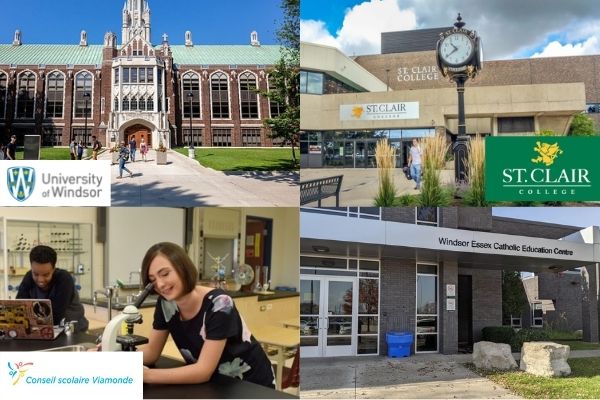
Windsor is home to one university and two colleges. They are the University of Windsor, St. Clair College, and College Boreal. Collectively, they offer programs to over 20,000 students annually.
Read more about education in Canada:
Schooling in Canada | A Look at the Education System
Higher Education Offers Benefits to Newcomers
Where to Get Medical Care in Windsor, Ontario
There are two hospitals in the city, Windsor Regional Hospital and Hôtel-Dieu Grace Healthcare. These are the places to visit in case of a medical emergency. Windsor Regional Hospital also has formal and informal agreements with Detroit-area hospitals to provide expanded healthcare services.
For non-emergency care, visit a local walk-in clinic. In case of an emergency, call 9-1-1. This number is the same across Canada.
Residents must obtain a health card to receive free medical care provided by the Ontario Health and Insurance Plan (OHIP). Click here to learn how to apply for OHIP. You can buy private health insurance for prescription medications and services that OHIP does not cover. Some employers offer medical benefits through their employee benefit plan.
Top left: The Canadian club brand centre, Top Right: Ontario Hockey League, Bottom Left: Art Gallery of Windsor, Bottom Right: Peche Island
What is Day-to-Day Life Like in Windsor?
Things to Do in Windsor
This city offers residents a diverse list of things to do. From local festivals, biking on trails along the Detroit River, checking out musical acts and events at the casino, and enjoying the outdoors, there is something for everyone.
Public Spaces & Attractions
This city is well known for being the home of Caesars Windsor. But there is much more to do than test your luck. Great restaurants and events are happening all the time. Other great attractions in the area include The Canadian Club Brand Centre and Hiram Walker & Sons Limited distillery, and the Art Gallery of Windsor. If you like waterparks, take the family to Adventure Bay Family Water Park.
Restaurants & Nightlife
In addition to the restaurants and nightlife at the casino, the city offers a great riverfront park system with fine restaurants. If you enjoy Italian food, check out Erie Street, Windsor’s Little Italy, called “Via Italia”. You can also sample wine in the Lake Erie North Shore Wine Region in Essex County.
If you enjoy festivals check out the Windsor-Detroit International Freedom Festival during Canada Day, the Bluesfest International Windsor each July, and Detroit Windsor International Film Festival.
Nature & Natural Landscapes
Windsor has an extensive bike trail system that includes the Riverfront Bike Trail, Ganatchio Bike Trail, and Little River Extension. Other things to check out in the area include Peche Island, taking a walking tour of Ford City, or visiting the Ojibway Prairie Complex.
Sporting Events & Concerts
This city is home to the Windsor Spitfires of the Ontario Hockey League, Windsor Express of the National Basketball League of Canada, and a variety of minor league teams. You can check out local concerts at The Colosseum at Caesars Windsor, Rockstar Music Hall and other local music venues.
Culture & Diversity in Windsor
Diversity
This is the fourth most diverse city in Canada. There are more than 170 ethnicities and 70 languages spoken. About 23% of the population are immigrants. This is more than 75,000 residents. The biggest minority groups are Arab (7.4%), Black (4.9%), South Asian (4.4%), and Chinese (3.4%).
Worship
This city has a diverse religious community. About 40% identify as Catholic, 22% Protestant, 6.9% Muslim, and 4% Orthodox. 20% of residents have no religious affiliations.
The Weather in Windsor
Windsor has a humid continental climate. And because of its southern location, it has the warmest climate of all Ontario cities. Windsor actually has the same latitude as Northern California. The average temperature reaches above 10°C (50°F) 223 days of the year.
It gets less snow than other cities in the province. Summers are hot and humid, with an average temperate of 23 degrees Celsius. Winters are mild, with the temperature dipping down to an average of -3 degrees in January.
Because of its southern location, Windsor has the warmest climate of all Ontario cities.
Common Questions Immigrants Ask About Living in Windsor
Is Windsor a Good Place for Immigrants?
Yes. Windsor is one of the most culturally diverse cities in Canada. It offers affordable housing and close access to the United States. There are largely Middle Eastern, Italian, Asian, and European communities.
What are the Benefits of Living in Windsor?
Windsor is known for having more affordable housing prices. You are only 10 minutes from Detroit, and the city offers great entertainment options for a city of its size. It is an ideal location if you plan to work in manufacturing or tourism.
What are Some Potential Disadvantages of Living in Windsor for New Immigrants?
The big potential drawback of moving to Windsor is the local economy. The city has a higher-than-normal unemployment rate. It is also relatively focused on industrial and manufacturing careers. But, on the other hand, being so close to Detroit also opens other career opportunities.
There’s no magic wand available to achieve your goals and create the life you know you want to live. However, there is a powerful process you can follow to turn your vision into reality.
Linda Ryan is the National Program Manager with BCCA-Integrating Newcomers, a government funded, Canada-wide, pre-arrival career coaching service for high skilled construction professionals immigrating to Canada (*BCCA-IN). A career and certified performance coach, she and the BCCA-IN team specialise in helping newcomers plan for, and achieve, employment success, no matter what city or province they are moving to.
Linda Ryan works closely with newcomers who are eager to continue their careers in Canada. In conversation with her, she discusses common obstacles people face when creating a vision for their business, career, or life. So whether you’re moving to Canada and starting a new career, or navigating any change, here are Ryan’s three tips to help you achieve your goals in life, create your reality, and act on your dreams.
Tip 1: Positive or negative?
The brain is a funny thing. It’s a data processor and as such, likes nothing more than having something to focus on. As the old saying goes; “garbage in = garbage out”! So be honest with yourself about how you’re feeling right now. If the answer is ‘negative’, why not make a conscious choice to think positively about your future?
Although you may not know exactly what the future looks like, choose to create a positive mindset around it and choose to put positive action towards it. Like all habit-forming, your new behaviour will take multiple tries (and fails) to become your new norm. But you know what? I think you’re worth it. Do you?
Tip 2: Dare to go there?
I work with many clients who know they’re not living their dream and I find that nine times out of ten their biggest obstacle is they are afraid to admit it. Unfortunately, in choosing to deny the existence of your fear (which by the way is a natural survival reaction designed to keep you safe), you are actively choosing to remain stuck. And if you choose to hold yourself back-guess what? You ain’t ever gonna get there! So whatever your goal in life, dream big, and take the necessary steps to get there.
This is often the question that evokes the strongest reactions in my clients. I’ve seen everything from disbelief, disdain and even disengagement. Great! That’s the reaction I want to see in a client because if that’s what they feel about being asked the question, imagine what they feel about the focus of the question-their vision, their ideal life, and their ability to create it! So we get to working on their ‘best life’ by posing the question again, not as a judgement but as a challenge.
I challenge you to think, act and be like a child when pondering your best life. Visualize your perfect life by allowing yourself the luxury of describing your perfect day. Write it, sketch it, better still, collect pictures from magazines and stick ’em to a sheet.
Having fun creating your story, fuels your desire to make it a reality. Clients who truly allow themselves to go there, elevate their thinking and energy to a child-like level where anything is possible. And guess what? When you allow yourself to even remotely believe anything is possible, you create a new set of emotions, actions and norms that will actually get you there.
So what are you waiting for?
Go have fun with your dreams and goals in life. If you don’t, no one else will!
Learn More about BCCA-IN
*The BCCA-Integrating Newcomers program is a free, pre-arrival, Canada-wide service, focused on helping high-skilled newcomers explore and build successful construction careers. Services include one-on-one career guidance, tailored resume, cover letter, LinkedIn advice, and an in-depth skills and education assessment to help newcomers focus on the best career, credentials and connections activities. The Integrating Newcomers team not only has multi-industry experience but are also immigrants who have built successful careers in Canada.
Newcomers to Canada often ask this burning question “how long will it take to get a job?” However, a better question might be “how can I reach my career goals?” By asking this question, it allows you to focus on what you truly love to do and help you to achieve your long-term career goals.
Linda Ryan is the Provincial Manager (Apprenticeship Services), BCCA. Prepare for Canada (PFC) spoke to Ryan to get her valuable insights about how you can commit to your long-term career goals by not applying for jobs. Sound odd? Find out about a smarter approach to achieving career success and the advice that Ryan provides to newcomers.
BCCA-Integrating Newcomers, is a government funded, Canada-wide, pre-arrival career coaching service for high skilled construction professionals immigrating to Canada (*BCCA-IN). The BCCA-IN team specialises in helping newcomers plan for, and achieve, employment success, no matter what city or province they are moving to.
PFC: When newcomers ask you how long will it take to get a job, what’s your response?
Linda Ryan:
I tell them to forget about applying for the job and instead commit to building their long-term career. And in that one sentence, I manage to dash hopes and yet plant a seed for success. My comment is perplexing until I follow it up with these questions, “what’s your dream job?” or “what’s the career you’d truly love?” Let’s face it, the last time you’ve been asked those questions was when you were a kid, everything was possible, and money didn’t matter.
PFC: What do you think is behind the question “how long will it take to find a job?”
Linda Ryan:
Well, for immigrants preparing to arrive in a new country, it’s nice to bask in the warm glow of the “I’m in” feeling. This is common, especially after receiving a confirmation letter from the government. However, it can quickly dissipate when the cold reality of “oh crap, how can I afford this?” sets in. So, the best advice I give to clients is to prepare yourself (from both a time and money perspective) for it to take up to six months to find the work you truly love to do.
PFC: When faced with financial concerns, what are the common job-hunting mistakes that newcomers can make?
Linda Ryan:
The worst thing you can do as a newcomer is to accept ‘survival jobs’ too early to earn some cash. Yes, it’s tempting and practical, but it can kill your career. This is because it’s so far from your profession that you’ll never be able to use it as a ‘Canadian experience’ reference. Or because it pays so little that you’ll have no spare time and energy to devote to:
Networking
Career-building through education
Volunteering, or
Searching for a job that aligns with your career goals.
Another common mistake is to assume that your out-of-country or in-country experience in a different discipline or industry equates to a role you’re fooling yourself into applying for. I always tell clients to aim for the moon and if you fall, you’ll hit a few stars along the way! What I mean is, hold true to your dream job, but be realistic and take small steps to get there.
Join Canada’s Construction Workforce | BCCA
Do you want one-on-one coaching to help you continue your construction career in Canada before you arrive?
The Integrating Newcomers program is for you if you’re a technical professional e.g. tradesperson, engineer (in any discipline), architect, technician, technologist, project manager, estimator, or analyst. This Canada-wide service can help you get started!
Don’t kid yourself into thinking you can shoehorn your project management experience for financial services companies into project management for construction companies. Or fool yourself that 10 years of engineering in another country will be accepted at face value for 10 years of engineering in Canada. It won’t! While the fundamentals are the same, the industries, credentials, processes, codes, and laws can differ. Until you have a few years of Canadian experience, your expertise or seniority will not be considered like-for-like.
PFC: What advice would you give to newcomers who are looking to land a role faster that aligns with their career goals?
Linda Ryan:
I offer three smart and easy steps to take to ensure you land a career-building role faster:
1. Do your Research
Invest more time in researching roles, duties, companies and less time applying. Don’t adopt the ‘spray and pray’ approach by firing off your resume. Decide that you are a 100% fit for the role (i.e. you could do the job with your eyes closed). Also ensure that the company is a match for you and that you tick the practical boxes (i.e. realistic commute, salary, hours etc.). Do this before you edit your resume.
2. Read the Job Description
Take the time to read the job description and critically assess your entire education and career (not just your existing resume), so that you are confident you can demonstrate you are the obvious best match for the role.
3. Look for Junior Roles in Your Field to Help You Achieve Your Long-Term Career Goals
Yes, it requires you to park your ego and take a few steps back to get in the door, be employed in a role aligned with your career goals, and earning while learning. So, before you spend time editing your resume or drafting a cover letter ask yourself: Is this role a solid stepping stone for my long-term career goals? Will the role give me opportunities to expand my network, credentials, job prospects in the field I’m interested in? How can I express these goals in my cover letter to test if a potential employer is open to supporting me on my career journey?
Then and only then are you ready to apply for the job.
Learn More about BCCA-IN
*The BCCA-Integrating Newcomers program is a free, pre-arrival, Canada-wide service, focused on helping high-skilled newcomers explore and build successful construction careers. Services include one-on-one career guidance, tailored resume, cover letter, LinkedIn advice, and an in-depth skills and education assessment to help newcomers focus on the best career, credentials and connections activities. The Integrating Newcomers team not only has multi-industry experience but are also immigrants who have built successful careers in Canada.
If you are moving to Saskatchewan, you must register for a health card to receive health benefits. You must apply for your Saskatchewan health card soon after you arrive because you may have a waiting period of up to three months before you receive coverage. You can also only apply for a health card after you arrive in Canada. Learn more about the Saskatchewan health plan, who is eligible, and how to obtain your health care card. This is vital information for newcomers, so you know how to benefit from Saskatchewan’s healthcare system and ensure your health and wellness.
Usually, your health coverage begins on or before the first day of the third month after you arrive in Saskatchewan. For example, if you arrive on September 27th, your coverage would begin on December 1. However, you may be eligible for benefits on your first day of arriving in the province if you belong to any of these special classes of newcomers:
Permanent residents
Non-immigrants who are in Canada in connection with their trade or profession
International students.
To find out if you can skip the waiting period, it’s best to contact eHealth Saskatchewan or call toll-free: 1-800-667-7551.
About Health Care in Canada
Canadians are proud of their privilege and access to one of the greatest healthcare systems in the world. Canada’s universal health care system is funded by tax dollars and Canadian citizens or permanent residents can apply for public health insurance.
Because health care is the responsibility of the provinces and territories in Canada, each province may have slightly different plans. So, it’s important to understand what the health plan covers in the province that you move to. Here’s what you need to know about health care in Saskatchewan and how to apply for a health card.
Is Health Care Free in Saskatchewan?
Many, (but not all) health care services are free if you have a Saskatchewan health card. For example, with your health card, any necessary medical services provided by a doctor are free (this includes both inpatient and outpatient services). Other services are covered in part, and some services are not covered.
Services that are fully covered include:
Physiotherapy or occupational therapy
Mammogram screening for women aged 50 -59
HIV testing and treatment of sexually transmitted infections
Immunization services, and
Mental health services.
However, not all health care services are free. Some services are only covered for a part of the cost, and you are responsible for paying the rest.
Services that are covered in part include:
Air ambulance service
Home care
Long-term care.
Services that are not covered include:
Routine dental services
Prescription drugs
Psychologist
Eyeglasses
Air ambulance
Ground ambulance
Naturopaths, massage therapy, acupuncture, and other parmedical services.
But many employers provide additional health insurance to their full-time employees to help cover some of the costs that the public health care plan doesn’t cover. So, be sure to find out if your employer offers health insurance, what the plan covers, and how much they cover.
If your employer does not provide health insurance, you can purchase private health insurance to pay for health expenses for you and your family.
What Do You Need to Apply for a Saskatchewan Health Card?
To apply for a health card, you’ll need supporting documents for you and each family member under the age of 18:
1. Proof that you can legally live in Canada
For Permanent Residents, proof can include a document such as:
Permanent Resident Card (front and back of card)
Confirmation of Permanent Residence
Canadian Immigration ID card
Notice of Decision – Convention Refugee.
For Foreign Nationals proof can include a:
Study permit (with confirmation of full-time enrolment)
Work permit
Foreign Passport with immigration stamp
Temporary Resident Permit.
2. Proof that you reside in Saskatchewan
Mortgage, rental, or lease agreement that you have signed
Utility bill (home telephone {mobile phone bill are not accepted} cable TV, water, gas, or energy)
Insurance policy (home, tenant, or auto)
Motor vehicle registration
Pay stub or letter from employer
School, college, or university report card or transcript)
Saskatchewan driver’s license or temporary license
Student ID card
Employee ID card
Immunization record.
If you need help to complete your health card application, many settlement agencies can help you with this, along with many other free services.
How Do I Get My Saskatchewan Health Card?
Your Saskatchewan health card ensures you receive the medical care you and your family need. So to apply for a health card, follow these three simple steps:
Note: Because eHealth Saskatchewan is based in the provincial capital, in-person drops and rapid processing are easy if you are living in Regina, Saskatchewan. You can explore our full city guide to see what life is like in the capital region.
International students may be eligible for a Saskatchewan health card
Health Insurance for International Students
If you are an international student, you may be eligible for Saskatchewan health coverage. You will have to show proof of full-time enrolment at an accredited school and a valid Study Permit from Immigration, Refugees and Citizenship Canada.
When Can I Apply for a Saskatchewan Health Card?
You can only apply for your health card when you arrive in Saskatchewan. And be sure to apply for it as soon as you arrive because you may have up to a three-month waiting period.
To qualify, you must be a resident of Saskatchewan and reside in the province for at least six months per year. Your health coverage will begin when your application is approved.
While you are waiting for access to public health care, you may want to purchase private travel medical health insurance to cover any health care costs or emergencies.
Can I Use My Saskatchewan Health Card in Other Provinces?
Yes, if you are travelling within Canada and need medical services, you need to show your Saskatchewan health card. So, be sure to carry your health card with you at all times. Provinces (except Quebec) and territories have an agreement to cover the cost of necessary medical services. The province of Saskatchewan will reimburse the host province’s costs.
However, some services are not covered, such as hospital transfer, ambulance, and return transportation to Saskatchewan. If you have private insurance, your insurance company may pay for these additional services. But check with your insurance provider to find out what they will cover.
Travelling Outside of Canada
Medical services may be much higher outside of Canada. And, you are responsible for paying the amount above what the Saskatchewan health plan covers. When travelling outside of Canada, it’s best to buy additional travel insurance.
One of the greatest benefits for newcomers is access to world-class and publicly-funded healthcare. This information ensures you know how to apply for a Saskatchewan health card for you and your family’s well-being.
Networking is a crucial way to research and learn about your profession in Canada. And asking the right networking interview questions can help you to make professional contacts, speed up your job search, and grow your career. Another key to successful networking is being authentic.
Linda Ryanis the National Program Manager with BCCA-Integrating Newcomers, a government funded, Canada-wide, pre-arrival career coaching service for high skilled construction professionals immigrating to Canada (*BCCA-IN). A career and certified performance coach, she and the BCCA-IN team specialise in helping newcomers plan for, and achieve, employment success, no matter what city or province they are moving to.
When it comes to networking, Ryan provides great insights and advice to newcomers on the importance of authenticity. Read more to learn why networking is important, how to create a network, and how to network while being yourself.
Grow Your Contacts through Effective Networking
Networking provides a chance for newcomers to connect with others from a range of professions. It’s also a vital way to achieve career success in Canada. When networking to build a genuine relationship, it can help you to:
Meet other professionals in your industry
Build confidence
Grow your network contacts
Access the hidden job market.
And when you connect to ask networking interview questions, you’ll gain helpful information about labour market trends, job postings, and training and skills development.
And as Ryan points out, you’ll achieve success when instead of ‘trying’ to network, you commit to building a genuine relationship by being curious, present, and authentic. In doing so, you’ll benefit by learning from their career experiences.
Join Canada’s Construction Workforce | BCCA
Do you want one-on-one coaching to help you continue your construction career in Canada before you arrive?
The Integrating Newcomers program is for you if you’re a technical professional e.g. tradesperson, engineer (in any discipline), architect, technician, technologist, project manager, estimator, or analyst. This Canada-wide service can help you get started!
Prepare for Canada asked Ryan for her best networking tips. Here’s what she had to offer about being genuine, authentic, and present:
1. You don’t build rapport, you erode it
You’ve heard it before, and it’s true, first impressions count! Ryan advises against entering a room with a “me, me, me” agenda. “Even if it’s only in your head, you’ll inadvertently push people away. They may not be able to put their finger on it, but on a primal level, they’ll sense an ulterior motive. As a result, they subconsciously see you as a threat and quickly and quietly move towards the exit or a less threatening professional animal!”
2. You can’t fake a smile
Another one of her favourite truths, you can’t fake it ’till you make it’ especially with a smile! As she explains, it’s all to do with muscles, tendons and exposure of the teeth. “You actually engage a different set of muscles to force a smile. So, your best efforts to force a smile (even if well-intentioned) are more like getting ready to bite. And guess what this does? It triggers another subconscious fight or flight instinct in your ‘prey’. I mean peer network!”
3. You can’t listen if you’re waiting to talk
Ryan explains that this pearl of wisdom was shared with her early. “It was like the heavens opened and the light shone for the first time. I always felt uncomfortable with my approach to networking, but I never knew that simple lever to pull. As a result, I got stuck every time when trying to create a meaningful networking connection.”
When you’re waiting to talk, you’re in your own head (so people feel unheard). If you’re waiting to talk, you’re not truly listening to what the other person is saying. Instead, you’re trying to find something intelligent or insightful to broadcast (so people feel undervalued). And, if you’re waiting to talk, you’re not allowing yourself to experience the human connection (subtle body language, energy, pitch/pace/tone of voice) that’s possible.
Why Networking in Canada is Important
Networking is about connecting with people who have similar interests. And a key element of your network is to provide mutual help and support. Strong networking skills can help you to find a job. As well, these skills will also help you to achieve success in the workplace after you land a job. So building and nurturing your network contacts is an essential part of your career success!
An important benefit of networking is that it can help you learn about jobs that are not yet advertised, also called the “hidden job market”.
To understand the hidden job market think of it as an iceberg. The top of the iceberg represents the visible job market or jobs that are widely advertised. The bottom part of the iceberg represents the hidden job market. This is where you can learn about jobs that are currently only posted internally.
When a company advertises a job externally, it’s common for employers to receive hundreds of applications for one position. And that means more competition for you. So networking is a helpful way to access the internal hiring process.
How Do I Create a Network in Canada?
Building a wide network of contacts is key to accessing the hidden job market. A helpful way to create a network is to make a list of people who can help you. This can include:
Friends and family
Former managers, colleagues, customers, and clients
When networking it’s good to start with who you know. However, that can be hard if you recently arrived and know very few people. So connecting with professional associations can be a great place to build your network and meet new people!
If you’re not used to networking for business purposes, it can feel uncomfortable. But, remember that other people want to help you to succeed in Canada. And one day, you’ll be in the same position when you can help others arriving in Canada.
You’ll become more comfortable when you ask the right networking interview questions. These networking questions are thoughtful and lead to useful information to conduct your job search. And by asking thoughtful questions you’ll leave people with a good and lasting impression. And like Ryan stated, “first impressions count”.
How to Ask Good Networking Interview Questions
Ask open-ended instead of closed-ended questions (require a yes or no reply). Open-ended questions encourage more discussion. For example: “How did you get started in this field when you arrived in Canada? Or, ” What job search activities did you find most helpful?”
Ask questions that will make people think and share their opinion.
Lead with a question about an article you read or other industry news. This shows that you are current and like to stay informed.
Listen actively and show that you have a keen interest in what your contact has to say.
Sample Networking Interview Questions
You’ll likely have your own questions that you would like to ask. And here are some other questions that you can add:
What skills were most valuable to help you achieve success in this field?
Where do you see this industry/sector going in the future?
What are some of the key changes affecting the industry in Canada?
Who are some of the most important leaders in the industry in Canada? Who should I follow?
Are there opportunities for self-employment in the field?
What changes are happening in the field that will affect future job opportunities?
What further training would help me to stay current in this field?
Listen actively to their responses and probe for more information with related networking interview questions.
Tips for Networking in Canada
Networking is a great way to propel your job search. But it’s also important to maintain and nurture your relationship. A strong relationship based on mutual support will go a long way to advance your career. These tips can develop and enhance your networking skills.
Share articles that would be of interest to others in your network.
Send a short note to congratulate your contacts when they changes roles, are promoted, or move to a new company.
Become known for helping others.
Offer to introduce your contacts to other professionals that you know.
Follow up with new contacts and thank them for helping you or sharing their ideas and time.
Invite your contacts to lunch or even tea or coffee to practice your networking skills and build your relationship.
Building relationships with other professionals is important when networking. And asking thoughtful networking interview questions can help you build rapport and reach your career goals.
Learn More about BCCA-IN
*The BCCA-Integrating Newcomers program is a free, Canada-wide service, focused on helping high-skilled newcomers explore and build successful construction careers. Services include one-on-one career guidance, tailored resume, cover letter, LinkedIn advice, and an in-depth skills and education assessment to help newcomers focus on the best career, credentials and connections activities. The Integrating Newcomers team not only has multi-industry experience but are also immigrants who have built successful careers in Canada.
If you’re moving to Canada and plan to drive, it’s important to know what you need to drive legally. If you already have a licence in your home country, you can check if you can exchange that license for a Canadian driving licence. Or, you may need to take a driving test in Canada. Each province in Canada has slightly different rules. Discover the simple process to get your driving licence in Alberta, Canada.
Exchanging a Driving License from Another Country
Canada has a reciprocal license exchange agreement with many countries. If you have a valid driver’s licence, you can exchange your license for an Alberta license without taking a knowledge or road test. Canada has a reciprocal license exchange agreement with the following countries:
Australia, Austria, Belgium, France, Germany, Isle of Man, Japan, Republic of Korea, Switzerland, Taiwan, United Kingdom, United States.
To exchange your licence for an Alberta licence, you must:
Hand in your valid licence to a registry agent
Provide proof of two or more years of driving experience to receive a full license.
Exchange a licence with a country that doesn’t have a reciprocal licence exchange agreement
To exchange a licence from a country that doesn’t have an agreement, you’ll need to pass a knowledge and road test.
Step 1. Exchange your driver’s licence
Visit a registry agent and hand in your valid driver’s licence that is equivalent or higher to an Alberta Class 5 licence.The registry agent will check to see if you can apply for the Graduated Driver’s Licence (GDL) exemption program and will give you an application to complete.
Step 2.Pass a Class 7 knowledge test
Visit a registry agent and take a knowledge test.
Your licence, application for GDL exemption, and support documents will be sent to the Alberta Government for review.
Step 3. Get a full Class 5 licence
There are two ways you can get a full Class 5 licence:
If you can prove that you have more than 2 years of driving experience, you’ll need to pass an advanced road test
If you have less than two years of driving experience, you must pass a basic road test to get a Class 5 GDL licence.
When you have more than two years of driving experience, you’ll need to pass an advanced road test to get a full Class 5 driver’s licence.
Ontario is a popular choice for immigration to Canada. In fact, it is also known as one of the big three immigration provinces for permanent residents, followed by British Columbia, and Quebec. Together these three provinces represent the majority of arrivals in Canada. So if you’re thinking of making Ontario your new home, find out more about OINP pathways.
What is the Ontario Immigrant Nominee Program (OINP)?
The OINP is a Government of Ontario program that provides permanent residence to selected applicants. The goal of this program is to help Ontario employers meet labour market shortages that exist in the province. Immigration, Refugees and Citizenship Canada (IRCC) works in partnership with the Ontario government to run this vital program.
The OINP nominates the people who meet the program requirements for permanent residence. However, IRCC makes the final decision to approve permanent residence applications.
What is the Provincial Nominee Program (PNP)?
Each province has a PNP (except for Quebec). These programs are for workers who have the skills, education, and work experience to contribute to the economy of a province or territory, and who want to:
Live in the specific province
Become a permanent resident of Canada.
As well, each province has its own unique requirements. So provinces will target certain groups such as students, business people, skilled workers, or semi-skilled workers based on their needs. The OINP is the Provincial Nominee Program for Ontario.
Learn More About Ontario’s Economy
Ontario is Canada’s leading manufacturing province with a rapidly growing technology base. These are just a few of the innovative industries that drive economic growth:
Aerospace:over 200 firms employing more than 44,000 direct and indirect people
Automotive:300+ companies work in connected and autonomous development and smart technology
Cybersecurity: Ontario has cybersecurity hubs in Toronto, Waterloo Region, and Ottawa. And according to Invest Ontario, it also has the 2nd largest IT cluster in North America.
Cleantech: Interested in being at the forefront of environmental progress? Ontario has the largest cleantech sector in Canada and employs more than 134,000 employees.
With a fast-growing economy, attracting skilled talent from around the world is a priority. So, if you have skills in many of the in-demand jobs, the OINP may appeal to you.
Working in Canada | How To Get Your First Job In Canada
Are you moving to Canada soon or already here? Do you need to find a job? Would you like to find good resources for finding employment in Canada? If so, join us for a free webinar where you can ask an expert your questions. We’ll discuss what you can do to make yourself more marketable to potential employers.
If Ontario sounds interesting to you, there are two ways that you may qualify for the OINP.
1.OINPEmployer Job Offer Category:
This is for workers who have a permanent job offer from an Ontario employer. The category has three streams that have an expression of interest (EOI) system.
Foreign Worker stream: for skilled foreign workers with a job offer in Ontario. View job offer requirements here.
International Student stream: for international students with a job offer in Ontario. Find out if you are eligible to apply here. This stream is for recent graduates in Ontario.
In-Demand Skills Stream: for foreign workers in an in-demand occupation such as construction, trucking, agriculture, and personal support workers with a job offer in Ontario. Find out if you are eligible to apply for this OINP stream here.
2.Human Capital Category:
This category is for workers with valuable work experience, education, language skills, and a profile in Canada’s Express Entry system. Graduate students can also qualify for this category. Also, there are two sub-categories:
International Graduate Streams:
The international graduate streams include both the Master’s Graduate Stream and the Ph.D. Graduate Stream. These streams allow graduates with an Ontario master’s degree or Ph.D. to apply for an OINP nomination.
Ontario Express Entry Streams:
The following three streams operate through the federal government’s Express Entry System. To qualify for Ontario’s Express Entry streams, you must receive a notification of interest from Ontario and have a current profile.
French-Speaking Skilled Worker stream: for French-speaking skilled workers with work experience, education and language proficiency in French and English
Human Capital Priorities stream: for skilled workers with required work experience, education and language proficiency in French or English
Skilled Trades stream: for foreign nationals with Ontario work experience in an eligible trade occupation.
What is an Expression of Interest (EOI)?
An expression of interest informs the OINP that you would like to be invited to apply for permanent residency in Ontario. As mentioned above, you can only apply to some of these streams if the OINP invites you to apply. So, an important first step is to register an EOI. When you register an EOI, it allows the OINP to gather information about your:
Education level
Language
Skills and work experience
Attributes that match the province’s labour market needs, and
Other important information.
Ontario launched the EOI system in 2021 to manage the high demand for the OINP. And because Ontario is such a popular destination, the EOI system avoids the first-come-first-served model. Learn more about how to register an OINP expression of interest.
What Happens After I Register an EOI for the OINP?
Once you register your EOI, your profile goes into a selection pool and your answers are scored. The OINP will notify you if you are invited to apply for the provincial nomination. But, if you receive an invitation it does not mean you get the provincial nomination. You will still have to meet the eligibility requirements of the stream that you are applying to. So be sure to check the requirements of the steam that you’re interested in.
Ontario is a popular immigration choice. And with the OINP, there are many streams that could lead you to this vibrant and prosperous province.
Contract employment can be a great option when you first arrive in Canada. Contract or temporary employment is very common in Canada. And, it can be beneficial for newcomers who are looking to:
gain Canadian experience
find a short-term job placement
understand the Canadian workplace.
What is contract employment?
Contract employment is a set-term agreement between an employer and a candidate. In some cases, these contracts are managed directly by the employer. But, sometimes a third party will hold the contract with the candidate, and possibly manage the payroll on behalf of the employer.
What to consider when looking for contract employment?
It is important to consider your qualifications for a contract role to ensure that you find a good match. When it comes to contract work, employers look for people who can jump right into the job with minimal training. So, it’s ideal if you have experience and qualifications that directly relate to the job.
Where and how to look for contract work?
Contract work is generally advertised in the same places as permanent employment. Some companies hire contract staff directly but most will use a recruitment agency or non-profit organization. Also, you can also find contract positions on job boards. You can usually find contract positions in a separate section on job boards. As well, settlement agencies in Canada such as Next Stop Canada provide free job search assistance for newcomers. These agencies can also direct you to contract opportunities.
Working in Canada | How To Get Your First Job In Canada
Are you moving to Canada soon or already here? Do you need to find a job? Would you like to find good resources for finding employment in Canada? If so, join us for a free webinar where you can ask an expert your questions. We’ll discuss what you can do to make yourself more marketable to potential employers.
What are the benefits of contract employment for newcomers?
For newcomers specifically, contract work can be a great opportunity. Contract work may be easier to secure than a permanent role. For example, employers may feel like they are taking a lower hiring risk when they hire people for a short-term contract. And, they may be more willing to try someone without local experience.
Because experience is an asset in contract employment, it’s less likely that an employer will feel you are overqualified.
Contract employment allows newcomers to:
test a specific role or company
build your professional network
gain Canadian work experience
demonstrate skills, knowledge, and job performance.
Does contract work lead to permanent or other work?
When you perform well in a contract role, it can increase your chances of securing a permanent role with the company. And, you can also use your contract experience to market yourself externally. At the same time, you are meeting new people and making important connections in your industry.
Are there disadvantages of contract employment?
This depends on the person. Some people may be concerned about not feeling like part of a team as a contract employee. Another disadvantage is that contract employment usually doesn’t cover benefits such as dental and health coverage. So, you would have to arrange health coverage for yourself. Also, some people find it challenging to have to start job searching again at the end of the contract. But, some people actually prefer to work on set-term contracts because it allows them more freedom, choice, and a variety of projects that they work on. Overall, the professional advantages of contract employment, plus the flexibility that it provides may counter the downsides.
Contract employment can be a great way to gain Canadian experience quickly after you land in Canada. However, it’s important to find a permanent job so remember to keep applying for other positions. And most importantly, stay positive while you search for permanent employment!