
Are you interested in continuing your software developer career in Canada? The IT industry in Canada is robust and expanding. With its reputation as a technology leader, Canada stands out as one of the best countries globally for building a software developer career. Software developers are a high-demand occupation in Canada. In May 2023, Immigration, Refugees and Citizenship Canada (IRCC) included this STEM occupation in Canada’s first-ever launch of category-based selection for Canada’s Express Entry system. There are many jobs available, and software developer salaries are attractive. This helpful overview provides information to help you research the profession, understand software developer job requirements, explore salaries in Canada, and more!
Typically, most software development positions in Canada require a university degree or college diploma, coupled with relevant work experience in a specialized field. While most software jobs are not regulated in Canada, many employers do require professional IT and software certifications, depending on the specific job requirements.
One of the great aspects of working in software development is the openness of Canadian employers to hire immigrants and newcomers. To ensure your eligibility, it is crucial to follow the appropriate steps.
How to Immigrate to Canada as a Software Developer
Before You Move to Canada to Pursue a Software Developer Career
The steps to secure a software developer job in Canada vary depending on your chosen career path. So, it’s vital to research the specific requirements for the job you aspire to. For instance, if your goal is to work as an app developer, you should research job requirements for software app developers in Canada.
To enhance your chances of finding a software developer job in Canada, there are general steps you can take even before your arrival:
- Attend the free webinar How to Find Your First Job in Canada as a Newcomer to learn about the job market in Canada.
- Take an online Canadian Language Benchmarks self-assessment to assess your language skills.
- Improve your English or French language skills (depending on your destination province). You will need to prove your language competency or be tested.
- Take language classes while you’re in your home country and continue them when you arrive in Canada.
- Understand how to practice your job in Canada and become familiar with the laws and legislation that govern it in the province where you will settle.
- Know the name of your job in Canada and learn about the specific software developer job requirements in Canada.
- Look into certification requirements and skill development options if you need to upgrade.
- Research software developer salaries and compensation information.
- Research Canadian companies and join software development groups on LinkedIn to learn about the industry in Canada.

What to Expect When Pursuing a Software Developer Career in Canada
In Canada, there are many software developer career paths with distinct qualification requirements. So, it’s important to understand how your international qualifications meet Canadian standards. Additionally, gaining insights into the Canadian labour market and workplace culture is important. Understanding the job market and employment outlook will help you to set realistic job search expectations.
Employment Outlook for Software Developer Jobs in Canada
Over 200,000 people work in software development in Canada. Even so, according to the Government of Canada Job Bank, they forecast a labour shortage from 2022-2031. This means there will be job opportunities for newcomers with skills, experience, and qualifications.
Start Your Research with the Software Developer NOC Code
The National Occupational Classification (NOC) provides a general overview and standard definition of software developer careers in Canada. The five-digit NOC code 21232 applies to:
- Software developers
- Software programmers
- Software development project managers
- Application programmers
- E-business software developers
- Multimedia developers
- Interactive media developers
- Computer game developers
You can review this information to understand the main duties and employment requirements.

Requirements to Become a Software Developer in Canada

To work as a software developer in Canada, you typically need a bachelor’s degree in computer science, software development, app development, computer systems engineering, or software engineering. Alternatively, completion of a college program in computer science may also be accepted. In some cases, employers may require candidates to hold a master’s or doctoral degree in a related field. However, if you plan to work as a software engineer, you must be a Professional Engineer (P. Eng.) and obtain a license to practice from a provincial or territorial association of professional engineers. Software engineers belong to a regulated profession in Canada.
Credential Recognition to Meet Software Developer Job Requirements in Canada
Several agencies in Canada assess international education credentials to help newcomers access education and employment opportunities. In Canada, software developers belong to a non-regulated profession. However, some employers may require specific IT certifications to be eligible for software developer jobs.
If you want to apply to a college or university to upgrade your skills, you may need an education evaluation. But, before you pay for an education evaluation, contact the school that you’re applying to and find out what steps to follow and what credential assessment agency to use. Some schools request that you use a specific agency. So taking this step can save you time and money.
It’s vital to emphasize your international education and skills for an education evaluation. Expand upon your existing knowledge and abilities and thoroughly explore university and college options before deciding if further education is necessary. Leverage your international credentials and experience to seek credit or course exemptions. You may have the opportunity to gain advanced standing, transfer certain credits, and benefit from prior learning assessment options. These avenues will enable you to complete your program faster and avoid expenses for education you have already completed.
Credential Assessment Services
Some of the assessment credential services in Canada include:
World Education Services (WES) – Ontario
International Qualifications Assessment Service (IQAS) – Alberta
The International Credential Evaluation Service (ICES) – British Columbia
To find more assessment services here.

Upgrading Your Skills to Meet Software Developer Job Requirements
You may need to upgrade your skills, especially your soft skills, to meet software developer job requirements in Canada.
Canadian employers look for friendly and assertive professionals with strong communication skills. They also look for people who will fit into their workplace culture and will become leaders over time. In the IT field, they expect employees to have a strong understanding of the business in addition to the technical aspects of the job. They encourage employees to upgrade their existing skills and acquire new skills.
Language Training for Software Developers in Canada
Strong skills in one or both of Canada’s official languages, English or French, are important for career success. Whether you focus on improving English or French depends on which of the two languages is mostly spoken in the area where you live.
There are Job-specific language training programs to teach you professional terminology. And, if you’re in Ontario there is the Occupation Specific Language Training (OSLT).
You may be eligible for the Language Instruction for Newcomers to Canada (LINC) program. Or you can find other free or affordable classes in English as a Second Language (ESL) or French as a Second Language (FSL) classes through local school boards or settlement agencies.
Bridging Programs for Software Developer Careers in Canada
Bridging programs help people with international software development education and experience meet Canadian industry qualifications. Here are some newcomer bridging programs to explore:
- GO Talent: Global Onboarding of Talent
- Algoma University: Computer Science Collaborative Online Bridging Program
- York University: Bridging Program for Internationally Educated Professionals (IEPs)
- ACCES Employment: IT Connections: Digital Economy Connections
- Humber College: Bridging Program .NET Developer
- Humber College: IT Infrastructure Bridging Program
- Bredin Centre for Learning: Centre for Skilled and Internationally Trained Professionals
Software Developer Schools in Canada

Continuing your education is a great way to progress in your career in Canada. And, many Canadian colleges and universities offer software development programs. These schools offer software development programs at the undergraduate and graduate levels:
Colleges
Institute of Technology Development of Canada
Universities
University of Ontario Institute of Technology
Software Developer Associations in Canada
Professional associations can be a valuable resource to help you advance your software developer career. The following associations provide information about licensure and certification and offer professional development, education, and networking opportunities.
Immigrant Networks
Professional immigrant networks are organized, volunteer-run member-based networks created by and for immigrants to:
- create a forum to contribute to and enrich their respective communities; and
- provide opportunities for their members to find meaningful employment and achieve their professional goals.
These networks offer mentoring, information sessions, professional development, workshops, speaker events, and connections to jobs. Here are a few examples:
- isans: Immigrant Services Association of Nova Scotia: isans helps newcomer professionals integrate economically and socially in Nova Scotia.
- Hispanotech.ca: They bring together Hispanics in Canada’s technology markets, help them enter the workforce, and recognize their contributions to the technology field.
How Much Do Software Developers Make in Canada?
Software developer salaries can vary significantly based on your level of experience, job title, and location. According to the Government of Canada Job Bank, the median hourly software developer salary is $40.38. The median software developer salaries can range from $23.60 to $58.97 per hour.
Software Developer Salary in Canada
Alberta has the highest earning potential. Your hourly software developer salary could be up to $64.90 per hour. British Columbia and Ontario also have hourly software developer salaries can reach $60 or more. Here are the most recent software developer salary numbers in Canada (as of November 2022):
| PROVINCE | LOW ($/HOUR) | MEDIAN ($/HOUR) | HIGH ($/HOUR) |
|---|---|---|---|
| Canada | 23.60 | 40.38 | 58.97 |
| Alberta | 22.12 | 39.83 | 64.90 |
| British Columbia | 25.00 | 42.79 | 62.50 |
| Manitoba | 23.59 | 37.18 | 52.88 |
| New Brunswick | 22.12 | 36.92 | 57.69 |
| Newfoundland and Labrador | 22.00 | 37.50 | 45.67 |
| Northwest Territories | N/A | N/A | N/A |
| Nova Scotia | 21.79 | 36.06 | 58.65 |
| Nunavut | N/A | N/A | N/A |
| Ontario | 24.25 | 43.00 | 60.00 |
| Prince Edward Island | 20.00 | 33.33 | 56.41 |
| Quebec | 22.00 | 37.46 | 54.10 |
| Saskatchewan | 22.14 | 36.45 | 57.69 |
| Yukon | N/A | N/A | N/A |
Best Provinces to Work in Canada as a Software Developer Based on Salary & Lifestyle
Like other IT careers, you can find software developer jobs in most Canadian cities, however, the Greater Toronto Area and Ottawa offer the highest concentration of jobs. One potential advantage of working in software development is the opportunity to work remotely.
Other cities to consider for software developer jobs include, Markham, Kitchener-Waterloo, Montreal, and Vancouver. Montreal is the heart of the gaming industry in Canada and Vancouver has many companies in the commercial/entertainment development sector. Markham is the second-largest tech cluster in Canada.
Pursuing a Software Developer Career in Canada
To continue your software developer career in Canada, there are many avenues to explore, provided you possess the academic credentials, work experience, and a clear plan to work in your desired location.
Software Developer Employers in Canada
There are about 45,000 companies in the Canadian IT sector, according to Innovation, Science and Economic Development Canada. 91% of these companies are in the software and computer services industries.
Some of the top software development companies in Canada include:
- Altus Group
- Shopify
- OpenText Corporation
- CGI Inc.
- Descartes Systems Group Inc.
- Constellation Software Inc.
- Hootsuite
- Prodigy.
You can also learn about Canadian companies by visiting Canada’s Best Diversity Employers website. These employers have been recognized for diversity, inclusion, and equity programs in the workplace.
How to Find Your First Software Developer Job in Canada

How you search for a software developer job will change based on your chosen career path. The job market in Canada is competitive for software developer careers. Here are tips to help you find your first job in Canada.
Job Search Techniques for Software Developers
You may need help with your job search, especially since finding a job in Canada may differ from your home country. Fortunately, there are settlement services to help you search for jobs, update your resume, write cover letters, and prepare for job interviews.
There are many ways to search for software developer jobs in Canada:
- Broaden your search and include cities across Canada, alternative careers, and companies outside the sector, as most will have IT departments.
- Join job-finding or networking groups in the software development sector through settlement agencies.
- Attend career/job fairs, info sessions, and related conferences.
- Browse online job boards to understand job requirements and current skills that employers are seeking.
- Volunteer to gain Canadian work experience.
- Find a mentor who can give you valuable advice and introduce you to their professional network.
Click here to find immigrant services in your area.
Networking for Software Developer Careers
Networking plays a crucial role in finding jobs and gaining insights into companies and the IT industry in Canada. Often, many companies do not advertise job vacancies, so networking is an effective way to tap into this ‘hidden job market.’ Connecting with fellow software developers can help you discover jobs in the hidden job market.
Conferences, association events, and social mixers are great venues to network and meet other professionals, build relationships, and exchange information.
LinkedIn is another valuable networking tool to connect with former colleagues and employers, search for companies and job openings, and meet other professionals in the field. Joining relevant software development groups and participating in group discussions can further expand your network.
When networking, it’s better to avoid directly asking for a job. However, if your contacts know of any job leads, they will likely tell you. Your network can serve as a valuable resource to learn about software development jobs in Canada.
Informational Interviews Can Help You Learn About Software Developer Job Requirements
Initiate contact with people who work in software companies and organizations that align with your career interests. Politely inquire if they would be open to connecting you with someone in the company who works in your field of expertise. Once connected, reach out to that individual, and request to meet with them at their convenience.
By meeting with others in the industry, you’ll expand your professional network, gain valuable insights into their company, and develop your understanding of software job requirements in Canada. It’s important to note that the purpose of an informational interview is not to secure a job, but rather to assess whether a specific position or employer aligns with your skills, experience, and interests.
An informational interview with a contact from your network can serve as a valuable source of career information. In addition to gaining insights about the software development industry, you will also benefit from their firsthand work experiences and guidance for your career path.
Resume Writing Tips
When crafting your resume, it’s helpful to keep the needs of hiring managers in mind. Your resume should demonstrate your ability to participate in project planning activities, collaborate effectively within a team, and engage in peer reviews to achieve common goals.
Additionally, emphasize your ability to design, develop, and release software updates for products. Consider these resume writing tips to showcase your qualifications and stand out as a strong candidate:
- Highlight both your technical skills and soft skills such as teamwork, leadership, and communication skills.
- List relevant skills such as database design, Linux, software development, HTML, JavaScript, and technical support.
- Ask someone to review your resume and provide constructive input.
Here are some examples of phrases that you might include in your resume:
- Develop and analyze technical designs and requirements to fulfill functional specifications.
- Review programming code to ensure adherence to software development standards.
- Adapt to evolving technologies by acquiring and applying new methodologies to achieve organizational objectives.
- Provide technical support to maintain network and application stability, and promptly address user issues.
Interview Techniques for Software Developer Jobs in Canada
Software developers have diverse roles and can work in many fields, which means that preparing for a software development job interview will depend on the specific position you are seeking.
When applying for software developer positions, employers expect candidates to have relevant experience and demonstrate their software development skills. This may involve presenting a portfolio of your work as part of the application process. This is a good strategy to set yourself apart from other candidates and tangibly showcase your skills and accomplishments.
In addition to bringing your portfolio to the interview, you can provide the interviewer with a link to your portfolio beforehand. The interviewer can review your work and learn more about your capabilities. During the interview, you can discuss your portfolio projects and achievements, and highlight your expertise and suitability for the position. Highlighting your practical and technical experience can enhance your chances of securing a job offer.
Sales and marketing careers are a popular choice in Canada. It’s an ever-evolving field that offers new opportunities and career paths for newcomers. Plus, with experience, you can expect a strong sales and marketing salary. Sales and marketing job requirements usually include a university degree or college diploma in business administration or a related field. You also require specialization in sales or marketing and experience as a sales, marketing, or public relations representative.
Sales and marketing is a non-regulated profession, so you don’t need a license for this occupation. Learn more about job requirements, job search and interview techniques, professional associations, and more to help you continue your sales and marketing career. Prepare yourself with this helpful overview!
How to Immigrate to Canada to Work in Sales and Marketing
Before You Move to Canada to Pursue a Sales and Marketing Career
Sales and marketing jobs can mean many things. There is a range of sales and marketing careers you could pursue. So, it’s important to know the path you want to take. To help you achieve professional success, it’s important to understand the Canadian labour market before you arrive. Here are some steps that you can take before you arrive:
- Attend the How to Find Your First Job in Canada as a Newcomer webinar to learn about the labour market.
- Research and plan your move to Canada at least three months before your arrival. You might even get a job before you arrive if you plan well.
- Contact professional associations in Canada such as the Canadian Marketing Association (CMA) and the Canadian Internet Marketing Association. The CMA is the only marketing association in Canada that embraces Canada’s major business sectors and all marketing disciplines, channels, and technologies.
- Assess your language skills by taking an online self-assessment on the Centre for Canadian Language Benchmarks website.
- Improve your English or French (depending on your destination province); you may be required to prove your language competency. Even if you speak fluent English or French, it’s helpful to improve your language skills.
- Enroll in language classes while you are in your home country and continue them after you move to Canada.
- Gather and organize your official education, work, and identity documents while still in your home country. You may need these papers for employment purposes, or if you are planning to pursue further education in Canada.
- Know other titles for your sales and marketing job in Canada to help you with your job search.
- Understand sales and marketing career certifications and specializations that can help you progress your career.
- Research sales and marketing salary information to know your earning potential.
What to Expect When Pursuing a Sales and Marketing Career in Canada
Sales and marketing is a non-regulated profession, so you don’t need a license to work. Depending on your sales and marketing career path there are certain credentials, certifications, skills, and experience employees will expect you to possess. To help you find a job faster when you arrive in Canada, it’s vital to understand sales and marketing job requirements.
Employment Outlook for Sales and Marketing Jobs in Canada
Job prospects for sales and marketing positions vary in Canada. That’s why it’s vital to research provincial and local job prospects and labour markets. With this information, you can identify where your skills and experience are most in demand across Canada. And, when you identify the best job markets, you can begin to research cities.
Start Your Research with the NOC Code for Sales and Marketing Jobs in Canada
To start your research, read the National Occupational Classification (NOC) descriptor for the profession. The NOC provides a standard definition of jobs in Canada and is used by various groups, including job seekers. The NOC can help you understand whether or not your skills and experience match the job requirements in Canada.
NOC Code for Marketing Jobs
The NOC code for a marketing specialist is NOC 11202. This role can include different titles such as:
- Advertising consultant
- Communications officer
- Communications specialist
- Digital marketing consultant
- Event marketing specialist
- Marketing consultant
- Marketing coordinator
- Media relations officer
- Public relations consultant, and more.
NOC Code for a Sales Analyst Job
The NOC code for sales analyst jobs is NOC 41402. This includes job titles such as:
- Business development officer
- Industrial development officer
- Market researcher
- Marketing analyst
- Marketing researcher, and more.
Other similar sales and marketing career paths include:
- Corporate sales managers (NOC 60010)
- Technical sales specialists (NOC 62100)
- Sales and account representatives (NOC 64101)
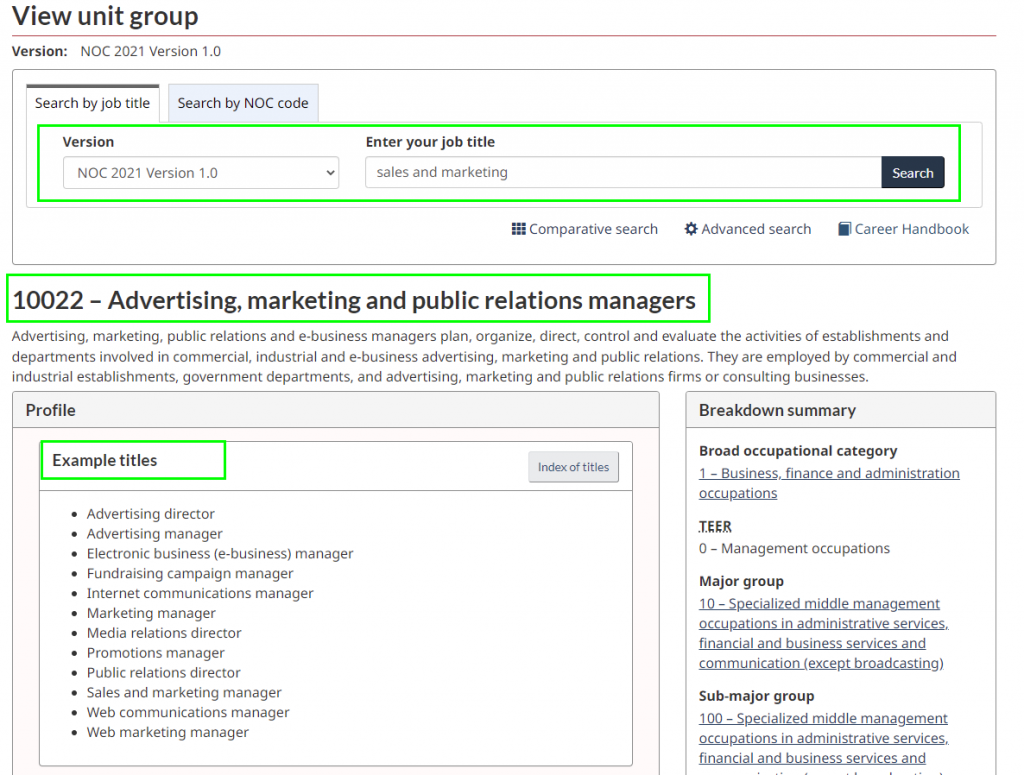
- Advertising, marketing and public relations managers (NOC 10022)
Requirements to Become a Sales and Marketing Professional in Canada

Requirements to work in a sales or marketing role will vary based on the job title, duties, company, and other factors. The Canadian Marketing Association has a rich resource library to find several publications, industry reports, newsletters. It’s important to stay current about what’s happening in the industry. You can also find more information about sales and marketing careers. Below we explain the steps you will need to take to work in sales and marketing in Canada.
Credential Recognition to Meet Sales and Marketing Job Requirements in Canada
Credential recognition is a process to verify and assess a person’s skills, competencies, and credentials in a fair and consistent manner. While sales and marketing are non-regulated professions in Canada, some employers do ask for your credentials evaluation. Mostly though, employers will assess your knowledge and experience and contact your professional references. So, before you spend money on a credentials evaluation, check with the companies you apply to find out if they require it.
Credential Assessment Services
Several agencies assess international credentials to help newcomers to Canada access the education and employment they need. If you are planning to enroll in a college or university program to upgrade your skills, you may require an educational assessment. However, be sure to contact the school that you plan to attend to determine what credential assessment agency to use. Some schools may have a preferred agency.
Make sure to highlight your international education and skills. In doing so, you may be able to get advanced standing, transfer some of your credits, and gain benefits from prior learning assessment options. If you’re able to use international credentials and experience to gain credit or course exemptions, you can complete your Canadian education program more quickly. This can save you time and money and build on your existing education.
Academic Credential Service Providers
Here are a few credential service providers you can use:
International Qualifications Assessment Service (IQAS) – Alberta
The International Credential Evaluation Service (ICES) – British Columbia
To find more academic evaluation services, click here.
Upgrading Your Skills to Meet Job Requirements
Canadian employers put a high emphasis on soft skills. These are your personal attributes that enhance your interactions, job performance, and career prospects. Unlike your hard skills, you can apply your soft skills broadly.
Soft skills, such as communication and leadership are important for sales and marketing professionals. That’s why it’s important to identify your strengths or areas that may need improving. If your hard skills will get you an interview, most probably it is your soft skills that will get you the job and contribute to high performance.
Though not a must, upgrading your education and skills can be an important part of your successful sales and marketing career in Canada.
Language Training for Sales and Marketing Professionals in Canada
You may have strong sales and marketing skills, but often that is not enough to get a job or maintain it. You may need more training or skills upgrading, especially related to language skills.
Strong communication skills in one or both of Canada’s official languages, English or French, are important for your future in Canada. Whether you choose to focus on learning or improving English or French will depend on which of the two languages most people speak in the area where you live.
You may be eligible for the Language Instruction for Newcomers to Canada (LINC) program. Otherwise, you can find free or affordable English as a Second Language or French as a Second Language classes through school boards or settlement agencies.
There are even language courses to teach you professional terminology, such as job-specific language training and in Ontario, Occupation Specific Language Training (OSLT). And if you already speak one of Canada’s two official languages at a high level, learning the other one is a good option to gain better job opportunities.
Bridging Programs
Bridging programs are a helpful way to transition from your international experience and training to the Canadian workplace. While there aren’t many bridging programs specifically related to sales and marketing, you can find continuing education courses that you can enroll in.
Here are a couple of examples of programs that you could use:
ACCES Employment
Sales and Marketing Connections
The program helps internationally trained sales and marketing professionals find employment in their fields in Ontario. The program includes business communications coaching, occupation-specific language training and sector-specific employment services.
York University
Bridging Program for Internationally Educated Professionals (IEPs)
The program helps IEPs transition into a position that matches their education, credentials, and experience. IEPs receive an individual, customized action plan tailored to their goals and career path.
Continuing Your Education in Canada
You may want to continue your education to advance your sales and marketing career in Canada. Most colleges and universities in Canada offer sales and marketing courses as part of business programs. You can check out business programs at some of Canada’s many colleges and universities including:
- University of Toronto
- York University
- University of British Columbia
- McMaster University
- University of Alberta
- Western University
- University of Manitoba
- Centennial College
- Fanshawe College
- Lambton College
- Sheridan College.
Sales and Marketing Associations in Canada
The following associations provide information about licensure and certification and offer professional development, education, and networking opportunities.
Canadian Marketing Association (CMA)
The Canadian Marketing Association (CMA) is the only marketing association in Canada that embraces Canada’s major business sectors and all marketing disciplines, channels, and technologies. Its programs help shape the future of marketing in Canada by building talented marketers and exceptional business leaders and by demonstrating marketing’s strategic role as a key driver of business success.
Canadian Internet Marketing Association (CIMA)
The Canadian Internet Marketing Association (CIMA) was formed by a group of Internet marketing professionals in Montreal and was officially launched in 2011. CIMA covers several web marketing avenues, including the following areas of note: Search Engine Optimization (SEO), Sponsored Search, Advertising, Social Media Marketing, Mobile Marketing, Email Marketing, and others.
Immigrant Networks
Professional immigrant networks are member-based associations or networks created by and for immigrant professionals to:
- Create a forum to contribute to and enrich their respective communities, and
- Provide opportunities for members to find meaningful employment and achieve their professional goals.
Activities of networks include networking events, mentoring, information sessions, professional development opportunities such as workshops, speaker events, and training and connections to employment opportunities.
Nova Scotia
isans: Immigrant Services Association of Nova Scotia: helps newcomer professionals with their full economic and social integration in the province of Nova Scotia.
Ontario
If you are settling in the Greater Toronto Area, you can also contact CAMP Networking. This is a professional immigrant association for new and established immigrants with a background in communications, advertising, or marketing. This group meets regularly to share knowledge and experience. Being part of a similar group can give you valuable leads and connect you to successful members and employers.
CAMP (Communications, Advertising and Marketing Professionals) organizes monthly meetings and events where members build on the intellectual and social capital that can help them get ahead in Canada. CAMP provides a forum for members to network, explore career leads, share experiences, get tips from industry leaders, volunteer their skills and time and make a difference in a cause they support.
How Much Do Sales and Marketing Professionals Make in Canada?

The average sales and marketing salary can depend on many things. Your job title, industry, experience, credentials, and location all matter. Sales and marketing salaries can be anywhere from $15 per hour to over $70 per hour. The province with the lowest starting sales and marketing salary is Prince Edward Island at $15 per hour. The highest is Ontario at $72.12 per hour. The median sales and marketing salary typically is in the range of $30-$40 per hour in Canada.
Sales and Marketing Salary in Canada
Here are the most recent (2022) sales and marketing salary figures by province. You can also explore salary figures by local region within the province where data is available.
Marketing Specialist Salary
| Province | Low ($/hour) | Median ($/hour) | High ($/hour) |
|---|---|---|---|
| Canada | 18.00 | 30.50 | 52.88 |
| Alberta | 20.00 | 35.58 | 57.69 |
| British Columbia | 18.27 | 27.47 | 48.08 |
| Manitoba | 16.00 | 26.67 | 47.38 |
| New Brunswick | 16.00 | 28.85 | 49.74 |
| Newfoundland and Labrador | 16.50 | 25.33 | 49.74 |
| Northwest Territories | 22.87 | 43.64 | 61.52 |
| Nova Scotia | 15.49 | 25.76 | 43.27 |
| Nunavut | 30.77 | 46.35 | 63.70 |
| Ontario | 17.00 | 31.32 | 54.40 |
| Prince Edward Island | 15.00 | 25.00 | 40.00 |
| Quebec | 20.00 | 30.00 | 50.48 |
| Saskatchewan | 20.19 | 32.93 | 48.08 |
| Yukon | N/A | N/A | N/A |
Sales Analyst Salary
| Province | Low ($/year) | Median ($/year) | High ($/year) |
|---|---|---|---|
| Canada | 22.00 | 40.38 | 65.89 |
| Alberta | 26.44 | 46.62 | 72.12 |
| British Columbia | 24.04 | 40.38 | 67.30 |
| Manitoba | 17.00 | 36.06 | 54.09 |
| New Brunswick | 23.08 | 34.36 | 43.59 |
| Newfoundland and Labrador | 25.19 | 37.84 | 51.20 |
| Northwest Territories | 30.62 | 43.70 | 58.22 |
| Nova Scotia | 32.47 | 46.15 | 64.10 |
| Nunavut | 28.66 | 44.10 | 60.68 |
| Ontario | 21.54 | 39.42 | 72.12 |
| Prince Edward Island | 33.33 | 42.05 | 50.87 |
| Quebec | 25.00 | 34.62 | 60.10 |
| Saskatchewan | 26.00 | 37.50 | 57.21 |
| Yukon | N/A | N/A | N/A |
Best Provinces to Work in Canada as a Sales and Marketing Professional Based on Salary & Lifestyle
You can find sales and marketing jobs in provinces and cities across Canada. However, you may want to broaden your search to small- and medium-sized cities. Cities that are located within a reasonable commute of larger cities such as Toronto, Vancouver, and Calgary may offer more affordable housing and a more relaxed lifestyle. It really depends on what’s important to you and your family when choosing a city. For example, cities such as Hamilton, or Markham are within an hour’s driving distance of Toronto and may offer more affordable housing options and less competition when searching for jobs.
Major Employers for Sales and Marketing Jobs in Canada
The largest employers for sales and marketing professionals are the telecom companies, such as Rogers, TELUS, and Bell. Banks such as Scotiabank, HSBC, RBC, CIBC, and TD, which all have their own marketing departments are other employers to check out. As a result of the changing media landscape, sales and marketing roles are less traditional and are more digital and data-driven. Remember, the type of employer you work for will have an impact on your career path and sales and marketing salary potential.
You can also visit Canada’s Best Diversity Employers. This special designation recognizes Canada’s best employers for diversity and inclusion.
How to Find Your First Sales and Marketing Job in Canada
The Canadian job market is competitive and finding a job in Canada may be different than in your home country. There are many ways to search for jobs in the sales and marketing sectors. These tips can help you to gain a competitive advantage:
- Join sales and marketing job-finding or networking clubs through immigrant-serving agencies.
- Attend sales and marketing career fairs and regularly check online job boards.
- Seek a mentor in the sales and marketing field who would give you valuable insights and introduce you to their professional network. You can also gain insights into sales and marketing salary, job duty, and career path expectations.
- Have a strong and active presence on social media channels like LinkedIn and Twitter.
- Join sales and marketing LinkedIn groups, where you can contribute content, ask questions, and connect with other professionals in Canada.
- Create a portfolio of your projects, documents, reference letters, testimonials, and recommendations. If you have won awards, make sure that you show them off. It might not be accepted in your home country, but in Canada, you need to speak about your awards and achievements.
Take Advantage of Free Immigrant Settlement Services
Many settlement agencies offer free services to help you with your Canadian job search. These services can help you find jobs, update your resume, write a Canadian-style resume and cover letter, and prepare for interviews. Many of these services offer both pre- and post-arrival services, so you can get started even before you arrive in Canada. Find immigrant services in your area.
Build Connections through Effective Networking
Networking is an important activity that can help you discover job leads, gain information, and meet others to expand your connections. In Canada, many job vacancies are not advertised, and can be found in the “hidden job market”. Your connections can help you discover these roles. Jobs in the hidden job market can often be easier to obtain because there are fewer applicants and less competition.
Good places to network include conferences, associations, and educational events to meet people, build relationships, and share information.

LinkedIn is another important professional tool for networking. It is great to connect with former colleagues and employers, gather information about companies, search for jobs, and get introductions to other professionals in your field. You can also mingle with people in the sales and marketing sector and join some related professional groups such as CAMP Networking and Multicultural Marketing Society of Canada.
Conduct Informational Interviews
An informational interview is a brief meeting no longer than 30 minutes. Ideally, you schedule the meeting with someone who currently works in sales and marketing so that you can learn more about the profession in Canada.
Your goal should be to learn more about the environment, a position, or an industry. Avoid trying to get a job during an informational interview. By conducting an informational interview with a contact from your network you gain solid information about career options, industries, or companies. Your contacts can also share their first-hand experience and impressions that can help you make vital career decisions.
Write Your Resume to Show How You Meet Sales and Marketing Job Requirements
Your sales resume must show your talent for making new contacts, closing orders, and generating referral business through effective account management.
If you are a Sales Executive, for example, your resume should include both account management and new business development. Show how you exceeded goals, as well as established, conveyed, and implemented vision. Use your resume to demonstrate your experience launching new products and creating name recognition in a highly competitive marketplace.
Here are example phrases to consider:
- Researched previous customer advertising and identified viable customers to meet the $100,000 quarterly sales quota.
- Provided leadership and training to newly hired account executives and facilitated creative sales strategies.
- Developed and managed new international accounts in Korea, China, India, Singapore, and other Asia-Pacific regions.
- Developed a loyal customer base and increased sales volume by 20% through personal attention to customer service.
Your marketing resume should show that you are a focused individual who is known for excellent interpersonal and communication skills. Highlight your ability to manage multiple projects with competing deadlines and establish competitive strategies to achieve success. For example, if you work in sports marketing, your resume should show that you can surpass competitors, aggressively increase market share, and drive profit margins to higher levels.
Here are some examples of phrases to consider:
- Managed digital advertising campaigns, including concept development, and implementation.
- Designed and managed marketing programs including promotional strategies, brand integrity, and marketing collateral.
- Oversaw all aspects of marketing, including product management, segment and strategic marketing, roadmaps, product definition, R&D, partnerships, M&A valuation, business plans, profitability, and growth.
Prepare for the Sales and Marketing Interview
Sales Job Interview Tips
Sales interviews are not interviews, but rather sales calls. Therefore, the first rule of interviewing for sales jobs is that you “don’t go to interview. You “go to sell” yourself.
The best way to prepare for a sales job interview is to practice responses to possible questions that an interviewer may ask you. Here are some questions that you could expect to answer:
- What do you consider the most important skills in sales?
- Is there any aspect of the sales process that you are uncomfortable with?
- Is there anyone you struggle to sell to?
- What are some examples of your sales experience?
- Describe the most difficult sales call you have made and how you prepared.
- Describe what your sales cycle was like in your last job
- Describe a time that you had to change your sales approach.
- How do you handle the negotiation phase?
- When do you decide that it is time to let a potential client go?
- How do you handle rejection?
As sales is a specific career field, the above sample questions represent only a small portion of possible questions you may face. Research the company’s products, target market, and sales strategy so that you can come up with more questions and practice answering them.
Marketing Job Interview Tips
Naturally, marketing job interviews have a lot of marketing-specific questions. When you are called for a job interview, you are going to be tested for your marketing spirit, in addition to your knowledge, your vision, and your ability to make decisions in the field.
Here are some common questions that you can expect during a marketing job interview:
- How do you generate your marketing plans?
- What measures do you use to assess if your marketing plan is working?
- How and when do you evaluate your marketing campaigns?
- Describe a marketing strategy that failed.
- Describe your most successful marketing campaign.
- How would you market our products if you were put on a severely limited budget?
These are only a sample of possible marketing job interview questions. There are thousands of other possible questions based on the type of company, its products and services, and its marketing budget. Use the information that you gathered during your research about the company to prepare questions that you would like to learn more about. Ensure that your questions go beyond basic information anyone could find on the company’s website. This will show your genuine interest and knowledge of the company.
With a positive outlook for sales and marketing jobs in Canada, now is the time to check out your options. This ever-evolving field offers new opportunities and career paths for newcomers.
Are you interested in continuing your medical laboratory technologist (MLT) career in Canada? Like many other healthcare professionals, MLTs are in high demand. Due to shortages of healthcare workers, there are great opportunities for MLTs. To help you learn more about the profession in Canada, we’ve outlined information about medical laboratory technologist job requirements, career options, job search techniques, salaries, and more!
How to Immigrate to Canada as a Medical Laboratory Technologist
Before moving to Canada, researching the job requirements for medical laboratory technologists is crucial. Careful research will help you to understand the job requirements, facilitate a smoother transition, and enable you to pursue your medical laboratory technologist career upon arrival. In fact, there are certain pre-arrival steps you can take to help your job search efforts.
Before You Move to Canada to Pursue a Medical Laboratory Technologist Career
Taking these steps before you arrive can enhance your prospects of practicing your profession in Can:ada:
- Attend the free webinar How to Find Your First Job as a Newcomer in Canada to learn about the job market.
- Research the demand for MLTs at the national, provincial, and municipal levels in Canada to understand where the greatest demand exists.
- Contact the Canadian Society for Medical Laboratory Society (CSMLS) and the provincial or territorial regulatory body in the area where you intend to settle and work to:
- Learn about the licensing process, cost, and length of time to obtain a license
- Identify what steps you can take before and after you move to Canada
- Determine what documents you need to bring to Canada for employment purposes or to continue your education. Verify if the documents need to be translated.
- Begin your Prior Learning Assessment (PLA) with the CSMLS. The PLA evaluates your academic credentials, practical learning, professional development, and work history to determine your equivalency to the national Canadian standards for MLTs.
- Gather and organize your official education, work, and identity documents before you move to Canada.
- Assess your language skills by taking an online self-assessment on the Canadian Language Benchmarks website.
- Improve your language skills and enroll in language classes while in your home country. Continue them after you move to Canada.
- Research medical laboratory technologist salary and benefits information in provinces across the country to target specific regions to live and work.
- Subscribe to professional association newsletters to stay current on industry developments while still in your home country.
- Understand how the MLT profession is practiced in Canada and familiarize yourself with the procedures, laws, and legislation that govern the profession in the province where you’ll settle.
What to Expect When Pursuing a Medical Laboratory Technologist Career in Canada
MLTs play an essential role in today’s healthcare system. According to the CDC, 70% of medical decisions rely on laboratory test results. This explains the important role that MLTs play in the healthcare industry in Canada and why job prospects are good. However, before you move to Canada to continue your career, it’s wise to research the job requirements before you arrive.
Your research will help you to understand everything from the licensing process to the length of time and costs involved. Researching before you arrive in Canada can save you time, money, and energy. It can help you to land a job in Canada with greater ease. You’ll have a good understanding of medical laboratory technologist salaries and you can compare the expected salary to the cost of living for housing, transit, food, etc. in the city you expect to live in.
The MLT profession is regulated in the provinces of Alberta, Manitoba, New Brunswick, Newfoundland and Labrador, Nova Scotia, Ontario, Quebec, and Saskatchewan. This means that by law, you can only work as an MLT in these provinces if you have been issued a license by the provincial regulatory body. These bodies set the rules and regulations to enter the MLT profession and issue licenses to those who meet the qualifications.
MLTs are not regulated in British Columbia, Prince Edward Island, Newfoundland and Labrador, and the Territories.
Employment Outlook for Medical Laboratory Technologist Jobs in Canada
According to the Government of Canada statistics, national labour shortage conditions for MLTs are predicted until 2031. As of 2021, there are about 51,300 medical laboratory technologists who work in hospitals, public and private laboratories, university research facilities, and many other settings across Canada. Due to increased demand in the medical field, there’s expected to be a surplus of medical laboratory technologist jobs that need to be filled. It’s anticipated that there will be 25,600 jobs and only 23,800 new job seekers. This is a great opportunity for internationally trained workers and newcomers. You can make a good medical laboratory salary in a job that meets your skillset.
Start Your Research with the NOC Code for Medical Laboratory Technologist Jobs in Canada
The National Occupational Classification (NOC) code for MLTs is NOC 32120. The NOC provides a standard description of the job and is used by various groups. For job seekers, it’s helpful to read the description to ensure that the MLT NOC best matches your job duties in your home country. Here, you’ll also find example job titles that MLTs also use in Canada. This can help you when you begin your job search.

Requirements to Become a Medical Laboratory Technologist in Canada
The employment requirements for medical laboratory technologist jobs (MLT) in Canada include:
- Completion of a 2-3 year college program in medical laboratory technology and a period of supervised practical training
- Registration with the provincial regulatory body or college of medical laboratory technologists in the region of work
- Certification by the Canadian Society for Medical Laboratory Science (CSMLS).
The CSMLS is the national certifying body and professional association for medical laboratory technologists and medical laboratory assistants. The CSMLS conducts exams for general medical laboratory technology, diagnostic cytology, clinical genetics, and medical laboratory assistants. Working in partnership with provincial regulatory bodies it does advocacy work, and certifies people in the profession. Its certification is accepted across Canada and is required by the provinces and territories that do not have yet an individual regulatory body.
The CSMLS certifies the following disciplines:
- General Medical Laboratory Technologist
- Clinical Genetics
- Diagnostic Cytology and Medical Laboratory Assistant (voluntary certification).
Credential Recognition to Meet Medical Laboratory Technologist Job Requirements in Canada
To be eligible for the CSMLS MLT certification exams, you need to complete an accredited educational program or a two-step prior learning assessment to evaluate your:
- Education
- Training, and
- Work experience.
You can complete the prior learning assessment process with the CSMLS before or after you arrive in Canada.
The exam is offered three times a year at various locations across Canada. You do not have to be a resident of Canada to take it, but you must come to Canada to write it. After successfully completing the certification exam, contact the relevant provincial authority if you want to work in a province where the occupation is regulated.
Credentials Assessment Services
If you plan to enroll in a college or university program to upgrade your skills, contact the school that you plan to attend. Find out the steps you need to take to apply and what credential assessment agency they suggest you use. Some services that you may be able to use include:
World Education Services (WES)
International Qualifications Assessment Service (IQAS) – Alberta
The International Credential Evaluation Service (ICES)
To find other credential evaluation, assessment, and qualification recognition services click here.
Make sure you highlight your international education and skills. Many employers value global experience. As well, build your existing knowledge and skills and explore university and college options thoroughly before deciding. Your international credentials and experience may help you to:
- Gain advanced standing
- Benefit from prior learning assessment options to gain credit or course exemptions.
- Transfer some of your credits, and
This will allow you to complete your program quickly and it may save you money if you don’t have to repeat courses.
Upgrading Your Skills to Meet Medical Laboratory Technologist Job Requirements
Canadian employers place a high value on soft skills or personal attributes that enhance your interactions, job performance, and career prospects. Unlike your hard skills, you can apply your soft skills broadly.
As a medical laboratory technologist in Canada, you must have expert knowledge, know how to use documents, and have good hand-to-eye coordination. Soft skills, such as critical thinking, communication, problem-solving, and teamwork are also important for medical laboratory technologists.
If your hard skills will get you an interview, most probably it is your soft skills that will get you the job and enable you to keep it afterward. Though not a must, upgrading your education and skills through a bridging program or other education can be an important part of your journey.
You may have strong technical skills, but often that is not enough to get a job or maintain it afterward. You may need more training or skills upgrading, especially with regard to your communication skills and team dynamics.
Language Training for Medical Laboratory Technologists in Canada
Having strong skills in one or both of Canada’s official languages – English or French – is extremely important for your future in Canada. Whether you choose to focus on learning or improving English or French will depend on which of the two languages most people speak in the area where you intend to live.
You may be eligible for Language Instruction for Newcomers to Canada (LINC) program. Otherwise, you can find other free or affordable classes in English as a Second Language (ESL) or French as a Second Language (FSL) classes through school boards or settlement agencies.
There are even language courses to teach you professional terminology, such as job-specific language training and occupation-specific language Training (OSLT) in Ontario. And, if you already speak one of Canada’s two official languages at a high level, learning the other one is a good option, as it may offer you better job opportunities.
Bridging Programs for Medical Laboratory Technologist Careers in Canada
Bridging programs are a good way to transition your international experience and training to the Canadian workplace. Many colleges, universities, and immigrant-serving agencies offer bridging programs or workshops. You may be eligible for one. Do some research to find a program that’s suitable for you.
Ontario: Michener Bridging Program for Medical Laboratory Science (BPML800).
In this comprehensive 16-week course participants gain simulated laboratory experience, intensive theory review, and thorough preparation to write the CSMLS certification exam. The simulated laboratory courses help MLTs obtain Canadian work experience. This course also fulfills refresher course requirements from your Prior Learning Assessment.
Medical Laboratory Technologist Schools in Canada

If you’re interested in continuing your education, Canadian universities and colleges across Canada offer medical laboratory technologist programs including:
- Northern Alberta Institute of Technology
Medical Laboratory Technologist Associations in Canada
The following associations provide information about licensing and certification and offer professional development, education, and networking opportunities.
National Associations in Canada
Canadian Society for Medical Laboratory Science (CSMLS)
Provincial and Territorial Medical Laboratory Technologist Regulatory Bodies
Alberta
College of Medical Laboratory Technologists of Alberta (CMLTA)
British Columbia
British Columbia Society of Laboratory Science (BCSLS)
Manitoba
College of Medical Laboratory Technologists of Manitoba (CMLTM)
New Brunswick
New Brunswick Society of Medical Laboratory Technologists (NBSMLT)
Newfoundland and Labrador
Newfoundland and Labrador College of Medical Laboratory Sciences (NLCMLS)
Nova Scotia
Nova Scotia College of Medical Laboratory Technologists (NSCMLT)
Ontario
College of Medical Laboratory Technologists of Ontario (CMLTO)
Quebec
Ordre professionnel des technologistes médicaux du Québec (OPTMQ)
Saskatchewan
Saskatchewan Society of Medical Laboratory Technologists (SSMLT)
Immigrant Networks
Professional immigrant networks are volunteer-run member-based associations or networks created by and for immigrant professionals that seek to:
- Create a forum to contribute to and enrich their respective communities
- Help members find meaningful employment and achieve their professional goals.
Some of the activities that you can participate in include networking events, mentoring, information sessions, and professional development opportunities.
Nova Scotia
Immigrant Services Association of Nova Scotia (isans): helps newcomer professionals integrate into the province of Nova Scotia from a professional and social standpoint.
Ontario
Professional Immigrant Networks (PINs – TRIEC)
How Much Do Medical Laboratory Technologists Make in Canada?

Medical laboratory technologist salaries can vary based on where you live in Canada. According to the Government of Canada Job Bank, medical laboratory salaries can range from $22 to $47.46 per hour. The median medical laboratory salary is $36 per hour.
Medical Laboratory Technologist Salary in Canada
Here are the most recent medical laboratory technologist salary numbers in Canada (as of November 2022). Medical laboratory technologist salaries were not available for the Canadian Territories.
| PROVINCE | LOW ($/HOUR) | MEDIAN ($/HOUR) | HIGH ($/HOUR) |
|---|---|---|---|
| National | 25.00 | 36.00 | 44.75 |
| Alberta | 27.00 | 44.00 | 46.83 |
| British Columbia | 22.00 | 35.00 | 40.00 |
| Manitoba | 30.26 | 36.20 | 42.04 |
| New Brunswick | 22.50 | 34.00 | 36.86 |
| Newfoundland and Labrador | 31.00 | 37.00 | 44.88 |
| Northwest Territories | N/A | N/A | N/A |
| Nova Scotia | 26.92 | 34.43 | 43.30 |
| Nunavut | N/A | N/A | N/A |
| Ontario | 26.00 | 40.38 | 47.46 |
| Prince Edward Island | 26.92 | 34.43 | 43.30 |
| Quebec | 23.15 | 30.22 | 36.00 |
| Saskatchewan | 23.00 | 36.99 | 39.83 |
| Yukon | N/A | N/A | N/A |
Best Provinces to Work in Canada as a Medical Laboratory Technologist Based on Salary & Lifestyle
Generally, MLT job prospects are “very good” in Alberta, British Columbia, Manitoba, Ontario, and Saskatchewan with employment growth expected to increase in the coming years.
You can find MLT jobs in provinces and cities across Canada. However, you may want to broaden your search to small- and medium-sized cities. Cities located within a reasonable commute of larger cities such as Toronto, Vancouver, and Calgary may offer more affordable housing and a more relaxed lifestyle. It depends on what’s important to you and your family when choosing a city. For example, cities such as Hamilton, or Markham are within an hour’s driving distance of Toronto and may offer a more affordable cost of living and less competition when searching for jobs.
Before deciding where you want to settle in Canada, research and find out the regions where the demand for MLTs high and determine the average salary that you can expect to earn based on your previous work experience.
Pursuing a Medical Laboratory Technologist Career in Canada
If you’re aiming to become a medical laboratory technologist in Canada, you’ll find that the path to this profession aligns with that of many other healthcare careers. To embark on this journey, you will need to possess the appropriate academic qualifications, relevant practical experience, and a clear plan regarding your desired work location within the country. The following information provides valuable guidance to help you pursue a medical laboratory technologist career in Canada:
Major Employers for Medical Laboratory Technologist Jobs in Canada
Medical laboratory technologists find employment opportunities in various settings, including hospitals, private clinics, cancer centers, research laboratories, industry, education, and administration.
Many professionals in the field of medical laboratory technology work on a full-time basis, typically following a forty-hour work week that may involve weekend shifts, evening shifts, and being on standby. However, there is also an increasing number of part-time, casual, and contract employment opportunities available for those seeking more flexible work arrangements. Many hospitals and healthcare centres post job openings on their websites. As well, you will find a member-only job board on the CSMLS website.
You can visit Canada’s Best Diversity Employers to check for immigrant-friendly organizations that you might be interested in. This special designation recognizes Canada’s best employers for recent immigrants. These employers offer interesting programs to help newcomers make the transition to a new workplace and a new life in Canada.
How to Find Your First Medical Laboratory Technologist Job in Canada

The MLT occupation is on the list of the 24 eligible occupations for the Federal Skilled Worker Program. The job opportunities for this occupation are positive in Canada, however, the Canadian job market is very competitive, so be prepared and understand the steps to gain employment.
As well, finding a job in Canada may be very different than in your home country. So, you may need help finding jobs, updating your resume, writing cover letters, and preparing for interviews. Fortunately, many settlement agencies offer services for newcomers to help with job searching activities.
You must look for jobs in the region where you will settle. Therefore, take your time to research job requirements in that region and develop a plan for finding work. There are many ways through which you can search for MLT jobs.
- Broaden your search and include alternative careers and sectors.
- Seek out a mentor in the medical laboratory sector such as someone who has retired from the profession. They could give you valuable insights and advice and probably introduce you to their professional network.
- Join business-related job-finding or networking clubs through immigrant-serving agencies.
- Attend industry job fairs and regularly check relevant job boards.
Some colleges or associations may maintain a job bank or suggest a commercial job site.
Use Immigrant Settlement Agencies
Most settlement agencies and other immigrant-serving organizations offer help with finding job vacancies, updating your resume, writing cover letters, preparing for interviews, and understanding what Canadian employers are looking for. To find immigrant services in your area, click here.
Leverage Your Professional Network to Continue Your MLT Career
Networking is a key activity that can help you get job leads and information about potential employers. It can also help you to meet others in your field and expand your professional network. And because many job vacancies are not advertised, you must make connections with practicing MLTs and others in your field.
Good places to network include conferences, associations, and industry get-togethers. These events are beneficial to meeting people, building relationships, and sharing information.
LinkedIn is another important professional tool for networking. It is a great resource to help you connect with former colleagues and employers, research companies, and get introduced to others in your field.
You can also join some related professional groups. But remember, that you have to allow time to cultivate and grow the ties you establish through networking. Nothing will happen overnight and you need to be patient.
Conduct Informational Interviews
An informational interview is a brief (20 or 30-minute) meeting with someone who is currently working as an MLT. The primary goal is to learn more about working in the profession in Canada. You should not try to get a job during an informational interview. Use the time to explore whether a particular position is a good fit for your professional skills and experience.
An informational interview with a contact from your network can be a great source of career information. In addition to gathering industry information, you also gain insights based on another professional’s first-hand experiences and impressions.
Tailor Your Resume
You will be eligible to practice your profession when you have finished the MLT certification requirements. And when you’re certified, you can apply for a medical laboratory position at a hospital, lab, private clinic or an independent diagnostic center.
Your chances of getting an interview depend on an impressive resume that stands out from other applicants. To do this, carefully read the job description and emphasize the experience that you have that the employer is seeking. This will give you a clear advantage over other applicants.
Objective
In your objective or goal statement, state what you want to attain in your chosen medical career and how the position you’re applying for relates to your field of interest.
Qualifications Summary
Detail your positive traits and other accomplishments that prove you’re a suitable candidate for the position. Use three to five bullet points to present your qualifications concisely. Include your goals and how you can contribute to organization’s success.
Education
List the colleges or universities you’ve attended, your major or specialization and the year you completed the course. Include all other training such as bridging programs you joined or on-the-job training.
Work Experience
List all your employers, from the latest or most recent employers. It’s preferable to list only the last ten years of employment. To make your medical technologist resume more presentable and easier to read, list the employer’s name first, then the position you held for that company or hospital, the dates of your employment, and highlight all your key duties and responsibilities for that position.
Certifications
List your certifications and other documents that show your qualifications and expertise. An excellent example is a certified true copy of the results of your medical technology licensure examination in Canada. Other advanced medical technology training programs or bridging certificates are also credible sources.
Finally, carefully review, proofread, and edit your resume. With a well-written resume, you have an added advantage over other applicants.
Interview Techniques for MLTs in Canada
A job interview can be daunting, but you can prepare yourself and be ready to impress your potential interviewer by thinking about the questions they will likely ask you and how you would answer them.
Here are a few questions that you might hear during a medical laboratory technologist interview:
Characteristics
What characteristics do you think medical laboratory technologists should have? The interviewer wants to ensure that you understand the job’s basic requirements and determine if you can meet them.
Teamwork
Lab work can be solitary, but you may have situations where you’ll work in a team. Are you someone who can’t be interrupted when working or can you switch gears and be part of the team? With this question, your potential employer wants to know if you have a cooperative attitude, regardless of the work style you prefer.
Education
By asking you what educational qualifications you hold, the employer wants to determine that you have the necessary skills to do the job competently and safely. If you will be working in a clinical lab you may be required in some provinces to be licensed by the provincial regulatory college.
Attention to Detail
How do you ensure you pay attention to detail when working? Your interviewer is looking for demonstrated experience in your answer. So, give an example of a previous situation that has highlighted the importance of attention to detail. This helps your interviewer to understand your previous experiences.
Dealing with Change
Few jobs are entirely static, and some lab-tech jobs are results-oriented and deadline-driven. Your interviewer in this case clearly needs to know that you are adaptable. Can you comfortably and quickly jump from one project to the next? Prepare a few examples that show your adaptability.
Types of Testing
Think about your previous job roles and study experiences. Mention the types of equipment you have used and what would you like to experience more of in the future.
Research the company to find out more about their work. Think about other questions they might ask and prepare your answers. It’s vital to show how your skills match what the employer is looking for.
With an expected shortage of medical laboratory technologists in Canada expected until 2031, this can be your chance to explore your options to continue your career in Canada.
Teacher jobs in Canada are desirable career paths for newcomers moving to the country. And, Canada’s education system is one of the best in the world. A teacher salary in Canada plus benefits make this a good-paying career choice. However, job prospects vary across Canada depending on the province or territory. Therefore, internationally trained teachers need to research where the teacher demand is greatest.
Where shortages exist, great opportunities are available if you’re an experienced teacher in your home country, have recently qualified as a teacher abroad, or want to pursue a teaching career in Canada. However, teachers with international qualifications must get credential recognition for their out-of-country experience.
If you plan to work as a teacher in Canada, it’s vital to know the job requirements before you arrive. Many jobs in Canada belong to regulated professions. And teaching is one of those professions.
What’s the best way to prepare for a teaching career in Canada? Continue reading for a helpful overview.
How to Immigrate to Canada as a Teacher
It’s vital to research the labour market for teaching before you immigrate to Canada. Ideally, you want to ensure that you meet the job requirements and whether or not you can teach in Canada with your international qualifications.
Before You Move to Pursue Teaching Jobs in Canada
Here are some steps you can take to prepare to teach in Canada:
- Research the labour market and teacher demand at national, provincial, and local levels.
- Contact the provincial regulatory body for teachers (see links below) where you plan to settle in Canada to learn about the licensing process including.
- Steps you can take before and after you arrive.
- Documents you need to bring to Canada and whether you have to have them translated. You may have to use a professional translation service in Canada.
- Application process and fees.
- Gather and organize your official education, work, and identity documents while still in your home country.
- Assess your language skills by taking an online self-assessment on the Centre for Canadian Language Benchmarks website.
- Enroll in language classes in your home country to improve your skills and continue classes when you arrive.
- Understand the teaching profession in Canada and become familiar with laws and legislation that govern teaching in the province where you will settle.
What to Expect When Pursuing a Career in Teaching in Canada
Knowledge of the short- and long-term employment outlook will help you set realistic expectations about teaching in Canada.

Start Your Research with the NOC Code for Teachers
The National Occupational Classification (NOC) is Canada’s reference for occupations. It provides job descriptions, occupational statistics, and labour market information. This is a good place to research what you need to teach in Canada. The NOC codes for teachers are:
Secondary School Teachers (NOC 21220)
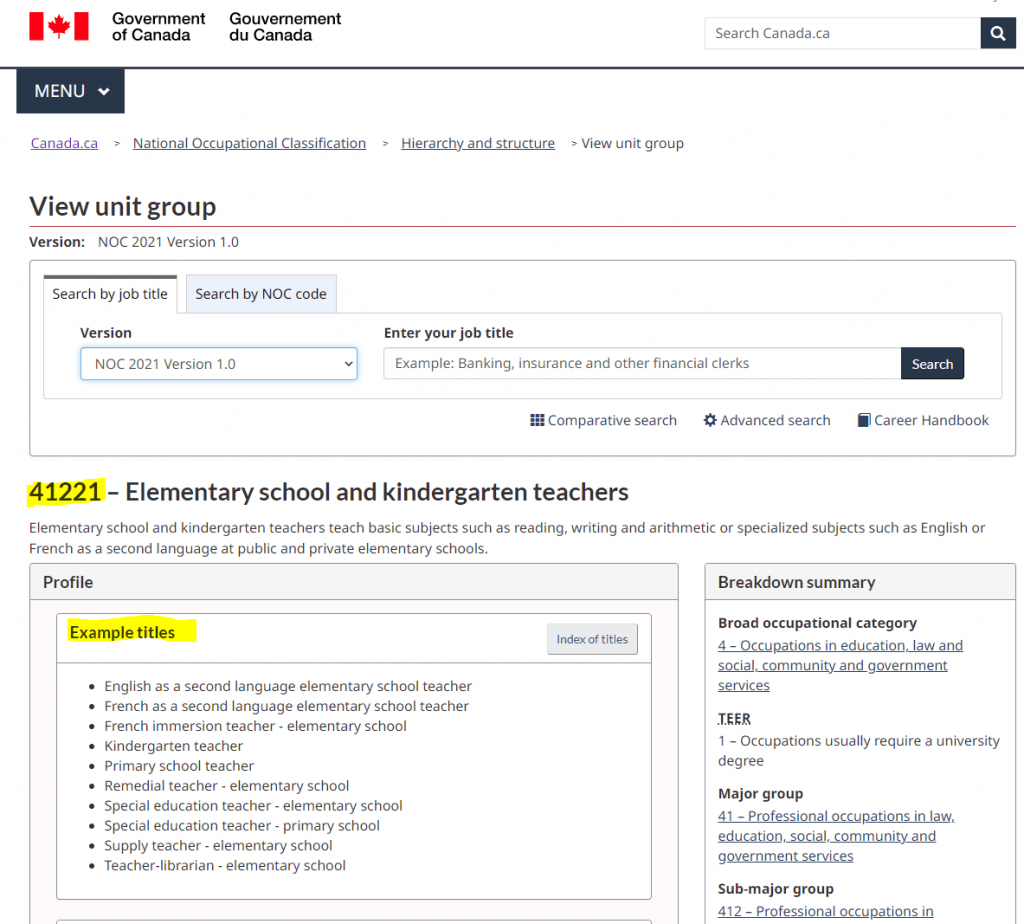
Elementary School and kindergarten teachers (NOC 41221)
The NOC code provides example titles for teachers you can search for in your job search.
Requirements to Become a Teacher in Canada
Each province has a teaching regulatory body that sets the requirements to practice teaching. You will require a bachelor’s degree in education and a provincial teaching certificate.
For example, if you want to teach in Ontario, the Ontario College of Teachers requires you to:
- Complete a minimum three-year postsecondary degree from an acceptable postsecondary institution
- Complete a four-semester teacher education program
- Apply to the College for certification and pay the annual membership and registration fees
- Complete the sexual abuse prevention program.
Learn How to Apply to the Ontario College of Teachers
If you intend to specialize in special education or instruction of English or French as a second language, you may require additional training and certification.
Unlike elementary and secondary teaching, teaching at the university or college level is not regulated. It’s up to the hiring department or institution to recognize your academic credentials obtained outside Canada. University teaching positions are competitive and normally they require that you have at least one graduate degree and a proven teaching record or academic publishing.

Credentials Recognition to Meet Teaching Job Requirements in Canada
The first thing to do is identify what you require to teach in Canada. To do this, contact the regulatory body that governs the teaching profession in the province or territory where you intend to settle in Canada. They will tell you what documents you need to provide, assessment fees, and the process. Take this step before you arrive in Canada!
It’s also important to understand the licensure process and what the regulatory body expects of you. Once you have all the information, you can begin the application process.
Credentials Assessment Services
If you plan to enroll in a college or university program to upgrade your skills, contact the school that you plan to attend to inquire about the steps you should take and the credential assessment agency you should use.
World Education Services (WES) – Ontario
International Qualifications Assessment Service (IQAS) – Alberta
The International Credential Evaluation Service (ICES) – British Columbia
To find more organizations and agencies providing credential evaluation, assessment, and qualification recognition services click here.
Upgrading Your Skills to Meet Teaching Job Requirements
In addition to accreditation, upgrading your skills through a bridging program or other courses and workshops is an important part of your journey to teaching in Canada. You may need more training or skills upgrading.
Canadian employers expect you to be a good communicator and organized. They want you to know how to train a child, listen strategically, motivate students, praise a student appropriately, and give helpful feedback for others’ work.
Strong skills in one or both of Canada’s official languages, English or French, are important for your future in Canada. Whether you focus on learning or improving English or French will depend on which of the two languages most people speak where you live.
Bridging Programs for Teaching Careers in Canada
Bridging programs are an effective way to transition from your international experience and training to the Canadian workplace. Many colleges, universities, and immigrant-serving agencies offer teaching-related bridging programs. You may be eligible for one. Do some research to find a program suitable for you.
The Bridge to Teaching (Bridge) program at the University of Calgary is an intensive teacher education program that prepares experienced foreign-trained teachers to teach in Alberta Schools. During the Bridge Program, participants focus on how to teach the Alberta Program of Studies in ways that engage students and how to assess students’ learning. Participants examine educational policies and pedagogies that affect teaching and learning in Alberta and explore how the expectations for teachers and students compare to those in their previous country.

Teaching Associations in Canada
The following associations provide information about licensure and certification. They also offer professional development, education, and networking opportunities.
National Teaching Associations
Canadian Education Association
Provincial &Territorial Teaching Regulatory Bodies
| PROVINCE/TERRITORY | REGULATORY BODY |
|---|---|
| Alberta | Alberta Teacher Certification |
| British Columbia | Ministry of Education Department of Education and Literacy, Teacher Certification Unit |
| New Brunswick | Department of Education, Teacher Certification |
| Newfoundland and Labrador | Department of Education, Teacher Certification |
| Nova Scotia | Department of Education, Registrar of Teacher Certification |
| Ontario | Ontario College of Teachers (OCT) |
| Prince Edward Island | Department of Education and Early Childhood Development, Registrar’s Office |
| Quebec | Québec – Ministère de l’Éducation, du Loisir et du Sport, Direction de la formation et de la titularisation du personnel scolaire |
| Saskatchewan | Saskatchewan Professional Teachers Regulatory Board |
| Yukon | Yukon Education. Teacher Certification |
Other Provincial Associations
Here are some additional provincial associations to consult when learning about your options to become a teacher in Canada.
British Columbia Teachers’ Federation
Newfoundland and Labrador Teachers’ Association
New Brunswick Teachers’ Association
Ontario English Catholic Teachers’ Association
Ontario Secondary School Teachers’ Federation
Elementary Teachers’ Federation of Ontario
Saskatchewan Teachers’ Federation
Immigrant Networks
Professional immigrant networks (PINs) are member-based associations or networks created by and for immigrant professionals that seek to:
- Create a forum to contribute to and enrich their respective communities, and
- Help members find meaningful employment and achieve their professional goals.
PINs organize networking events, mentoring, and information sessions. They also provide professional development opportunities such as workshops, training, and connections to job opportunities.

How Much Money Does a Teacher Make in Canada?
A teacher’s salary in Canada depends on factors such as the city and province where you teach, experience, teaching level, and specialization. Many newcomer teachers have a higher salary in Canada compared to their home country.
Teacher salaries may be higher in Nunavut, Yukon, and the Northwest Territories because of the challenges in hiring qualified teachers and the higher cost of living in the northern regions.

Teacher Salary in Canada (Primary Teacher)
These are the most recent primary school teacher salaries in Canada (wages/hour as of November 2023).
| PROVINCE | LOW ($/hour) | HIGH ($/hour) |
|---|---|---|
| Canada | 25.00 | 54.95 |
| Alberta | 26.00 | 52.75 |
| British Columbia | 24.62 | 53.42 |
| Manitoba | 25.00 | 55.36 |
| New Brunswick | 24.04 | 45.46 |
| Newfoundland & Labrador | 27.47 | 59.62 |
| Northwest Territories | 35.90 | 61.06 |
| Nova Scotia | 25.00 | 49.45 |
| Nunavut | 20.13 | 71.24 |
| Ontario | 25.00 | 56.30 |
| Prince Edward Island | 22.50 | 46.67 |
| Quebec | 24.73 | 51.48 |
| Saskatchewan | 26.44 | 51.35 |
| Yukon | 30.00 | 71.24 |

Teacher Salary in Canada (Secondary School Teacher)
Here are the latest high school teacher salaries in Canada:
| PROVINCE | LOW ($/hour) | HIGH ($/hour) |
|---|---|---|
| CANADA | 28.57 | 57.60 |
| Alberta | 28.85 | 56.80 |
| British Columbia | 27.50 | 54.95 |
| Manitoba | 26.00 | 55.76 |
| New Brunswick | 26.44 | 43.27 |
| Newfoundland and Labrador | 38.75 | 63.85 |
| Northwest Territories | 22.89 | 73.50 |
| Nova Scotia | 24.04 | 51.27 |
| Nunavut | 26.38 | 73.50 |
| Ontario | 30.65 | 60.90 |
| Prince Edward Island | 24.04 | 45.64 |
| Quebec | 28.85 | 51.79 |
| Saskatchewan | 30.77 | 56.04 |
| Yukon | 23.44 | 60.10 |
What are the Best Provinces in Canada for Teaching Jobs Today?
According to the Canada Job Bank, some of the best provinces in Canada for teaching include: secondary school teaching job prospects include:
- Manitoba
- New Brunswick
- Ontario.
You can research secondary school teaching job prospects for these provinces and find the best local regions for jobs. You can also find job prospects for primary school teachers in Canada.
There are hundreds of schools, colleges, universities, and teaching centers across Canada and you can find jobs in many cities or towns. Focus on the provinces and cities seeing population growth and where there will be a higher teacher demand. Teacher shortages are historically greater in the country’s underserved northern areas such as Yukon Territory.
Pursuing a Teaching Career in Canada
Pursuing a career in teaching starts with getting the right academic credentials based on the province where you plan to work. Below is valuable information to help you pursue a teaching career in Canada:
Major Employers for Teaching Jobs in Canada
Teachers in Canada look for jobs at the school board, and then at the school level. You can view a list of provincial school board associations that represent just over 250 school boards in Canada by visiting the Canadian School Boards Association (CSBA) website.
Large cities typically have more teaching jobs available. For example, The Toronto District School Board is the largest employer of teachers in Canada. It employs about 40,000 employees people in 584 schools.

How to Become a Teacher in Canada
If you are new to Canada and want to become a teacher, you will have to complete these steps:
- Get an undergraduate degree: Complete a bachelor’s degree at an accredited university in Canada
- Decide where you want to teach: A teaching career can take many paths. Choosing where you want to teach will help you with graduate school selection. For example, if you want to teach in Alberta, it’s best to get your teaching certificate from a school in the same province.
- Consider the grade and subjects you want to teach: In Canada, you can teach at the primary, middle school, and high school levels. You can also specialize in different subjects.
- Go to teachers’ college: Complete a graduate program in education in the province you will teach. Complete all in-class and practical requirements.
- Get certified: Apply for certification and complete all requirements.
- Search for teaching jobs: Start your search for your first teaching job.
How Can I Get a Teaching Job in Canada?
To get a teaching job in Canada you need to know how to search for jobs and prepare for the interview. The application process and requirements may be different than in your home country. Use these tips to help you get a teaching job in Canada.
Job Search Techniques for Teachers
You may need help to find job vacancies, update your resume, write cover letters, and prepare for interviews. Fortunately, many settlement services can help you with your job search.
Here are some tips to help you search for teacher jobs:
- Broaden your search and include alternative careers.
- Seek a mentor in the teaching sector such as a retired teacher. A mentor can give you valuable insight and advice and introduce you to their professional network.
- Join teaching-related job-finding or networking clubs through settlement services.
- Attend teaching-related career or job fairs.
Immigrant Settlement Agencies
Most settlement agencies and immigrant-serving organizations offer employment services to help newcomers work in Canada. This can include help finding jobs, updating your resume, writing cover letter, and preparing for interviews. Click the link to find immigrant services in your area.
Writing your Teaching Resume
You can improve your chances of finding a teaching job by creating a Canadian-style resume. Other information to include in your teaching resume include:
Teaching Certificates
List all teaching certificates and other endorsements and include completion dates or expected completion dates.
Experience
Break this section into separate subheadings such as teaching and related work experience. Experience can be paid or unpaid; including internships, observation experience, classroom management skills/strategies, teaching methods used, experience with students with functional needs, and interactions with parents.
List your teaching experiences in reverse chronological order.
Use action verbs and specific details such as grade levels taught, class size, and any other information that will help a reader visualize you in that experience. Include the job title, name of the school, and dates for each position.
Credentials
Highlight your academic credentials and include certifications and degrees on the first page under your profile. You can mention your most important teaching credentials in a summary of your qualifications.
Accomplishments
Showcase your teaching accomplishments. You can include your practicum/intern/volunteer experience and treat it just like a job on your resume.
Accomplishments can include delivering in-service training workshops for teacher colleagues, developing after-school programs or extracurricular activities, and expertise in teaching methods or approaches.

Use Keywords
Include keywords specific to the teaching job to make your resume stand out. Keywords will also help Applicant Tracking Systems to flag your resume. You can identify important keywords from the job description.
Some relevant keywords may include teaching and learning, curriculum development, curriculum planning, creative lesson planning, and classroom management.

Create a Teaching Portfolio
Create a teacher portfolio so you can bring samples of your work to help you succeed in job interviews. Your portfolio shows your strengths and what you offer. You can include your resume, recommendation letters, sample syllabi, and lesson plans.

Interview Techniques for Teaching Jobs in Canada
When you are invited to attend an interview, you need to prepare. Use your research about teaching in Canada to show how you are a perfect fit. Prepare to answer questions with clear examples, as you would prepare to lead a classroom.
You may be interviewed by a school team consisting of the principal, vice-principal, and one or two staff members, or you may be interviewed at the board level by a panel of interviewers. It’s important to practice your responses to help you show confidence during your interview!
If you show any shyness or hesitancy, it could create doubt about your teaching ability. Be sure to reflect your interest in students and their needs when you respond to questions. Show how you are responsible for improving the social and academic achievement of your students. Interviewers will assess if your responses are consistent with the information you have included in your cover letter and resume. Clearly show how you meet the requirements to teach in Canada.

Sample Interview Questions for Teacher Jobs
Below are sample questions that interviewers may ask you:
- How do you use technology to enhance student learning?
- What is your educational philosophy?
- Describe how you would prepare to teach a large amount of material. (Hint: Show a sample lesson plan or discuss how you would use a curriculum map that includes learning objectives, assessments, activities, and standards).
Of course, there are many other questions that you need to prepare to answer. Be familiar with current teaching approaches. If you are applying for a position as a 3rd-grade math teacher, for example, there may be recent teaching developments that you can discuss. This will show your knowledge and commitment to teaching and set you apart from other candidates.
Informational Interviews to Learn About Teaching in Canada
An informational interview is a brief (20–30-minute) meeting with someone who currently works in teaching. Your goal is to learn more about teaching in Canada. The goal is to gather information and determine if a position is a good fit for your interests and your personality. Avoid asking for a job in an informational interview.
An informational interview with a contact from your network can be a great source to gather career information. In addition, you’ll learn about the teacher’s first-hand experiences and insights on teaching job requirements in Canada.
Networking to Find Teacher Jobs in Canada
As many job vacancies are not advertised, connecting with practicing teachers and others within your field is important. Building networks will help you discover job leads and gather vital information about teaching in Canada.
When you network with others, you also get insights about teaching in general or specific schools. This information can strengthen your resume, cover letter, and interview skills. Meeting others is also a great way to expand your professional network.
Teaching conferences and associations are good places to network, build relationships, and share information. LinkedIn is another important professional tool for networking. It is great to connect with former colleagues and employers, search for jobs, and get introductions and recommendations. You can also mingle with people in the teaching sector and join related professional groups.
Networking is more about building relationships. It’s not appropriate to ask a networking contact for a job. However, if they have job leads, they will likely share them with you. Remember, it takes time and effort to cultivate and grow the ties you establish through networking.
With a positive outlook for teaching jobs in Canada, now is the time to check out your options. With international experience, passion, and talent, a teaching career is within reach!
Administrative assistance jobs are a popular choice among newcomers to Canada. Most companies have administrative assistants to help run the business. Since administrative assistant careers can take many paths, it’s a great opportunity for immigrants with a variety of skill sets. Plus, administrative assistant salaries can increase to higher levels once you gain experience.
The job requirements for administrative assistants usually require completion of secondary school and a one- or two-year college program. In addition to completing a program for administrative assistants (or another related program) previous clerical experience is also helpful. This role is a non-regulated profession in Canada, so you do not need a license. Learn about job requirements, job search strategies, interview techniques, and more!
How to Immigrate to Canada as an Administrative Assistant
Preparing before you move to Canada, can speed up your job search. These are some steps you can take before you move to Canada to help you work in an administrative assistant career and even find a job faster when you arrive.
Before You Move to Canada to Pursue an Administrative Assistant Career
- Attend the webinar What to Know about the Canadian Job Market to learn about the labour market and job search strategies.
- Research the Canadian job market to get a sense of job prospects across Canada.
- Assess your language skills by taking an online self-assessment on the Centre for Canadian Language Benchmarks website.
- Improve your language skills and enroll in language classes while in your home country and continue them after you move to Canada.
- Contact the local (or nearest) branch of the Association of Administrative Professionals in the city where you’ll settle in Canada and enquire about the employment process in Canada.
- Gather and organize your official education, work, and identity documents while still in your home country. Find out what documents you need to bring for employment purposes or to continue your education.
- Research administrative assistant salaries and benefits to understand your earning potential.
- Understand how the profession of administrative professionals is practiced in Canada.
- Know the name of your job in Canada and make a list of potential employers.
What to Expect When Pursuing an Administrative Assistant Career in Canada
To help you prepare for your job search, it’s helpful to understand the nature of the job and the specific skills that Canadian employers seek. This will involve some basic research. Administrative assistant careers are unique because jobs are diverse. Your role will be shaped by the industry and company. Some positions may be more advanced than others even though they share the same job title. This will also be reflected in the administrative assistant salary for the job.
Employment Outlook for Administrative Assistant Jobs in Canada
Job prospects for administrative assistants vary across Canada. So it’s best to explore provincial job prospects to assess where there the outlook is good.
The labour market conditions over the next 10 years are expected to be balanced for administrative assistant careers. There are expected to be 68, 200 job openings from 2022-2031, many of which will be filled by newcomers, according to the Government of Canada.
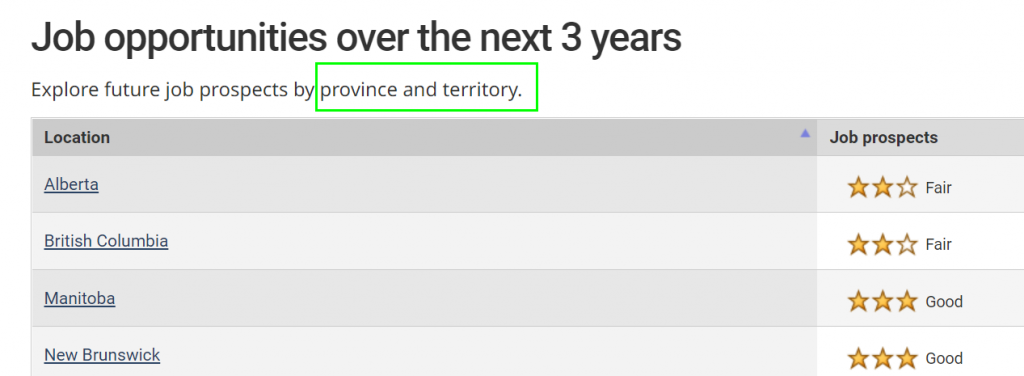
You can even explore future job prospects in local regions when you click on the provincial job prospects links.
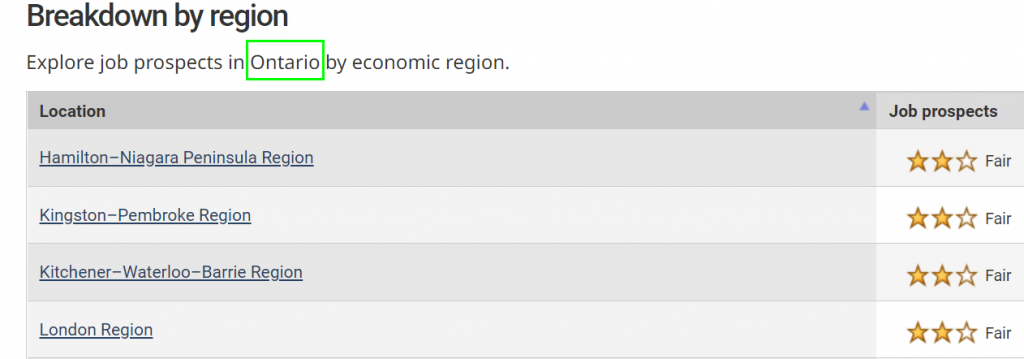
This detailed information is provided by the Government of Canada Job Bank site and it is a great location to research job prospects, wages, skill requirements, and even search for administrative assistant jobs.
Start Your Research with the NOC Code for Administrative Assistants
As part of your research, you can view the National Occupational Classification (NOC) code. The NOC provides a standard definition of jobs in Canada. This five-digit code is used by various groups, including job seekers such as you.
The NOC for administrative assistants is NOC 13110. You can use this information to learn about the nature of the job duties and get job titles and employment requirements. While the job title for NOC 13110 is Administrative Assistant, when searching for jobs in Canada, you will find other titles for the same role. You can use these other titles when you search for jobs in Canada and expand your search efforts.
If you have specialized experience, you may also want to refer to these NOCs:
- Executive assistants NOC 12100
- Legal administrative assistants NOC 13111
- Medical administrative assistants NOC 13112.
Requirements to Become an Administrative Assistant in Canada

Administrative assistant careers are non-regulated in Canada which means you do not need a license to work in this field. But, most jobs will require you to have certain credentials and education to qualify for the positions. Requirements will vary based on the employer and the job title. Below are steps to take to work as an administrative assistant in Canada:
Credential Recognition in Canada
Credential recognition is a process to verify and assess your skills, competencies, and credentials fairly and consistently. While administrative assistants belong to a non-regulated profession in Canada, some employers may ask for an educational assessment. Mostly though, employers will assess your skills, knowledge, and experience and contact your professional references. So, before you spend money to get your credentials evaluated, find out if the company that you are applying to requires an assessment.
Administrative assistants can become a member of the Association of Administrative Professionals. The association helps its members with skill development and growth to enhance job opportunities and contributions to both the workplace and the community.
Related Post:
What is Credential Recognition?
Credential Assessment Services
You may also require an educational assessment if you plan to enroll in a college or university program to upgrade your skills or continue your education in Canada. However, before you pay for an assessment, contact the school that you plan to attend to find out what they require and the credential assessment service that you should use. Some schools may have a preferred service provider.
When you get an educational assessment be sure to highlight your international education and skills. You may be able to receive advanced standing, transfer some of your credits, and benefit from prior learning assessment options. If you can gain credit or course exemptions, you can avoid repeating the education you already have, or you may shorten the amount of time required to complete courses. It’s important to build on your existing knowledge and skills and explore your options carefully before you decide that you need to return to school.
Several agencies assess international education credentials to help newcomers to Canada access the education and employment they need including:
To find more credential evaluation, assessment and qualification recognition services click here.
Upgrading Your Skills to Meet Administrative Assistant Job Requirements
Canadian employers place a high value on soft skills, such as personal attributes that enhance your interactions, job performance, and career prospects. Unlike your hard skills, you can apply your soft skills broadly.
Soft skills, such as communication, coordination, and sociability, are even more important for administrative assistants. That’s why identifying areas in your soft skills that need improvement is crucial. If your hard skills will get you an interview, most probably it is your soft skills that will get you the job and enable you to succeed.
Though not a must, upgrading your education and skills through a bridging program or other courses and workshops may be an important part of your journey to becoming a successful administrative assistant in Canada.
Language Training

Administrative assistants require strong communication skills, document management, note-taking, presentation, proofreading, report compilation and writing, organizational ability, time management, and software expertise. Having strong communication skills in one or both of Canada’s official languages, English or French, is also important for your career success.
Whether you choose to focus on learning or improving English or French will depend on which of the two languages most people speak in the area where you intend to live.
You may be eligible for Language Instruction for Newcomers to Canada (LINC) program. Otherwise, you can find other free or affordable English as a Second Language or French as Second Language classes through local school boards or settlement agencies.
There are even language courses to teach you professional terminologies, such as job-specific language training and Occupation Specific Language Training (OSLT) in Ontario. If you are in Toronto, the Toronto District Board of School offers a fourteen-week Enhanced Language Training program focusing on Customer Service & Administration for immigrant women.
And, if you already speak one of Canada’s two official languages at a high level, learning the other one is a good option, as it may offer you better job opportunities.
Administrative Assistant Schools in Canada
More than 60 schools offer administration courses and programs in Canada. There are several education streams you can choose from:
- Administration studies
- Office administration
- Business administration
- Human resources
- Business management
- Bookkeeping.
Courses are offered by most community colleges. Some programs are available online. Some schools to consider are:
- Georgian College
- Centennial College
- Seneca College
- Fanshawe College
- Mohawk College
- Niagara College.
Read more about the benefits of higher education for newcomers.
Administrative Assistant Associations in Canada

The main administrative assistant association in Canada is the Association of Administrative Professionals. This association has branches in Ontario, Alberta, and Atlantic Canada.
Immigrant Networks
Professional Immigrant Networks (PINS) are organized associations or networks created by and for immigrant professionals that seek to:
- Create a forum to contribute to and enrich their respective communities, and
- Provide their members with opportunities to find meaningful employment and achieve their professional goals.
PINS can provide networking events, mentoring, information sessions, professional development, and connections to job opportunities.
Nova Scotia
isans: Immigrant Services Association of Nova Scotia: helps newcomer professionals with their full economic and social integration in the province of Nova Scotia.
Ontario
Professional Immigrant Networks (TRIEC)
For information, tools, free webinars, and more visit our Finding a Job in Canada resource page. Get the help you need to achieve your career goals in Canada!
How Much Do Administrative Assistants Make in Canada?
According to the Government of Canada Job Bank, administrative assistant salaries can range from $14.50 to $43 per hour depending on where you live in Canada. Some of the common factors affecting administrative assistant salaries include your job title, industry, experience, education, and location. The median hourly administrative assistant salary is $24.
Administrative Assistant Salary in Canada
Here are the most recent administrative assistant salary numbers in Canada:
| Province | Low ($/hour) | Median ($/hour) | High ($/hour) |
|---|---|---|---|
| Alberta | 18.27 | 26.10 | 34.64 |
| British Columbia | 17.00 | 24.85 | 36.00 |
| Manitoba | 14.63 | 22.12 | 30.84 |
| New Brunswick | 15.00 | 22.00 | 29.76 |
| Newfoundland and Labrador | 16.48 | 24.04 | 30.00 |
| Northwest Territories | 20.00 | 26.00 | 35.12 |
| Nova Scotia | 14.50 | 22.00 | 29.55 |
| Nunavut | 27.00 | 30.00 | 43.00 |
| Ontario | 17.00 | 24.54 | 35.90 |
| Prince Edward Island | 16.00 | 24.00 | 29.40 |
| Quebec | 16.67 | 23.00 | 31.79 |
| Saskatchewan | 16.35 | 23.32 | 32.00 |
| Yukon | 19.00 | 28.80 | 34.03 |
Best Provinces to Work in Canada as an Administrative Assistant Based on Salary & Lifestyle
Most provinces and Canadian cities offer employment opportunities in the administrative sector. However, when looking for jobs, broaden your geographic area to include smaller cities and towns close to the city where you plan to live. For example, you may want to consider cities that are within close proximity to larger cities. For example, the city of Hamilton is less than a one-hour drive to Toronto and can offer a more affordable cost of living.
Research cities in Canada and determine where there is a demand for your profession and where you would like to settle.
Pursuing an Administrative Assistant Career in Canada
Pursuing an administrative assistant career begins with education, and experience, and then selecting a province to work in. Once you decide where to live, you’ll want to identify the best employers in the area. Below is valuable information to help you pursue an administrative assistant career in Canada:
Major Employers for Administrative Assistant Jobs in Canada
Administrative assistants can work in any province and for a variety of organizations. It’s common to find jobs in government, the private sector, small businesses, and industries such as health care, education, and many others.
You can visit Canada’s Best Diversity Employers website to check for immigrant-friendly corporations and organizations that you might be interested in. This special designation recognizes Canada’s best employers for their commitment to equity, diversity, and inclusion.
How to Find Your First Administrative Assistant Job in Canada

The Canadian job market can be competitive, so you need to prepare and understand the job search process. You must look for jobs in the region where you will settle. Therefore, take your time to research job requirements in that region and develop a plan to find a job. There are many ways that you can search for jobs. These helpful tips are important actions that you can take to propel your job search:
- Broaden your search and include alternative careers and sectors.
- Seek out a mentor who currently works in your field who could share their insights and introduce you to their professional network.
- Join job-finding or networking clubs through immigrant settlement agencies.
- Attend industry job fairs and regularly check online job boards.
Connect with Settlement Agencies
Finding administrative assistant jobs in Canada may be different than in your home country and you may need help to find jobs, update your resume, write a cover letter, and prepare for interviews.
Most settlement agencies offer free job search services before and after you arrive in Canada.
Click the link to find immigrant services in your area.
Build Your Professional Network
Networking is an essential relationship-building activity that can help you discover job leads, gain information about a company or industry, and meet others who can help you to expand your network. As many job vacancies are not advertised, you must make connections with others in your field. The “hidden job market” accounts for roughly 70- 80% of available jobs in Canada. Tapping into the “hidden job market” through networking can greatly help your job search efforts.
Good places to network are industry conferences and functions where people meet, build relationships and share information.
LinkedIn is another helpful networking tool that’s great for connecting with former colleagues and employers, searching for jobs, and getting introductions and recommendations. You can also join some related professional groups.
Learn about the Job Environment by Conducting Informational Interviews
An informational interview with a contact from your network can be a great source of career information. The purpose of this brief 20 – 30-minute meeting is to speak with someone who currently works in the position or industry that you would like to learn more about.
An informational interview can help you to gather valuable and professional insights. And, you gain benefits by speaking with someone who can share their thoughts and first-hand experience. You should not try to get a job during an informational interview but rather research and learn more about a position, company, or industry.
Write a Strong Resume
When you write your resume it’s important to tailor it for the specific job that you are applying for. When you can show how your skills and experience match the job requirements, it will be much easier for employers and human resource recruiters to discover your resume. Here are some essential tips to write a winning administrative assistance resume:
Use the Job Description to Tailor Your Resume
Using a generic resume for all administrative jobs is not effective. It’s more effective to carefully review the job description and emphasize how your skills match the job requirements. Use bullet points to describe your related responsibilities and successful outcomes.
Highlight Your Technical Skills
Employers want to know immediately which technical skills you possess. To do this, you can include a line that says, “Experienced with” and then list all applicable software programs and skills that you possess.
Do Your Research on Administrative Assistant Careers
It’s important to showcase the skills that employers are searching for. One way to do that is to review administrative assistant job postings. Identify the skills that employers value and require.
You can use your network to find the names of current administrative assistants. You may want to view their LinkedIn profile or other presence they may have on professional websites to learn about their skills and previous experience. This way you can compare your skills with those of current employees.
As a newcomer, you bring your international experience to the table. This is especially valuable when you apply to companies that have global operations. So be sure to highlight your international experience.
Interview Techniques and Tips for Administrative Assistants
When interviewing for an administrative assistant job in Canada, be sure to ask specifically what the job entails. Admin jobs range from answering phones, scheduling appointments, and setting up virtual meeting rooms to charting budgets, purchasing merchandise, and troubleshooting software problems. Your pay as an administrative assistant can vary depending on your role and duties, the industry, and even the city where you are employed.
Be Professional
Communication is your primary role as an administrative assistant. Be it on the phone, in person, or through e-mail, you must be well-mannered and articulate. Be sure to present yourself professionally before, during, and after the interview.
Dress for Success
While some companies have receptionists, others rely on administrative assistants to answer phones and greet clients. Because the company’s administrative assistant may be the first point of contact, it’s crucial to dress professionally to show respect to the company and its clients.
Discuss Your Computer Skills
Talk about your spreadsheet, data management, and electronic filing system expertise. Or, if you are interviewing with an advertising company, talk about how your social media skills can help with the company’s online presence. If you are interviewing for a school administrative job, discuss the role of email communication with parents, posting online grades and notices, and electronic bill payment.
Here are some sample questions that a human resources manager or hiring manager may ask you during an interview:
- Describe some of the software platforms that you use.
- Describe how you recently learned new computer skills to help you perform in your role.
- Describe how you use software to help you manage multiple projects and your time.
Remember that a job interview is a two-way street. Research the company before the interview and prepare questions. You can ask your questions at the end of the interview.
With a positive outlook for administrative assistant jobs in Canada, now is the time to check out your options.
Working as a dentist in Canada is a good career choice and a profession that will face labour shortages in the coming years. Dentist salaries can be lucrative, but you must undergo extensive training to earn an attractive dentist salary. Dentist job requirements in Canada typically require one to four years of pre-dentistry university studies and a university degree from a recognized dental program. Also, you must obtain a license from a provincial or territorial regulatory body to practice in Canada. To continue your successful dentistry career in Canada, you must research the profession to understand the job requirements. Get the information you need to navigate job requirements for dentists with international experience.
How to Immigrate to Canada as a Dentist
It’s vital to research the dentistry profession in Canada before you arrive. Your thorough research will help you to understand what you require to continue to work as a dentist in Canada. Dentists belong to a regulated profession in Canada. And, it can take a great deal of time, money, and effort to obtain a license to d to practice dentistry in Canada. However, when you know the licensing process, you can prepare in advance.
Each province and territory has its own regulatory body to grant a license to practice dentistry within its jurisdiction. These regulatory bodies recognize the National Dental Examining Board of Canada (NDEB) certificate.
Before You Move to Canada to Pursue a Dentist Career
These are some steps you can take before you move to Canada:
- Attend the webinar How to Find Your First Job in Canada as a Newcomer to learn about the labour market.
- Visit the Canadian Dental Association for general information on dental occupations in Canada.
- Contact the Provincial regulatory body to learn about the licensing process, and the steps that you can take before and after you arrive in Canada (see section 5: Dentistry Associations). Find out what documents you need to bring and if they need to be translated. You may need to use a professional translation service in Canada.
- Take an online self-assessment on the Centre for Canadian Language Benchmarks website to assess your language skills.
- Improve your language skills and enroll in language classes while you are in your home country and continue them when you arrive in Canada. You will need to prove your English or French (depending on your destination province) language competency or be tested.
- Gather and organize your official education, work, and identity documents while still in your home country.
- Complete a “Certificate of Standing” form that is required by Canadian provinces and territories. Your current (and any previous licensing body or governing authority such as the Ministry of Health must complete the form. You can get the form from the Canadian regulator’s website or from them directly.
- Research dentist salary and benefits information
What to Expect When Pursuing a Dentist Career in Canada
Dentistry is a regulated profession in Canada, so you must be a licensed member of a provincial or territorial regulatory body to practice or use the title of dentist or dental surgeon. With this license, you can work in private practice, hospitals, clinics, public health facilities, or universities. It’s also important to understand how dentistry is practiced in Canada and to become familiar with the legislation that governs dentistry in the province where you’ll settle.
Employment Outlook for Dentist Jobs in Canada

Understanding the demand for dentists in Canada can help you determine what the job prospects will be like. To find out more about job prospects, wages, jobs, requirements, and skills, you can visit the Canada job bank. With this information, you can research the national, provincial, and regional job forecasts for dentists.
According to current data for the period of 2022-2031, employment growth for dentists is above the average for all occupations. There are expected to be about 13,500 new opportunities. This is due to industry expansion as well as many existing dentists retiring in the coming years. However, there is a shortage of dentists to fill these roles, creating an opportunity for internationally trained dentists.
Start Your Research with the NOC Code for Dentist Jobs in Canada
If you have international qualifications, it’s important to know what you require to work in Canada and understand the Canadian labour market. The National Occupational Classification (NOC) is a great place to start your research. Here, you’ll find general information about the job profile, example dentistry titles, duties, and job requirements. Using the 5-digit NOC code 31110 for Dentists you can use this information to help with your job search.
Dentist Career Requirements in Canada
To practice as a dentist, you need to have a license in Canada regardless of your education or experience in another country. So, it’s important to contact the provincial or territorial regulatory body (links provided below) that governs the dental profession in Canada before you arrive in Canada. They can tell you what documents you will require as well as the cost of assessment fees. The licensing process can be lengthy and expensive. So you need to prepare for this reality and ensure that you afford both the time and cost. Take your time to learn about the licensing process and what the dental regulatory body will expect of you.
All regulatory bodies recognize the certificate of the National Dental Examining Board of Canada (NDEB). However, to write the exam, you must be a graduate from an accredited program in Canada or the USA – and with some conditions, Australia, New Zealand, and Ireland.
If you have graduated from a dental program outside of the mentioned countries, you will be considered an internationally educated dentist and have to take a two-year qualifying program to sit for the exam. In addition to the application and document verification processes, the NDEB assessment process includes three assessments:
- Assessment of Fundamental Knowledge
- Assessment of Clinical Judgement
- Assessment of Clinical Judgment
You need to successfully complete all three steps before you can write the NDEB exams. Once you pass these exams you may apply to the dental regulator in your province to get licensed.
If you’re immigrating to Quebec, you have three years to meet the mandatory requirement for French language proficiency. If you wish to work in a dental specialty, you will need additional training.
Related Post: How Do Education Evaluation and Credential Recognition Differ? (Infographic)
Credentials Assessment Services
If you plan to enroll in a university program to upgrade your skills, contact the school that you plan to attend to learn what credential assessment agency you should use. You can use these credential assessment services for more information:
World Education Services (WES) – Ontario
International Qualifications Assessment Service (IQAS) – Alberta
The International Credential Evaluation Service (ICES) – British Columbia
To find other credential evaluation, assessment and qualification recognition services click here.
Upgrading Your Skills to Meet Dentistry Job Requirements

In addition to accreditation, upgrading your skills through a bridging program or other courses and workshops is an important part of your journey to becoming a dentist in Canada. As a dentist, you must continually update your knowledge and skills on new dental procedures and practices. You can benefit from ongoing learning and professional growth offered through continuing education courses and seminars.
You may have strong technical skills, but often that is not enough to get a job or maintain it afterward. As a dentist, you must have skills that include:
- Providing emergency care or other treatment
- Assessing conditions through exams or diagnostic testing
- Using special instruments and equipment, and more.
You may need more training or skills upgrading, especially your soft skills.
If you would like to be a self-employed dentist, you may require advanced business skills as well as financial resources to establish and maintain the dental practice.
Improving Your Language Skills for Dentistry Jobs
Dentistry requires advanced language abilities in reading, writing, and speaking. Having strong skills in one or both of Canada’s official languages – English or French – is extremely important for your future in Canada. Whether you choose to focus on learning or improving English or French will depend on which of the two languages most people speak in the area where you intend to live. Read more about the importance of communication skills.
You may be eligible for Language Instruction for Newcomers to Canada (LINC) program. Otherwise, you can find other free or affordable English as a Second Language (ESL) or French as a Second Language (FSL) classes through school boards or settlement agencies.
There are even language courses to teach you professional terminology, such as job-specific language training and if you are located in Ontario, Occupation Specific Language Training (OSLT). You may already speak one of Canada’s two official languages at a high level, and learning the other one is a good option for better job opportunities.
Bridging Programs for Dentist Careers in Canada
Bridging programs are a good way to transition from your international experience and training to the Canadian workplace. Many colleges, universities, and immigrant-serving agencies offer bridging programs or workshops. You may be eligible for one. Learn more about bridging programs to find one that’s suitable for you:
Alberta
This centre provides internationally educated health professionals with the necessary tools to become successfully licensed in their Health Care Profession in Alberta/Canada. Participants will be assigned a dentist Career Coach who will guide them through the licensing and employment process.
British Columbia
University of British Columbia
International Dental Degree Completion Program
This program is offered to graduates of international dental programs that are not accredited by the Commission on Dental Accreditation of Canada. This two-year program will lead to the awarding of the Doctor of Dental Medicine (DMD) degree.
Manitoba
University of Manitoba
International Dentist Degree Program
This program is offered to graduates of international dental programs not accredited by the Commission on Dental Accreditation of Canada.
Ontario
University of Toronto
International Dentist Advanced Placement Program
This program is for graduates of non-accredited dental programs that have not been recognized by The Commission on Dental Accreditation of Canada. It prepares them to take the NDEB examinations. After successful completion of this 5-month program, students are fully integrated into the third year of U of T’s four-year Doctor of Dental Surgery Program (DDS), leading to the degree of Doctor of Dental Surgery.
Western University
ITD – Internationally Trained Dentists Program
Held over two academic years beginning in May/June, the Program leads to a Doctor of Dental Surgery degree (DDS). Upon successful completion of the ITD Program and the NDEB Written and Objective Structured Clinical Examinations, candidates will be eligible for licensure/registration as a dentist in all Canadian provinces (a French proficiency exam is required for licensure in Quebec).
Dentist Schools in Canada
If you plan to continue your education, there are 10 dental schools in Canada. Each one has specific programs and specializations. You can research different schools to determine which one is best for you based on your career goals:
Dentist Associations in Canada

The following associations can provide more information about licensing, certification, professional development, education, and networking opportunities.
National Dentistry Associations in Canada
Canadian Dental Association (CDA)
National Dental Examining Board of Canada (NDEB)
Commission on Dental Accreditation of Canada (CDAC)
Royal College of Dentists of Canada (RCDC)
Association of Canadian Faculties of Dentistry (ACFD)
Provincial/Territorial Dental Regulatory Bodies
Alberta
Alberta Dental Association and College (ADAC)
British Columbia
College of Dental Surgeons of British Columbia (CDSBC)
Manitoba
Manitoba Dental Association (MDA)
New Brunswick
New Brunswick Dental Society (NBDS)
Newfoundland and Labrador
Newfoundland and Labrador Dental Association (NLDA)
Northwest Territories
Nova Scotia
Provincial Dental Board of Nova Scotia (PDBNS)
Nunavut
Professional Licensing, Department of Health and Social Services, Government of Nunavut
Ontario
Royal College of Dental Surgeons of Ontario (RCDSO)
Quebec
Ordre des dentistes du Québec (ODQ)
Saskatchewan
College of Dental Surgeons of Saskatchewan (CDSS)
Yukon
Professional Licensing, Department of Community Services, Government of Yukon
Immigrant Networks
Professional immigrant networks (PINS): These volunteer associations or networks are created by and for immigrant professionals and seek to create a forum to contribute to and enrich their respective communities. They also provide opportunities for their members to find meaningful employment and achieve their professional goals.
PINS offers activities that include networking events, mentoring, information sessions, professional development opportunities, and connections to job opportunities.
For example, in Nova Scotia there is isans: Immigrant Services Association of Nova Scotia: isans helps newcomer professionals to integrate economically and socially in the province of Nova Scotia.
How Much Do Dentists Make in Canada?

Dentist salaries can span a wide range depending on your experience and level of specialization. According to the Government of Canada Job Bank, dentist salaries can range from approximately $30,000 to about $350,000 annually. The province with the highest average dentist salary is Alberta ($127, 890). The province with the lowest average dentist salary is British Columbia ($104,055).
Dentist Salary in Canada
Here are the most recent dentist salary (November 2022) numbers in Canada. At this time, data is not available for all provinces and territories.
| Province | Low ($/year) | Median ($/year) | High ($/year) |
|---|---|---|---|
| Alberta | 31,688 | 127,890 | 344,374 |
| British Columbia | 35,592 | 104,055 | 214,633 |
| Nova Scotia | 30,870 | 115,050 | 166,709 |
| Ontario | 32,274 | 114,966 | 248,306 |
| Quebec | 29,862 | 121,027 | 243,253 |
Best Provinces for Dentist Careers in Canada Based on Salary & Lifestyle
There is an increasing demand for dentists in Canada because of population growth, an aging population, and technological advancement in diagnosis and treatment. Though the demand for dentists is throughout Canada, you may want to consider the fast-growing provinces of Alberta and Saskatchewan and rural areas throughout the country. Large cities such as Toronto, are also a good option. A dentist’s salary will vary based on your location and the job prospects.
Also, it is important to consider the availability of bridging or other educational qualifying programs in dentistry when researching and choosing your destination city. Visit Choosing a City to discover cities across Canada and learn about the local employment market, the housing market, newcomer support, and more.
Major Employers for Dentistry Jobs in Canada
Dentists in Canada work in private practices or may be employed in hospitals, clinics, public health facilities, or universities. Some are employed by local, provincial, and federal health authorities or choose to serve in the Canadian Armed Forces.
If you want to explore possible dental career opportunities outside the dental practice, you may consider working as a dental educator, researcher, administrator, or sales representative. These options also offer competitive dental salaries. You can also visit Canada’s Best Diversity Employers website. This special designation recognizes Canada’s best employers for diversity and inclusion.
How to Find Your First Canadian Dentist Job
The Canadian job market is competitive, so you must prepare and understand the steps to gain employment. You must register to practice as a dentist in the province or territory where you intend to work and look for jobs in that region. Take your time to research job requirements in the region and develop a plan to find work.
There are many ways to search for a job in dentistry for example:
- Broaden your search and include alternative dentist careers.
- Seek out a mentor in the dental sector who would give you valuable insight and advice and probably introduce you to their professional network.
- Join dentistry job-finding or networking clubs through immigrant-serving agencies.
- Attend healthcare or dentist career/job fairs and regularly check online job boards.
- Visit dental college websites and view their job bank. As well, hospitals and other health institutions post vacancies on their websites.
For more information on job search techniques, click here.
Use Immigrant Settlement Agencies
Finding a job in Canada may be different than in your home country. Most settlement agencies and other immigrant-serving organizations offer help to find job vacancies, update your resume, write cover letters, prepare for interviews and understand what Canadian employers are looking for.
Click here to find immigrant services in your area.
Network with Dental Professionals
Networking is a critical activity that involves building relationships with other professionals to expand your connections. When done effectively, you can find job leads, gain advice and information about the dental profession, and expand your network. Networking can also help you discover unadvertised jobs in what is known as the “hidden” job market. Making connections with other dentists and others in your field can help you discover jobs.
Good places to meet new people and network with others include conferences, associations, and schools.
LinkedIn is another important professional tool for networking. It is great to connect with former colleagues and employers, search by company or jobs, and get introductions and recommendations. You can also connect with people in the dental field and join related professional groups.
Conduct Informational Interviews with Practicing Dentists
While the job outlook is good for dentists, landing that next opportunity, requires effort and outreach. Informational interviewing is an effective way to practice your communication abilities, research skills, and networking talents to work for your own benefit.
An informational interview is a brief, 20–30-minute meeting you schedule with a person currently working in dentistry in Canada. The purpose of the interview is to learn more about the profession in Canada and gain insights.
Your goal should not be to get a job but rather to learn more about dentistry in Canada and industry trends and issues. An informational interview with a contact from your network can be an excellent source of dentist career information because, in addition to basic information about the dental field, you’ll also gain from hearing directly about your contact’s first-hand experience and impressions.
To identify possible people to meet with, use your existing network to identify people to speak to. Create 15-20 open-ended questions that will yield useful information about dentistry in Canada.
Resume Writing Tips for Dentist Jobs in Canada
All dentists have degrees, but where they separate themselves is in their experience, expertise, and special training. You can stand out and create an effective resume by highlighting your special skills and experience. Consider these tips when preparing your resume:
- Emphasize your clinical skills and education if you’re applying to a large general dental practice.
- Highlight any experience you have with the business administration side of the profession.
- List any certification or proficiency in specific dental skills (oral surgery, anesthesia, pediatric dentistry, etc.).
- List your professional organizations and publishing experience, if any. Even if it’s just been writing advice columns for your community newspaper, an employer will look favourably at a dentist who keeps a good public profile.
- Limit the length of your resume to two pages.
Interview Techniques for Dentistry Jobs in Canada
Practice is key before you attend an interview and it can make the difference between a job offer or a job decline. To prepare for an interview for a role in dentistry, here are some questions that an interviewer may ask you:
Education
- How would you describe your educational experience?
Personality
- What type of personality types do you work best with?
- How would you handle an unhappy or uncomfortable patient?
- What do you like most about dentistry? Least?
Philosophy
- What would you say is your dental philosophy?
- How would you describe your knowledge of current dentistry technology and procedures?
- What professional development have you done in the last year to enhance your skills and knowledge?
- What experience do you have with the business and administrative side of running a dental practice?
Questions You May Want to Ask in a Dentistry Job Interview
- How is your dental practice changing? Is it growing?
- Do you actively market or depend on referrals?
- What are your goals for the practice?
- What role would I play in this practice?
Avoid asking questions about dentist’s salary and benefits until the time is right or the subject is brought up by the interviewer. It’s helpful if you have a portfolio of your work. Obviously, respect the anonymity and privacy of your patients, but you can impress a prospective employer when you can show the quality of your work (before and after photos, case histories, etc.).
Regardless of the type of dental practice you work for, make sure that you convey value to your next boss. How much did you produce? Yes, you are highly trained, qualified, and skilled, but at the end of the day, this is about operating a profitable small business. A dental practice wants to know that you are going to contribute as least as much and hopefully more to your next practice than you have to your current employer.
The need for physiotherapists in Canada is on the rise. As Canada’s population is aging, there is an increasing need for professionals in this field. Like other professions in healthcare, there is a shortage of physiotherapists. This is an opportunity for licensed physiotherapists to move to Canada and help fill the void. Learn more about physiotherapist jobs in Canada and what you require to work.
To work as a physiotherapist in Canada, employers require a university degree in physiotherapy and a period of supervised practical training. You also require a licence or registration with a physiotherapist regulatory body in the province or territory where you plan to settle. Because physiotherapists belong to a regulated profession, you can only practice as a physiotherapist or physical therapist if you are licensed as a full member of a provincial or territorial regulatory body. These bodies are represented by the Canadian Alliance of Physiotherapist Regulators (The Alliance).
This overview of the Physiotherapist field in Canada will give you insights into employment requirements, credentials recognition, job search techniques, and more.
How to Immigrate to Canada as a Physiotherapist
Before You Move to Canada to Pursue a Physiotherapist Career
Now is an exciting time to move to Canada to continue your career as a physiotherapist because there are many opportunities. But you need to follow specific steps to gain employment.
To help you take charge and continue your career in Canada, there are steps that you can take before you move. Careful research of job requirements will improve your chances of practicing Physiotherapist in Canada:
Attend the How to Find a Job in Canada as a Newcomer webinar to learn about the labour market, trends, and employment forecasts.
- Contact the provincial or territorial physiotherapist regulatory association in the province where you plan to settle in Canada.
- Find out what procedures you must follow, potential costs, and the time required to obtain a licence to practice in Canada.
- Determine what steps in the licensing process you can take before and after you move.
- Assess your language skills by taking an online self-assessment on the Centre for Canadian Language Benchmarks website.
- Improve your language skills and enroll in language classes while you are in your home country and continue them after you move to Canada. You will need to prove your English or French (depending on your destination province) language competency or be tested.
- Gather and organize your official education, work, and identity documents while still in your home country. Check with your provincial or territorial regulatory body about what documents you need to bring. Verify if they need to be translated. You may need to use a professional translation service in Canada.
- Understand how Physiotherapist is practiced in Canada and become familiar with provincial laws that govern your profession where you will settle.
Following these steps will help you to position yourself well to find a physiotherapist job once you arrive in Canada.
What to Expect When Pursuing a Physiotherapist Career in Canada
Employment Outlook for Physiotherapist Jobs in Canada
Physiotherapists are in demand in Canada. A shortage of professionals in this field is expected until 2028. There are expected to be 13,600 job openings between 2019-2028 according to the Government of Canada. However, only 11,300 new therapists will be seeking jobs during this time. This creates a great opportunity for international professionals to fill these Physiotherapist jobs.
Start Your Research with the NOC Code for Physiotherapist Jobs in Canada
The National Occupational Classification (NOC) provides a standard definition of the physiotherapist’s role, main duties, job requirements, and example titles. You can use the five-digit NOC code 31202 to conduct basic research about the role in Canada.
The NOC also provides a list of example titles for physiotherapists. You can use these titles when searching for jobs in Canada.

You can also conduct further research at the Canadian government Job Bank site. Here you will find key facts about working in the field, including information about wages, job prospects, required skills, and more.
Requirements for Becoming a Physiotherapist in Canada
Because physiotherapy is a regulated profession in Canada, you need to get certified by a regulatory authority in the province where you plan to settle. This will require a credentials assessment to support your job search, apply for professional licensure, or apply for post-secondary education in Canada.

Credential Recognition Meeteet Physiotherapist Job Requirements in Canada
The provincial or territorial regulatory body can advise you about the documents you require, assessment fees, and the specific process to follow. It’s vital to contact the regulatory body in the province where you plan to settle before you arrive in Canada to learn what you require to work.
It’s also important to take your time and fully understand the licensure process and what the regulatory body will expect of you. Regardless of your education or experience, you need to have a licence to practice as a physiotherapist in Canada.
- The Canadian Alliance of Physiotherapist Regulators will assess your educational credentials and qualifications if you are immigrating to the Yukon Territory and all the provinces except Quebec.
- You must complete the Physiotherapist Competency Exam (PCE), which has a writing component (Qualifying Exam) and a Clinical Component (Physiotherapist National Exam). You can get information on the credentialing process, exam dates, and resources for you to prepare for the exam on The Alliance’s website.
- After you complete the PCE exam and the other provincial regulatory requirements, you can apply for full licensure or registration as a physiotherapist. If you’re immigrating to Quebec, you must follow the requirements set out by the l’Ordre professionnel de la physiothérapie du Quebec.
Credential Assessment Services
If you plan to enroll in a college or university program to upgrade your skills, contact the school that you plan to attend to find out what assessment agency you should use. These are some of the recognized assessment agencies that you can use:
World Education Services (WES) – Ontario
International Qualifications Assessment Service (IQAS) – Alberta
The International Credential Evaluation Service (ICES) – British Columbia
To find more organizations and agencies providing credential evaluation, assessment, and qualification recognition services, click here.
Upgrading Your Skills to Meet Physiotherapist Job Requirements
In addition to accreditation, upgrading your skills through a bridging program or other courses is an important part of your journey to becoming a physiotherapist in Canada.
You can benefit from learning and professional growth opportunities offered through continuing education courses and seminars.
Skills Upgrading to Qualify for Physiotherapist Jobs in Canada
In addition to having strong technical skills, it’s vital to have effective communication and professional skills (or soft skills). Demonstrating both technical skills and soft skills will help you to find the job that you desire and succeed in the role. As a physiotherapist, you must be interested in helping people. You may need more training or skills upgrading, especially regarding your soft skills. Those working in healthcare are expected to have strong bedside manners and excellent interpersonal skills.
Language Training for Physiotherapists in Canada
Physiotherapists require effective communication skills, patience, adaptability, and the ability to give directives to patients. Having strong skills in one or both of Canada’s official languages, English or French, is important for your future in Canada. Whether you focus on learning or improving English or French will depend on which of the two languages is most spoken in the area where you intend to live.
You may be eligible for the Language Instruction for Newcomers to Canada (LINC) program. Otherwise, you can find other free or affordable classes in English as a Second Language (ESL) or French as a Second Language (FSL) classes through school boards or settlement agencies.
There are even language courses to teach you professional terminologies, such as job-specific language training and Occupation Specific Language Training (OSLT) in Ontario. And, if you already speak one of Canada’s two official languages at a high level, learning the other one is a good option, as it may offer you better job opportunities.
Bridging Programs for Physiotherapist Careers in Canada
In Canada, you may be eligible to attend a bridging program to continue working in your Physiotherapist career. Bridging programs help “bridge” your international experience and training with what Canadian employers require. Many colleges, universities, and immigrant-serving agencies offer Physiotherapist bridging programs or workshops. You may be eligible for one.
Here are some Physiotherapist bridging programs for internationally educated professionals (IEPs) that you can explore to support your academic options.
Alberta
University of Alberta
Physical Therapy Bridging Certificate Program (PTBC)
This program supports internationally educated physical therapists (IEPTs), who already possess qualifications verified by the Canadian Alliance of Physiotherapist Regulators, to work toward licensing requirements to practice as a physiotherapist in Alberta.
Academic coursework is designed to support the development of the additional knowledge, skills, and clinical reasoning required to meet Canadian entry-to-practice standards. Cultural and workplace orientation is provided to help integrate into the workplace.
British Columbia
University of British Columbia
The Physio Refresh program assists IEPs to prepare for and complete the written and practical components of the Physiotherapist Competency Exams.
Ontario
Ontario Internationally Educated Physical Therapy Bridging Program
This program provides educational opportunities for physical therapists educated outside of Canada, who already possess specified qualifications. It helps IEPs develop the knowledge, skills, and clinical reasoning required to meet Canadian entry-to-practice standards. The program also provides cultural and workplace orientation to facilitate success in the workplace.

Physiotherapist Schools in Canada
If you plan to continue your education in Canada, here are some of the physiotherapist schools in Canada. Continuing your education is a vital part of career development that contributes to your professional success.
| University | Province |
|---|---|
| McMaster University | Ontario |
| Queen’s University | Ontario |
| University of Ottawa | Ontario |
| University of Toronto | Ontario |
| Western University | Ontario |
| University of British Columbia | British Columbia |
| University of Alberta | Alberta |
| University of Saskatchewan | Saskatchewan |
| University of Manitoba | Manitoba |
| Dalhousie University | Nova Scotia |
Physiotherapist Associations in Canada
There are a variety of Physiotherapist associations across Canada. The associations listed below provide additional information about licensing and certification and offer a variety of professional development, education, and networking opportunities.

National Physiotherapist Associations in Canada
There are two nationally recognized Physiotherapist associations in the country. They are:
Canadian Physiotherapist Association (CPA)
Canadian Alliance of Physiotherapist Regulators (The Alliance)
Provincial and Territorial Physiotherapist Regulatory Bodies
Here’s a list of Physiotherapist associations by province:
Alberta
British Columbia
College of Physical Therapists of British Columbia (CPTBC)
Manitoba
College of Physiotherapists of Manitoba (CPTMB)
New Brunswick
College of Physiotherapists of New Brunswick (CPNB)
Newfoundland and Labrador
Newfoundland and Labrador College of Physiotherapists
Nova Scotia
Nova Scotia College of Physiotherapists (NSCP)
Ontario
College of Physiotherapists of Ontario
Prince Edward Island
Prince Edward Island College of Physiotherapists (PEICP)
Quebec
Ordre professionnel des physiothérapeutes du Québec (OPQ)
Saskatchewan
Saskatchewan College of Physical Therapists (SCPT)
Yukon
Professional Licensing, Department of Community Services, Government of Yukon
Immigrant Networks
Internationally trained therapists can use immigrant networks in Canada to get assistance with making the transition to working in Canada.
Professional immigrant networks are volunteer-based associations or networks created by and for immigrant professionals to create a forum to contribute to and enrich their respective communities. They also provide opportunities for their members to achieve their professional goals.
These networks offer networking events, mentoring, information sessions, professional development, and connections to employment opportunities.
For example, isans: Immigrant Services Association of Nova Scotia, helps newcomers integrate economically and socially into the province of Nova Scotia.
How Much Do Physiotherapists Make in Canada?
Physiotherapists can be paid a salary or on a per-hour basis. Roles can be part-time or full-time depending on where you work. Some people work part-time hours at multiple facilities. The hourly rate is $25 to $50 per hour based on the Canadian average. The median hourly rate is $41.03. In a full-time role, you could make $48,100 to $96,200.
Salary can vary based on your experience, specialization, location, and other considerations.
Physiotherapist Salary in Canada
Here are the most recent physiotherapist salary numbers in Canada:
| Province | Low ($/hour) | Median ($/hour) | High ($/hour) |
|---|---|---|---|
| Alberta | 19.45 | 41.54 | 52.70 |
| British Columbia | 40.00 | 43.00 | 56.04 |
| Manitoba | 23.08 | 38.00 | 42.00 |
| New Brunswick | 27.40 | 37.00 | 42.00 |
| Newfoundland and Labrador | 31.25 | 42.83 | 50.00 |
| Northwest Territories | N/A | N/A | N/A |
| Nova Scotia | 23.65 | 39.00 | 44.00 |
| Nunavut | N/A | N/A | N/A |
| Ontario | 18.00 | 42.00 | 49.00 |
| Prince Edward Island | 27.03 | 39.00 | 45.13 |
| Quebec | 32.05 | 38.50 | 49.04 |
| Saskatchewan | 23.08 | 44.00 | 49.00 |
| Yukon | N/A | N/A | N/A |
Best Provinces to Work in Canada as a Physiotherapist Based on Salary & Lifestyle
The labour market conditions for 2019-2028 show a labour shortage at the national level. And, job opportunities for physiotherapists are expected to be good for the next few years. While there is a shortage of physiotherapists across all of Canada, the shortage is higher in smaller cities. Hospital and Physiotherapist clinics often have trouble finding qualified workers. Your chances of finding employment may be better in these areas.
Using labour market research from the Government of Canada Job Bank, you can assess the health of the provincial and regional labour market. This can help you identify provinces and cities where you may like to settle based on job opportunities over the next three years.
Once you identify provinces with good job prospects, research cities within the province that have the same outlook. For example, in the Province of Alberta, job prospects remain good in cities like Calgary and Edmonton. And, to get a flavour of the city, you can further explore whether it meets your personal, professional, and social needs. For example, here are some cities across Canada where the job bank shows a good outlook:
Calgary, Alberta
Edmonton, Alberta
Fredericton, New Brunswick
Hamilton, Ontario
London, Ontario
Ottawa, Ontario.
Pursuing a Physiotherapist Career in Canada
Becoming a physiotherapist in Canada follows a similar path to many other healthcare careers. You need to get the right academic credentials, relevant work experience, and a plan for where you want to work within the country. Below is valuable information to help you pursue a physiotherapist career in Canada:
Major Employers for Physiotherapist Jobs in Canada
The job outlook for the Physiotherapist profession in Canada is positive. Many jobs are expected to open over the next few years due to both newly created positions and older workers retiring.
Physiotherapists in Canada are normally employed at hospitals, health care centers, industry and sports organizations, and rehabilitation centres, but opportunities also exist for those wishing to set up private clinics.
You can visit Canada’s Best Diversity Employers website to check for hospitals or healthcare centres where you may be interested in working. This special designation recognizes Canada’s best employers for diversity, inclusion, and equity.

How to Become a Registered Physiotherapist in Canada
To work as a physiotherapist in Canada, you must complete a bachelor’s degree and then complete a Master’s degree in physiotherapy. You are then required to complete the Physiotherapist Competency Examination (PCE) before you are eligible to practice. There are two types of licence registration:
- Provisional Practice: You’ll work as a PT resident under the supervision of a College-approved supervisor.
- Independent Practice: You are fully licensed and no longer must practice under supervision.
How to Find Your First Canadian Physiotherapist Job
The Canadian job market is competitive, so you need to prepare and understand the job search steps needed to gain employment.
To work as a physiotherapist, you must register with the province or territory where you intend to settle. And you must look for jobs in the region where you will register. Therefore, take your time researching job requirements in that region and develop a plan for finding work.
There are many ways to search for Physiotherapist jobs:
- Broaden your search and include alternative careers.
- Seek out a mentor who currently works in the field who could share valuable insight and probably introduce you to their professional network.
- Join Physiotherapist or healthcare job-finding or networking clubs through immigrant-serving agencies.
- Attend Physiotherapist or healthcare job fairs and regularly check the online job boards. Check the job boards at Physiotherapist colleges, associations, hospitals, and other health institutions.
Use Immigrant Settlement Agencies to Find Physiotherapist Jobs
You may discover that finding a job in Canada is different than in your home country. Fortunately, most settlement agencies and other immigrant-serving organizations offer help to find jobs, update your resume, write cover letters, prepare for job interviews, and understand what Canadian employers value.
Click the link to find immigrant services in your area.
Career Networking for Physiotherapists
Networking is an important activity that can help you grow your connections and discover job leads. Your professional network can also offer you advice and information about working in Physiotherapy in Canada. As many job vacancies are often “hidden,” for example, they are not widely advertised, your network can help you discover these job openings. Your contacts can help connect you to practicing physiotherapists and others in your field so that you can expand your network.
Good places to network include conferences, associations, and schools. Networking is all about meeting people, building relationships, and sharing information.
LinkedIn is another place to network. It’s a great space to connect with former colleagues and employers, search for companies and jobs, and get introductions and recommendations. You can also invite other physiotherapists to join your network or join related professional groups.
But remember that you have to allow time to cultivate and grow the ties you establish through networking.
Informational Interviews for Physiotherapists in Canada
While the job outlook looks good for physiotherapists, landing your first job in Canada requires effort and outreach. Informational interviewing can help you to learn more about how Physiotherapist is practiced in Canada, or issues affecting the field. Requesting to conduct an informational interview is a terrific way to learn more about the industry.
Informational interviews are typically no longer than 30 minutes. Your goal is to gather information about the field, not to get a job. This will help you to gain insight into what skills and experience are required, or what skills you may need to develop. In addition to basic information about the Physiotherapist field in Canada, you’ll learn from their first-hand experiences and impressions.
- Make a list of the hospitals, Physiotherapist clinics, public health agencies, and others, as desired, that operate in your area.
- Use your resources including professional organizations, LinkedIn, and other networking tools to identify organization insiders, health unit coordinators, etc., that you may want to interview.
- Create 15-20 open-ended questions that will yield full and useful information.
Resume Writing for Physiotherapists
The Canadian job market is competitive. So, you need to stand out from other physical therapy applicants to continue your career in Canada. As a physiotherapist, you need a specific set of skills to be successful in your field. Your resume should emphasize your education and experience, and a chronological resume is the most effective format. An effective physiotherapist resume must also highlight the following: Proficiencies, licenses and certifications, and achievements.
Here are some tips to help your resume stand out:
Objective
Be specific about your area of expertise and the environment you’d like to work in, such as “To obtain a physiotherapist position at a private clinic that focuses on osteoarthritis and rheumatoid arthritis.”
Experience
List your employment dates and highlight your most relevant skills, such as working with a certain population, or expertise with specialized techniques, injuries, or afflictions.
Keywords
Use relevant Physiotherapist keywords on your resume. The keywords are often used to scan the resume through applicant tracking systems and help your resume get discovered. database. You can use keywords such as job titles, qualifications, professional affiliations, areas of expertise, patient assessment, geriatrics, muscle re-education, and others. If you use acronyms, spell out the words so your resume can be scanned for those words.
Interview Techniques
With competition in the Physiotherapist job market, it’s important to be professional. Your behaviour will indicate to the interviewer how you will perform should they offer you a job.
When you interview for a job, the hiring manager will ask questions about your education and experience, but they will also ask about how you work with patients. Because physical therapy requires effective communication skills, patience, and adaptability, the employer wants to confirm your ability to connect with patients in a professional and caring manner.
Here are some tips to help you succeed in your interview:
Show Interest in Physiotherapist
As with other medical professions, an employer wants assurance that you’re passionate and committed to the rehabilitation process. Share with the interviewer how you became interested in physical therapy and the path you took to certification.
Get Your Sales Pitch Ready
During the job interview, your job is to persuade the interviewer that you are the best physiotherapist for the role. So, to do that, discuss your background, education, experience, achievements, and why you’re the best candidate for the job.
Communication Style
Prepare to answer questions about your ability to communicate and interact with patients. Because physical therapy requires giving friendly, understandable directives to patients, hiring managers want to know that you communicate positively. This communication style is vital to gaining the trust and confidence of patients. Explain how you get patients to perform exercises willingly. Discuss ways that you praise and encourage patients’ rehabilitation efforts. A confident and affirming communication style can help you get the job.
Highlight Your Success
Discuss specific situations in which previous patients achieved positive results or a complete recovery because of your treatment. The interviewer might ask you to discuss a memorable experience with a patient, a time you effectively treated a difficult patient, or a situation where you helped a patient overcome overwhelming odds. Even though some patients never recover completely, a hiring manager wants assurance that your skills, education, and experience produce positive results.
Get more great tips for successful networking: Build Your Professional Network Before You Arrive.
With a positive outlook for physiotherapist jobs in Canada, now is the time to check out your options.
Now is a good time to consider moving to Canada and working as a midwife in Canada. There are significant job shortages in the healthcare industry in the country, including midwives. This has created an opportunity for internationally trained midwives who are looking for midwife jobs in Canada. Midwife salaries are good, and there are many midwife career opportunities.
A good place to start your research is with the Canadian Association of Midwives (CAM). They are a national organization representing midwives and the midwife profession in Canada. It provides leadership and advocacy for midwifery as a regulated, publicly funded, and vital part of the primary maternity care system in all provinces and territories. CAM also promotes the development of the profession in the public interest and contributes the midwifery perspective to the national health policy agenda.
Another helpful resource to research the profession is the Government of Canada Job Bank. Here you can explore information about regional wages, job prospects, and requirements.
If you’re interested in continuing your midwife career in Canada, explore the job requirements, job search techniques, professional associations, and more.
How to Immigrate to Canada as a Midwife
Researching midwife career requirements before you come to Canada can give you a head start once you arrive in the country.
Requirements are different than what you are accustomed to in your home country. It can be time-consuming to become a midwife, so it’s helpful to know what to expect.
There are steps that you can take before you immigrate to improve your chances of practicing your midwifery in Canada.
Before You Move to Canada to Pursue a Midwife Career
- Attend the free How to Find a Job in Canada as a Newcomer webinar to learn about the labour market.
- Contact the provincial midwife regulatory body in the province where you plan to work to determine:
- How your international qualifications will be assessed
- How to follow the licensing process, costs, and time required to become registered
- What documents to bring for employment purposes, or to continue your education? Verify if documents need to be translated. You may need to use a professional translation service in Canada.
- Steps that you can take before and after you move to Canada
- Check out the Canadian Midwifery Regulators Council (CMRC) website for internationally-educated midwives for information about registering as a midwife in Canada and the required competencies.
- Understand how midwifery is practiced in Canada and familiarize yourself with the procedures, regulations, and legislation that govern your profession in the province where you will settle.
- Assess your language skills by taking an online self-assessment on the Centre for Canadian Language Benchmarks website.
- Improve your language skills. To practice midwifery, you require advanced English or French (depending on your destination province) language competency.
- Enroll in language classes while in your home country and continue them after you move to Canada.
- Gather and organize your official education, work, and identity documents while still in your home country.
- Explore midwife salary, compensation, and benefits options.
- Know example midwife job titles that are used in Canada to help with your job search.

What to Expect When Pursuing a Midwife Career in Canada
The midwife profession is regulated in Canada (except in Newfoundland and Labrador; Prince Edward Island, and Yukon Territory). In regulated provinces, provincial/territorial regulatory bodies set the standards for entry into the profession and issue licenses to practice to those eligible.
Midwives who register with a regulatory body can use the title “Registered Midwife”. This also allows you to perform duties that are restricted to midwives through legislation legally. So, it’s critical to gather information about the registration process before you move to Canada.
Employment Outlook for Midwife Jobs in Canada
If you have international midwife qualifications, it’s essential to research the profession in Canada. What’s required, the type of duties, and example job titles. All the information will help you to prepare for your job search before and after you arrive in Canada.
According to the Government of Canada’s Job Bank, prospects for midwife jobs are very good in most provinces, including Alberta, British Columbia, Manitoba, Newfoundland and Labrador, Nova Scotia, Ontario, and Saskatchewan.
It’s projected there will be a shortage of midwives for 2022-2031. This is good news for internationally trained midwives. There will be lots of job opportunities in the coming years. This trend could also see midwife salaries increase in the coming years.
Start Your Research with the NOC Code for Midwife Jobs in Canada
The National Occupational Classification (NOC) is a great place to begin your research. The NOC 31303 provides a standard definition of the midwife’s role. You can use the information to clearly understand the role, main duties, job requirements, and example titles. This information can help you conduct your job search more effectively in Canada.
Canadian Midwife Career Requirements
To work as a midwife in Canada, employers usually require that you have completed an undergraduate degree program in midwifery (or equivalent program) along with supervised practical training. As well, to get a midwife job you must register with a regulatory body in Nova Scotia, New Brunswick, Quebec, Ontario, Manitoba, Saskatchewan, Alberta, British Columbia, the Northwest Territories, and Nunavut.
Credential Recognition to Meet Job Requirements in Canada
Internationally educated midwives must demonstrate that they have the skills, knowledge, and abilities required of a Canadian Registered Midwife. This process, known as credentials recognition, ensures that your international experience and credentials are assessed fairly and rigorously. Having your credentials recognized will also improve your midwife’s salary.
Credential Assessment Services
The following organization can assess your international credentials:
World Education Services (WES)
Comparative Education Service: University of Toronto School of Continuing Studies
International Qualifications Assessment Service – Alberta (IQAS)
The International Credential Evaluation Service (ICES).
To find more organizations and agencies that provide credential evaluation, assessment, and qualification recognition services, click here.
Upgrading Your Skills to Meet Midwife Job Requirements in Canada
Canadian employers put a high emphasis on soft skills, which are personal attributes that enhance your interactions, job performance, and career prospects. Unlike your technical or hard skills, you can apply your soft skills broadly. If your hard skills get you an interview, often it’s your soft skills that will get you the job and succeed in it.
If you plan to work in private practice, you need to have good business administration skills, such as hiring staff and record-keeping, and have knowledge of medico-legal issues and risk management.
Midwifery is a relatively new profession in Canada, and you must be willing to educate the public about it and deal with the challenges of integrating a new profession into the healthcare system.
If you plan to attend college or university to upgrade your skills, contact the school to find out what steps to take and what assessment agency to use to assess your education credentials.
Be sure to highlight your international education and skills. Build on your existing knowledge, skills, and education before you decide if you need to return to school for more training. You may be able to receive advanced standing, transfer some of your credits, and benefit from prior learning assessment options and gain credit or course exemption. Any of these activities will allow you to complete additional education more quickly, save money, and avoid repeating the education you already have.
Language Training in Canada
While you may have strong technical skills, often that’s not enough to get a job or maintain it afterward. You may need more training or skills upgrading.
Having strong skills in one or both of Canada’s official languages – English or French – is important for your future in Canada. Whether you choose to focus on learning or improving English or French will depend on which of the two languages is most spoken in the area where you intend to live.
You may be eligible for the Language Instruction for Newcomers to Canada (LINC) program. Otherwise, you can find other free or affordable classes in English as a Second Language (ESL) or French as a Second Language (FSL) through school boards or settlement agencies. There are even language courses to teach you professional terminologies, such as job-specific language training and Occupation Specific Language Training (OSLT) in Ontario.
If you already speak one of Canada’s two official languages at a high level, learning the other one is a good option, as it may offer you more employment opportunities.
Bridging Programs for Midwife Careers in Canada
Bridging programs are a good way to transition from your international experience and training to the Canadian workplace. Many colleges, universities, and immigrant-serving agencies offer bridging programs or workshops for newcomers. You may be eligible for one.
There are two bridging programs in Canada:
University of British Columbia
Internationally Educated Midwives Bridging Program (IEMBP)
The IEMBP program is for midwives who have completed their education at an approved midwifery program outside of Canada. It helps midwives to use their skills in a Canadian context.
Toronto Metropolitan University
International Midwifery Pre-registration Program (IMPP)
The IMPP is a bridging program for qualified midwives educated outside of Canada who wish to practice in Ontario. The program is intended for experienced international midwives, fluent in English, who have practiced midwifery for the past five years. It is not a re-education or re-training program.
Midwife Schools in Canada
Many immigrants take further education after coming to Canada. Some even want to change careers or enhance their careers with a Ph.D. or MBA. Learn more about the benefits of higher education for newcomers.
There are several Canadian universities offering midwifery programs. Each program administers exams recognized by their respective provincial regulatory bodies. The courses and programs will vary to some degree. Here are several schools to consider:
- Laurentian University (Sudbury, Ontario)
- McMaster University (Hamilton, Ontario)
- Metropolitan Toronto University (Toronto, Ontario)
- University of British Columbia (Vancouver, British Columbia).
Midwife Associations in Canada
The following associations provide information about licensing, and certification, and offer professional development and networking opportunities. They can help you further your midwife career.
National Midwife Associations in Canada
Canadian Association of Midwives
Provincial Midwife Regulatory Bodies
British Columbia College of Nurses & Midwives
Alberta
College of Midwives of Alberta
Saskatchewan
Saskatchewan College of Midwives
Manitoba
College of Midwives of Manitoba
Ontario
College of Midwives of Ontario
Quebec
Ordre des sages-femmes du Québec
Nova Scotia
Midwifery Regulatory Council of Nova Scotia
New Brunswick
Midwifery Council of New Brunswick
Northwest Territories
Northwest Territories Health Professional Licensing (Midwifery)
Nunavut
Government of Nunavut Professional Practice – Health & Social Services
Immigrant Networks
Professional immigrant networks are organized, volunteer-run member-based associations or networks created by and for immigrant professionals that seek to:
- Create a forum to contribute to and enrich their respective communities
- Provide opportunities for their members to find meaningful employment and achieve their professional goals.
Activities offered include networking events, mentoring, and professional development opportunities. You can also learn about connections to job opportunities.
For example, isans: Immigrant Services Association of Nova Scotia helps newcomer professionals with their full economic and social integration in the province of Nova Scotia. In Ontario, you can access Professional Immigrant Networks (TRIEC).

How Much Do Midwives Make in Canada?
Midwife salaries can start at $20 per hour and go up to $65 per hour. The median midwife salary is $54.01 per hour. From an annual salary perspective, midwives can expect to make between $41,600 and $135, 200 per year. The average midwife salary is $112, 340.
The compensation you’ll be offered will depend on your level of experience, education, and where you live in Canada. Quebec and Alberta have the lowest median hourly rate. Ontario and British Columbia have the highest median hourly rate.
Midwife Salary in Canada
Your earning potential can vary based on where you choose to work. A midwife’s salary can vary significantly based on your province and home city. Here are the most recent midwife salary numbers in Canada:
| Province | Low ($/hour) | Median ($/hour) | High ($/hour) |
|---|---|---|---|
| Alberta | 20.00 | 48.27 | 57.31 |
| British Columbia | 43.40 | 57.95 | 63.00 |
| Manitoba | 35.00 | 49.69 | 55.71 |
| New Brunswick | 48.00 | 52.00 | 56.50 |
| Newfoundland and Labrador | 48.00 | 52.00 | 53.00 |
| Nova Scotia | 39.00 | 53.00 | 59.07 |
| Ontario | 25.00 | 56.92 | 65.00 |
| Quebec | 34.71 | 46.00 | 55.00 |
Best Provinces to Work in Canada Based on Midwife Salary & Lifestyle
Job prospects can vary across Canada. Identifying the best locations or cities for midwives can help you decide which location offers the greatest job opportunities. Generally, job prospects in this occupation are very positive, and demand is soaring for midwives from different cultures.
Though most Canadian cities offer employment opportunities to practice as a midwife, you may find more opportunities in fast-growing cities such as Edmonton or Calgary, Alberta. When looking for jobs, broaden your geographic area to include smaller cities and towns close to your target city. Some smaller regions may be willing to offer a higher midwife salary to recruit you to work in the area.
Before deciding where you want to settle in Canada, research and find out where there is a high demand for midwives.
Pursuing a Midwife Career in Canada
Becoming a midwife in Canada is similar to many other healthcare professions. You’ll need to complete rigorous academic and practical training before you can work in the field. The following information can help you continue your midwife career in Canada.
Top Employers for Jobs in Canada
In Canada, midwives collaborate with other health professionals and consult with or refer to medical specialists as appropriate. They attend births in hospitals, birth centres, and at home. Midwives can work in hospitals, clinics, birthing centres, or in private practice.
Visit Canada’s Best Diversity Employers website to locate hospitals or healthcare centres that you might be interested in. The Best Diversity Employers receive this special designation for their commitment to workplace diversity, inclusion, and equity.
How to Find Your First Midwife Job in Canada
The demand for midwives is high in most Canadian cities. However, the Canadian job market is very competitive, so you must understand and prepare to gain employment. As well, finding a job in Canada may be very different than in your home country.
There are many ways through which you can search for opportunities to practice as a midwife.
- Seek a mentor in the midwifery sector – for example, a retired midwife – who would give you valuable insights and advice and introduce you to their professional network.
- Join healthcare-related job-finding or networking clubs through immigrant-serving agencies.
- Attend industry job fairs and check online job boards regularly.
- Some colleges or associations maintain a job bank or can suggest a commercial job site.
Consult Immigrant Settlement Agencies that Work with Midwives
Most settlement agencies and other immigrant-serving organizations offer help to find job vacancies, update your resume, write cover letters, prepare for interviews, understand what Canadian employers are looking for, and educate about self-employment. To find immigrant services in your area, click here.
Resume Writing Tips for Midwife Jobs
As the Canadian job market is competitive, your resume needs to stand out from other midwifery applicants.
Your resume is the most important part of your midwife job search. It’s your marketing tool that shows your credentials and an invitation for employers to learn about your midwifery skills and qualifications.
Submitting a well-written resume along with a strong cover letter is the primary step in your job application process. Your goal is to write an effective resume that highlights your relevant experience and accomplishments to spark interest in that will spark their interest in interviewing you.
Your resume must link your experience, education, and skills directly to the midwife job description. As you begin to write your resume, work on the content and composition, then decide on a format that highlights your strengths and career goals. Expect to go through several drafts in this process.
Job Interview Techniques for Midwife Careers
Your application for your midwifery post has been successful, and you’ve been invited to interview – well done! Having reached this stage of the selection process, you need to prepare for your interview.
The interview is your chance to show potential employers you have the right personality, qualifications, experience, and proven track record for the role.
During the interview, the hiring manager will ask you standard questions that you can easily prepare for. However, they may ask questions that you do not expect. But the more you prepare, the more confident you will be. So, focus your responses around the key competencies and skills of the midwife job.
Tips to Prepare for the Job Interview
- Research your prospective employer before the interview.
- Visit their website for information such as the size of the organization and their key priorities.
- Ask other midwives about the reputation, strengths, and weaknesses of the practice.
- Read the job description and assess how your knowledge and experience match the job requirements.
- Identify why you want to work at the organization. Hiring managers commonly ask why you’re interested in working for the organization.
Common Midwife Job Interview Questions
Here are some common questions that you can expect to answer.
- What do you consider your strengths to be as a midwife?
- What qualities make you an effective member of the maternity team?
- Describe how you stay current on midwifery best practices.
The interviewer may ask questions to gain insight into your approach to work situations and people. For example:
- If a woman had a post-partum hemorrhage immediately following the delivery of a baby, what would you do? In this case, you might outline a process similar to this:
- Assess the situation
- Take appropriate action
- Follow procedures and guidelines
- Communicate appropriately
- Keep proper records
- Evaluate and learn from the situation.
Prepare questions to ask at the end of your interview to show genuine interest in the position. For example:
- How do you support employee professional development? This question shows your commitment to learning and development and may help you decide if this is the right employer for you.
- How would you describe the work culture? This can help you assess if the employer is attentive to issues such as work-life balance, team dynamics, and a positive work environment. This question indicates your interest to work in a positive environment. Hopefully, you will be seen as someone who would contribute in a positive way.
- What are the most significant issues that the organization is facing? This shows that you see your role in the context of the bigger picture. You can also find out how your role may be affected by future changes or projects.
Informational Interviews for Midwife Careers
An informational interview is a brief (20–30-minute) meeting that you schedule with a midwife to learn more about the profession in Canada.
You should not try to get a midwifery job during an informational interview but rather find out more about practising midwifery in Canada. An informational interview with a contact from your network can be an excellent source of career information. In addition to gathering information about the midwife profession in Canada, you’ll benefit from their first-hand experiences and impressions.
Networking Advice to Help Newcomers Find a Midwife Job
Meeting new people, building relationships, and sharing information is really what networking is all about. It’s also an essential activity that can help you discover job leads, learn about the profession in Canada, and expand your network. This is particularly important if you’re new to Canada.
As many midwife job vacancies are not advertised, connecting with other midwives can help you find a job in what’s known as the “hidden job market”. Good places to network include conferences and association events.
LinkedIn is another important professional tool for networking. It is great to connect with former colleagues, search for companies and jobs, and get introductions to people currently working in a midwife job.
You can also join related professional groups to learn about midwifery in Canada, make contacts, and access important resources. But remember, that you have to allow time to cultivate and grow the ties you establish through networking. Nothing will happen overnight and it’s helpful to be patient. Starting to network before you move to Canada can help you identify opportunities.
With a positive outlook for Midwife jobs in Canada, now is the time to check out your options.
Thousands of people work in human resources jobs in Canada. It’s a popular career choice that can lead you down many paths. All types of businesses need human resource (HR) professionals to assist with operations. With HR job prospects looking good over the next few years, it’s a great career option for newcomers to Canada. Plus, human resource salaries can offer a good quality of life in Canada.
Many human resources jobs require a university degree or college diploma in human resources management or a related field (i.e., business administration, industrial relations, commerce, or psychology). Also, some employers may require you to hold a Chartered Professional in Human Resources (CPHR) designation. Prepare to continue your human resources career in Canada with this helpful overview.
How to Immigrate to Canada as a Human Resources Professional
There are several ways to pursue a human resources career in Canada. Obtaining the CPHR designation can give you an advantage over other job candidates. Established in 1994, CPHR is the national voice of HR associations from across the country. However, since human resources is not a regulated profession in Canada, you may be able to find an HR position when you arrive. The average human resource salary is attractive for many internationally experienced professionals looking to continue their careers.
Before You Move to Canada to Pursue a Human Resources Career
The more research you do before you arrive, the better your chances of finding a job in Canada. There are steps that you can take before you move to Canada to make it easier and faster to secure an HR job in Canada:
- Attend the free webinar How to Find Your First Job in Canada as a Newcomer to learn more about the labour market.
- Research the Canadian job market to learn what HR qualifications employers look for and how they will view your international qualifications.
- Learn more about the CPHR designation, the most sought-after mark for HR professionals in Canada.
- Check with provincial or territorial HR associations to find out what documents you need to bring and verify if they need to be translated. You may need to use a professional translation service in Canada.
- Understand how HR is practiced in Canada and familiarize yourself with HR legislation in the province where you plan to settle.
- Prepare your professional human resources career documents such as official education, reference letters, testimonials, and recommendations while in your home country.
- Assess your language skills by taking an online self-assessment on the Centre for Canadian Language Benchmarks website.
- Improve your language skills. Even if you speak fluent English or French, it’s helpful to improve your language skills. Enroll in language classes while you’re in your home country and continue them when you arrive in Canada.
- Research human resource salary and benefits information.
- Check with the professional association governing your occupation in your home country and find out if they have any links with similar associations in Canada.
What to Expect When Pursuing a Human Resources Career in Canada
Job prospects vary in Canada for human resources professionals, so it’s important to research the national, provincial, and local job markets. Your research will allow you to match your skills and experience with labour market needs and continue your career in Canada.
Employment Outlook for Human Resources Jobs in Canada
The outlook for human resources jobs is balanced. There is about an equal number of openings as people seeking jobs. Companies are always looking for HR managers, specialists, and generalists. According to the Government of Canada Job Bank, HR job prospects are good in most provinces. There are expected to be 48,600 new openings between 2022-2031 and slightly fewer professionals to fill these jobs. This is a good opportunity for newcomers and internationally trained HR professionals.
Start Your Research with the NOC Code for Human Resources Jobs in Canada
The National Occupational Classification (NOC) code for Human Resources Professionals is NOC 11200. This NOC provides a standard definition of HR jobs in Canada and is used by various groups, including job seekers. Before searching for an HR job, it’s helpful to read the NOC description to ensure that you perform similar job duties in your home country. You can also find example job titles that HR professionals use in Canada. This will be helpful when you begin your human resources career search.
Other Human Resources job titles include:
- Human resources and recruitment officers (12101)
- Human resources managers (10011)
- Personnel clerks (14102)
Requirements to Work in Human Resources in Canada
The requirements for human resources jobs can vary by company. HR is a non-regulated profession in Canada. However, some employers do ask for your credentials to be evaluated. Mostly though, they will give you a project to test you and consider your professional references.
Some companies may request an education evaluation to assess your academic background. However, before you spend money, it’s best to find out if the company you are applying to requires it.
The same rule applies if you plan to attend a college or university program to upgrade your skills. Contact the school you want to attend first to find out if you need an education evaluation and ask if they have a preferred provider.
Make sure to showcase your international education and skills. Try to build on your existing knowledge and skills and explore your options before you decide if you need further education.
For example, your international credentials and experience may allow you to get advanced standing, transfer some of your credits or benefit from prior learning assessment options. This way you may be able to complete your program faster and without spending more money or repeating the education you already have.
Credentials Assessment Services for HR Professionals
Credential recognition is a process to verify and assess a person’s skills, competencies, and credentials in a fair and consistent manner. Several agencies assess international education credentials to help newcomers to Canada access the education and employment they need.
World Education Services (WES) – Ontario
International Qualifications Assessment Service (IQAS) – Alberta
The International Credential Evaluation Service (ICES) – British Columbia
To find more organizations and agencies providing credential evaluation, assessment and qualification recognition services click here.
Upgrading Your Skills to Meet Human Resources Job Requirements

There are various ways you can upgrade your skills to meet job requirements in Canada. Canadian employers put a high emphasis on soft skills. These are best described as attributes that enhance your interactions, job performance, and career prospects. Unlike your hard skills, you can apply your soft skills broadly.
Soft skills, such as communication, teamwork, and collaboration are important for HR professionals. Identifying the soft skills that you may need to improve is crucial. If your hard skills get you an interview, most likely it’s your soft skills that will get you the job and allow you to succeed.
You may be able to take courses through professional associations and post-secondary institutions. You can also take advantage of bridging programs or other courses and workshops to open up HR job opportunities.
Language Skills for Human Resources Jobs
You may have strong HR skills, but you may need more training or skills upgrading to achieve success in the workplace. This is especially relevant to your language skills.
Having strong skills in one or both of Canada’s official languages, English or French, is important to succeed in Canada. Whether you learn or improve English or French will depend on which of the two languages most people speak in the area where you live.
You may be eligible for Language Instruction for Newcomers to Canada (LINC) program. Otherwise, you can find other free or affordable classes in English as a Second Language (ESL) or French as a Second Language (FSL) classes through local school boards or settlement agencies.
There are even language courses to teach you professional terminologies, such as job-specific language training and Occupation Specific Language Training (OSLT) in Ontario. And, if you already speak one of Canada’s two official languages at a high level, learning the other one is a good option, as it may offer you better job opportunities.
Bridging Programs for Human Resources Careers in Canada
Bridging programs are a helpful way to transition your international experience and training to the Canadian workplace. In addition to the colleges, universities, and immigrant-serving agencies that offer Human Resources bridging programs, many also offer HR programs and continuing education courses that you can enroll in to advance your career.
HR Bridging Programs in Ontario
York University – Toronto
Bridging Program for Internationally Educated Professionals
This program assists internationally educated human resource professionals (IEHRPs) to gain employment at a level that matches their skills and experience and in roles appropriate to their career path. The program includes comprehensive skills and experience assessment, access to a specialized curriculum, mentorship, internship, and career coaching opportunities. It also helps IEHRPs earn their CHRP designation.
Accessible Community Counseling and Employment Services (ACCES) – Toronto and Brampton
This seven-week program helps internationally trained HR professionals find employment commensurate with their experience and education. Participants will have access to human resources professional networks, mentoring, guest speakers, as well as post-hire services to support workplace activities.
HR Bridging Programs in Alberta
Bredin Centre for Learning
Centre for Skilled and Internationally Trained Professionals
A no-cost program that helps internationally trained professionals understand and successfully move through the licensure and credential process in Canada. Those who are not part of a regulated profession can get up-to-date information about their profession.
Human Resources Schools in Canada
Many immigrants take further education after coming to Canada. Some even want to change careers or enhance their careers with a Ph.D. or MBA. More than 80 colleges and universities offer human resources degree and diploma programs. Some of the top schools include:
University of Toronto
- York University
- University of Calgary
- University of Winnipeg
- Queens University
- Western University
- Toronto Metropolitan University.
Click here for links to Canadian Universities and Colleges.
Human Resources (HR) Associations in Canada
The associations listed below provide additional information about the CPHR designation, professional development, education, and networking opportunities.
National Human Resources Associations
Chartered Professionals in Human Resources (CPHR) Canada
Provincial HR Associations
British Columbia
Chartered Professionals in Human Resources British Columbia and Yukon
Alberta
Chartered Professionals in Human Resources Alberta
Saskatchewan
Saskatchewan Association of Human Resource Professionals (SAHRP)
Manitoba
Chartered Professionals in Human Resource Management Manitoba (CPHR Manitoba)
Ontario
Human Resources Professionals Association (HRPA)
New Brunswick
Chartered Professionals in Human Resources New Brunswick
Nova Scotia
Chartered Professionals in Human Resources Nova Scotia
Newfoundland and Labrador
Chartered Professionals in Human Resources Newfoundland & Labrador
Quebec
Ordre des CRHA et CRIA du Québec (ORHRI)
HR Sector Councils
The following HR sector councils are partner organizations comprised of business, labour, and educational stakeholders. They operate at arm’s length from the Government of Canada and are a platform for stakeholders to share ideas, concerns, and perspectives about HR skills and issues. Working collaboratively, they find HR solutions for their specific sector.
HR sector councils enable human resource development by industry.
Canadian Agricultural Human Resource Council
Child Care Human Resources Sector Council (CCHRSC)
Cultural Human Resources Council
Food Processing Skills Canada (FPSC)
Mining Industry Human Resources Council (MiHR)Petroleum Labour Market Information (PetroLMI).
How to Find Your First Human Resources Job in Canada

The Canadian job market is competitive and sometimes the job search can be difficult. But there are many ways that you can search for jobs in HR:
- Broaden your search and include alternative careers.
- Seek out a mentor, such as a retired HR professional who could give you valuable advice and introduce you to their professional network.
- Join HR job-finding or networking clubs through immigrant-serving agencies.
- Attend HR job fairs and conferences and regularly check job boards.
- Have a strong and active presence on social media channels such as LinkedIn. Join HR LinkedIn groups, where you can contribute content, ask questions, and build connections.
Use Immigrant Settlement Agencies
Most settlement agencies and other immigrant-serving organizations offer help to find job vacancies, update your resume, write cover letters, and prepare for interviews. Click the link to find immigrant services in your area.
Immigrant Networks for HR Professionals
Professional immigrant networks are associations or networks created by and for immigrant professionals that seek to:
- Create a forum to contribute to and enrich their respective communities, and
- Assist members in finding meaningful employment and achieving their professional goals.
Activities that they offer include networking events, mentoring, information sessions, professional development, speaker events and training and connections to job opportunities.
The following professional immigrant networks mentioned do not exclusively serve the HR profession, but many HR professionals are members.
Immigrant Networks in Nova Scotia
There is one main resource to consult: Immigrant Services Association of Nova Scotia (isans)
Immigrant Networks in Ontario
Chinese Professionals Association of Canada
Javeriana University Professional Alumni Association in Canada
Informational Interviews for HR Jobs
An informational interview is a brief (20 – 30 minute) meeting you schedule with someone currently working in HR. The purpose of the interview is to gather information and learn more about the profession in Canada.
Your goal should not be to get an HR job during an informational interview. Also, don’t bait and switch, by asking for an information interview and then requesting your contact to circulate your résumé to hiring managers. Also, be sure to ask meaningful questions.
Avoid asking questions you can easily find answers to through a basic internet search (the annual sales of a publicly-held company, for example).
An information interview is also beneficial to get a professional’s first-hand HR experiences and impressions. The information interview typically should last no more than 30 minutes, so plan your time accordingly.
Networking for Human Resources Career Success

Good places to network include conferences, association luncheons, and chamber mixers for their convenience in meeting people, building relationships, and sharing information.
Effective networking can help you discover job leads, gather information about a company or the HR profession in Canada, and meet other HR professionals.
LinkedIn is a helpful online tool for networking. It is a great resource to connect with former colleagues and employers, search for jobs, and broaden your network. You can also connect with people who work in HR and join related groups and forums.
Writing Your HR Resume
Ideally, your resume should reflect you as an HR professional with experience in several key areas. It should reflect your role as responsible for hiring good people, acting as a coach, and providing direction to employees, imparting training, creating policies, dealing with employee relations, resolving disputes, etc.
What works best in HR is a functional resume, that clearly shows the years of HR experience and responsibilities. Consider these tips when writing your resume:
Highlight Your Achievements in Human Resources
Examples:
- Developed new HR policies and procedures to create a culture of trust, fairness, and inclusion.
- Implemented HR strategies to enhance recruitment programs and increase employee retention.
- Led the delivery of leadership development initiatives to enhance organizational effectiveness.
Use Power Verbs
Include power verbs like advocated, addressed, demonstrated, hired, assigned, interacted, interfaced, litigated, terminated, recruited, screened, guided, scheduled, etc. These portray your active involvement while describing your job functions.
List Your Key HR Roles
List your titles like HR Assistant, HR Specialist, HR Manager, etc. to show career progression and list any designations.
Make Your Resume Stand Out
Your resume must reflect your understanding of how HR policies impact the company’s overall business mission and goals. To make it stand out, go beyond job functions and state how your services made a difference to the organization. Also mention numbers: hires done, training taken, level of people trained, timelines in closing a hire, etc. Clearly identify how your achievements align with the human resources job description and requirements.
Highlight any awards you may have won. It may feel awkward to show them off if this is not common in your home country. However, in Canada, you need to speak about your awards and achievements.
Interview Techniques for Human Resources Jobs
Once you have been invited for an interview, you will need to prepare for the interview. Conduct thorough research on the employer and think about why you are a perfect fit for the job. You need to be confident and calm in the interview, so practicing your answers is very important!
Within the HR sector, behavioural-based interviews are common and are geared to assess skills such as:
- Communication
- Planning and Organizing
- Problem-Solving
- Team Work
- Functional skills (HR policies and legislation).
For senior HR positions, questions can deal with your:
- Skills in managing a large department or team
- Ability to create HR strategy and policies
- Ability to design and deliver change management programs.
The following are sample questions that you may be asked during job interviews:
- It is important that you are up to date with all legislation, what do you know about the provincial Employment Standards?
- What is the reason for grievance procedures and tell us about your experience handling grievances?
- Describe a time when you had to gather a large amount of data, analyze it objectively and make a decision or a recommendation based on the results.
How Much Do Human Resources Professionals Make in Canada?

Your specific HR certifications, experience, skills, and education all factor into your human resources salary in Canada. However, the median wage for an HR generalist in Canada is $36.22/hour. Annual salaries can go above $100,000 especially if you work for a large company. Hourly human resources salaries can start at as low as $16.70 in Newfoundland and they can reach as high as $68.27 per hour in Alberta.
Average Human Resources Salary in Canada
Human resources salaries can vary based on where you live. Here are the most recent human resources salary numbers in Canada:
| Province | Low ($/hour) | Median ($/hour) | High ($/hour) |
|---|---|---|---|
| Alberta | 26.92 | 39.82 | 68.27 |
| British Columbia | 25.00 | 38.00 | 57.95 |
| Manitoba | 21.63 | 34.62 | 55.13 |
| New Brunswick | 27.48 | 33.68 | 49.45 |
| Newfoundland and Labrador | 16.70 | 35.85 | 60.28 |
| Northwest Territories | 30.05 | 47.81 | 66.93 |
| Nova Scotia | 18.03 | 32.97 | 49.45 |
| Nunavut | 30.55 | 48.19 | 63.26 |
| Ontario | 23.08 | 36.06 | 55.94 |
| Prince Edward Island | 20.00 | 32.00 | 56.41 |
| Quebec | 23.00 | 35.53 | 54.95 |
| Saskatchewan | 23.00 | 41.80 | 57.69 |
| Yukon | 29.67 | 44.00 | 51.79 |
Best Provinces to Work in Canada as a Human Resources Based on Salary & Lifestyle
There are opportunities to work in human resources across Canada. Generally, mid-sized and large companies have HR departments. So HR opportunities may be greater in cities such as Toronto, Vancouver, Edmonton, and Calgary where many large companies are located. These cities also tend to have a higher average human resources salary.
Major Employers for Human Resources Jobs in Canada
HR jobs are found in large corporations, government agencies, educational institutions, agencies, and businesses of all sizes. Some of the top human resources employers in Canada include:
- Peninsula
- Mercer
- Deloitte
- EY (Ernst and Young)
- Accenture
- Bain & Company.
Common Human Resources Job Titles
When looking for HR jobs in Canada, it’s helpful to know the titles that employers use. Some HR jobs may be described differently in Canada.
Here are some of the most common HR titles:
- HR Coordinator
- HR Generalist
- HR Advisor
- HR Business Partner
- HR Consultant
- HR Manager
- HR Director
- Talent Acquisition Specialist
- Recruiter
- HRIS Analyst
- HR Executive.
To learn about companies that hire recent immigrants, visit Canada’s Best Diversity Employers website. These employers have received this designation because of their commitment to diversity, equity, and inclusion in workplace programs.
With a positive outlook for human resources jobs in Canada, now is the time to check out your options.
Optometry jobs are one of the many within healthcare experiencing a shortage now or will soon. The Canadian population is aging, and many in the profession are retiring. This has created a great opportunity for internationally trained optometrists to pursue optometry careers in Canada. If you’re currently in or have graduated from optometry school abroad, moving to Canada is worth considering.
Becoming an optometrist in Canada requires years of education and training. A Doctor of Optometry requires seven to eight years of post-secondary education to obtain a professional designation.
To start, you’ll need to complete a Bachelor of Science degree or higher from a recognized optometry school. Following this, you need to complete a four-year Doctor of Optometry Degree at a school of optometry from an accredited university. In addition to an optometry degree, graduates must meet provincial licensing requirements in the province or territory where they plan to settle. If you plan to continue your optometry career in Canada, you need to familiarize yourself with the necessary steps to complete. Below is an overview of optometrist job requirements, job search strategies, optometry salaries, and much more.
How to Immigrate to Canada as an Optometrist
Before You Move to Canada to Pursue an Optometry Career
There are steps that you can take before you move to Canada to improve your chances of practicing your profession in Canada. Completing as many steps as possible can help you make a quicker transition in your optometry career once you move:
- Attend the How to Find Your First Job as a Newcomer in Canada webinar to learn about labour market conditions.
- Confirm that the Accreditation Council on Optometric Education (ACOE) recognizes your international optometric education.
- Contact the provincial or territorial optometric regulatory body in the province where you intend to settle and work in Canada to learn about the:
- Procedure to follow and eligibility to obtain a license or certificate of registration
- Steps you can take before you move to Canada
- Documents you need to bring (verify if they need to be translated and if you need to use a professional translation service in Canada)
- Cost and time required to obtain a license
- Find out how the Federation of Optometric Regulatory Authorities of Canada (FORAC) assesses your international qualifications.
- Assess your language skills by taking an online self-assessment on the Centre for Canadian Language Benchmarks website.
- Improve your language skills, enroll in language classes in your home country, and continue them after moving to Canada.
- Gather and organize your official education, work, and identity documents while still in your home country
- Review optometry school options if you plan to upgrade your education.
- Become familiar with how the optometry profession is practiced in Canada and the procedures, governing legislation, and regulations in the province where you plan to settle.
What to Expect When Pursuing an Optometry Career in Canada
Optometrists are independent primary health care providers representing the front line of vision health. They can work in settings such as clinics, hospitals, community health centres, research, teaching, administration, or private practice.
An optometry career can offer routine or flexible working hours, along with a good income, and the option to own your own business. Several factors influence income including provincial healthcare coverage, practice location, optometry school credentials, and the services provided.
To learn more about working as an optometrist, the Government of Canada Job Bank provides information about wages, job prospects, job requirements, and skills. This site is a vital research tool to explore the labour market even before you arrive in Canada.
Employment Outlook for Optometrist Jobs in Canada
The outlook for optometrist jobs is good. Like other healthcare professions, optometry is also facing a critical labour shortage that is forecasted until 2028. This is mainly due to the:
- Demand for optometry health services as the Canadian population ages
- Prevalence of age-related eye conditions
- The number of practicing optometrists who are approaching retirement as well as the field’s growth.
- Not enough people in Canada graduating from optometry school.
This bodes well for an optometrist with international qualifications. But, you still need to meet specific optometry job requirements.
Start Your Research with the NOC Code for Optometrist Jobs in Canada
If you have international qualifications, it’s important to research job requirements before you move to Canada. Careful research will give you an idea of what’s involved to continue your optometry career in Canada, and the length of time and cost to become licensed. The process can be time-consuming and costly, so you need to prepare yourself for this reality.
Using the NOC: 31111
You can start your optometry career research using the National Occupational Classification (NOC) 31111 (NOC 2021 Version 1.0) for optometrists. The NOC provides a standard definition of the main duties that optometrists perform. You’ll also learn about the types of job titles and requirements.
Requirements for Becoming an Optometrist in Canada
Credential Recognition to Meet Optometrist Job Requirements in Canada
Optometry is a regulated profession in Canada. Provincial and territorial regulatory bodies set the standards for entry into the profession and issue licenses to practice to those eligible. Licensing requirements include completing the Optometry Examining Board of Canada’s (OEBC) national exam and licensure by the provincial or territorial governing body.
By law, you can only practice as an optometrist in Canada, or use the title, if you have been authorized by a provincial or territorial regulatory body. Graduating from optometry school and having a degree is not enough.
Credential Assessment Services
Regardless of your education or experience, you must have a license to meet optometry career requirements in Canada. Credential assessment is the first of many steps before you can even apply for registration to practice optometry in any province or territory in Canada. The credential assessment process involves a fair and rigorous review of your international qualifications to ensure that they meet Canadian standards.
International graduates may be eligible to obtain a license or certificate of registration to practice in a province or territory in Canada. Optometrists educated outside of North America and who would like to practice in any Canadian province (except Quebec) must contact the Federation of Optometric Regulatory Authorities of Canada (FORAC) to have academic credentials assessed. Credential assessment results are valid for three years.
Before you can apply to FORAC for credential assessment, you must have your university education evaluated by World Education Services (WES). If your academic credentials are similar to the Doctor of Optometry program at the University of Waterloo, you can register for the Internationally Graduated Evaluating Exam.
Upgrading Your Skills to Meet Optometry Job Requirements

If you plan to attend a college or university program to upgrade your skills, contact the optometry school where you plan to study. Find out what steps to take based on your optometry career goals and what credential assessment agency you should use.
Make sure to highlight your international education and skills. Try to build on your existing knowledge and skills and explore university and college options thoroughly before deciding. There are differences between optometry schools in Canada.
You might be able to get advanced standing, transfer some of your credits, and benefit from prior learning assessment options by using your international credentials and experience to gain credit or course exemptions. This way you will complete your program more quickly, without wasting money and repeating the education you already have.
Skills Upgrading to Qualify for Optometrist Jobs in Canada
Canadian employers place a high value on soft skills. These are skills and personal attributes that enhance your interactions, job performance, and career prospects. Unlike your technical or hard skills, you can apply your soft skills broadly. While your hard skills will get you an interview, most likely it’s your soft skills that will get you the job and allow you to succeed.
Soft skills, such as communication, collaboration, and critical thinking skills are important job requirements for optometrists. Patients expect you to listen to them to understand their needs and concerns. If you are working with a team, strong interpersonal skills and teamwork are a necessity. Everyone must work as a unit to effectively assess patient needs and treatment options.
For those who plan to work in private practice, strong business skills are vital for optometry careers. This can include skills such as financial management, budgeting, and knowledge of Canadian insurance plans and regulations. Though not a must, upgrading your education and skills through continuing education can be vital to meet job requirements in Canada.
Language Training for Optometrists in Canada
You may have strong technical skills, but often that is not enough to get a job or maintain it afterward. You may need more training or skills upgrading, especially regarding your communication skills and interpersonal skills.
Having strong skills in one or both of Canada’s official languages – English or French – is important for your future in Canada. Whether you choose to focus on improving English or French will depend on which of the two languages is most spoken in the area where you intend to live.
You may be eligible for the Language Instruction for Newcomers to Canada (LINC) program.
Otherwise, you can find other free or affordable classes in English as a Second Language (ESL) or French as a Second Language (FSL) through school boards or settlement agencies. There are even language courses to teach you professional terminologies, such as job-specific language training and Occupation Specific Language Training (OSLT) in Ontario.
If you already speak one of Canada’s two official languages at a high level, learning the other one is a good option, as it may offer you more job opportunities.
Bridging Programs for Optometrist Careers in Canada
The University of Waterloo also offers an Advanced Standing Optometry Preparatory Program (ASOPP). ASOPP provides an education pathway for individuals who have completed optometry training outside of North America and who want to obtain a license to practice in Canada. It helps internationally trained optometrists get licensed and begin practice in Canada.
Optometry Schools in Canada
The University of Waterloo’s School of Optometry and Vision Science is the only English language school to offer a Doctor of Optometry program in Canada.
A French language Doctor of Optometry is offered at the Université de Montréal.
Many immigrants pursue more education at optometry schools after arriving in Canada.
Some want to continue their education to enhance their career options. For example, if you plan to work in private practice or co-own an optometry practice, additional business skills may be helpful. Learn more about the benefits of higher education in Canada.
Other optometry schools that offer pre-optometry degrees and diploma programs include:
- Red Deer College
- Dalhousie University
- University of Regina
- Douglas College
- University of Alberta
- Thompson Rivers University
- Stenberg College
- University of Winnipeg
Optometry Associations in Canada
The associations listed below provide information about licensure and certification and offer professional development, education, and networking opportunities.
National Optometry Associations
Canadian Association of Optometrists (CAO): The CAO is a national organization that works with ten provincial optometry associations. It is the national voice of optometry and represents the interests of 85% of optometrists in Canada. CAO membership allows you to connect with colleagues through events, education, conferences, research, and networking.
Optometry Examining Board of Canada
Federation of Optometric Regulatory Authorities of Canada
Provincial Optometry Regulatory Bodies
Alberta
Alberta College of Optometrists
British Columbia
College of Optometrists of British Columbia
Manitoba
Manitoba Association of Optometrists
New Brunswick
New Brunswick Association of Optometrists (NBAO) – Board of Examiners of New Brunswick
Newfoundland and Labrador
Newfoundland and Labrador College of Optometrists
Northwest Territories
Professional Licensing, Department of Health, and Social Services, Government of the Northwest Territories
Nova Scotia
Nova Scotia College of Optometrists
Nunavut
Professional Licensing, Department of Health, and Social Services, Government of Nunavut
Ontario
Prince Edward Island
Prince Edward Island College of Optometrists
Quebec
Ordre des optométristes du Québec
Saskatchewan
Saskatchewan Association of Optometrists
Yukon
Professional Licensing, Department of Community Services, Government of Yukon
Immigrant Networks
Professional immigrant networks are organized, volunteer-run member-based associations or networks created by and for immigrant professionals that seek to:
- Create a forum to contribute to and enrich their respective communities
- Provide opportunities for their members to find and keep a job and achieve their professional goals.
These associations provide networking events, mentoring, information sessions, professional development, and connections to job opportunities. When joining a professional immigrant network, it can help you achieve job search and long-term career success.
Nova Scotia
isans: Immigrant Services Association of Nova Scotia: isans helps newcomer professionals with their full economic and social integration in the province of Nova Scotia.
Ontario
Toronto Region Immigrant Employment Council (TRIEC): helps newcomers to expand their professional networks and understand the local labour market.

How Much Do Optometrists Make in Canada?
The annual salary for an optometrist in Canada can range from $27,446 up to $167,858 or higher. The average annual salary is about $86,000 per year, according to the Government of Canada Job Bank.
The main factors affecting your earning potential are where you live, your experience, your specializations, and whether you own an optometry business or work for a company.
Optometrist Salary in Canada
Here are the most recent Optometrist salary numbers in Canada. Salary information is not available for all provinces :
| Province | Low ($/year) | Median ($/year) | High ($/year) |
|---|---|---|---|
| British Columbia | 32,959 | 73,717 | 135,876 |
| Ontario | 32,724 | 86,806 | 179,461 |
| Quebec | 31,923 | 101,485 | 175,448 |
Best Provinces to Work in Canada as an Optometrist Based on Salary & Lifestyle
Generally, optometry job prospects are positive in several provinces. Jobs are most commonly found in larger provinces such as British Columbia, Ontario, Alberta, and Quebec. Good prospects can be found in cities such as Calgary and Edmonton, Alberta, and many Ontario cities. When looking for jobs, broaden your geographic area to include smaller cities and towns outside of the large urban cities.
Before you choose a city to live in, research the demand for optometrists. And, once you have identified cities with strong demand, research those cities to see if they meet your personal and practical needs.
Pursuing an Optometrist Career in Canada
In Canada, optometrists may work in private practices or the public healthcare system. New job openings in the sector will come mainly from opportunities that arise when practicing s retire or to a lesser degree, from employment increase.
Optometrists usually begin practice as an associate at one or more existing practices. New optometrists may even split their time between a few optometry clinics. Once established, many optometrists will purchase a practice on their own, with a partner, or with a group of partners. Some practices may even run an optical dispensary.
Major Employers for Optometry Jobs in Canada
There are a variety of potential employers in the optometry field. Many are in the private sector. Some of the biggest optical companies in Canada are:
- Hakim Optical
- Fyidoctors
- LensCrafters
- Pearl Vision,
How to Find Your First Canadian Optometrist Job

Job prospects for optometrists in Canada are good. So, there will be opportunities to pursue. It’s important to look for jobs in the region where you will settle. Therefore, take your time to research job requirements in that region and develop a plan for finding work.
Job Search Techniques for Optometrists
When looking for optometry jobs, you need to understand the specific requirements of the province where you will live. Use this information to establish a job search process that works for you. There are many ways to search for optometry jobs:
- Broaden your search and include alternative careers and sectors.
- Seek out a mentor in the optometry sector who would give you valuable insights and advice and probably introduce you to their professional network.
- Join healthcare job-finding or networking clubs through settlement agencies.
- Attend industry job fairs and regularly check online job boards.
- Check university or optometry association job banks.
Consult Immigrant Settlement Agencies
Settlement agencies offer free services to help you find job vacancies, update your resume, write cover letters, prepare for interviews, and understand what Canadian employers are looking for. This can be very helpful since searching for an optometry job in Canada may be different than in your home country.
To find immigrant services in your area, click here.
Informational Interviews for Optometrists
An informational interview can help optometrist candidates learn specifics about working in the industry. An informational interview is a brief (20–30-minute) meeting that you schedule with a person who is currently working in the optometry field.
You should not try to get a job during an informational interview but rather use the opportunity to learn more about the profession in Canada. An informational interview with a contact from your network can be a great source of career information. In addition to gathering information about optometry in Canada, you’ll gain the added benefit of hearing first-hand about their professional experiences.
Networking to Build Your Optometry Career in Canada
A vital activity that can help you build your optometry career in Canada is networking. And effective networking is all about connecting with other professionals, building relationships, and sharing information. It offers many benefits that can help you discover job leads, better understand the industry in Canada, and expand your optometry network.
In Canada, many job vacancies are found in the “hidden job market”. These are jobs that are filled even before they are advertised. Networking with practicing optometrists is a great way to learn about these jobs and give you a job search advantage.
Great places to network included optometry conferences and associations. In these settings, you’ll be surrounded by other optometrists who are likely eager to collaborate and connect with others who share a similar career path.
LinkedIn is another important networking tool. It’s helpful to connect with former colleagues and employers, search for jobs and learn about recent optometry research and industry news.
You can also join related professional groups where you can learn more about the profession in Canada, make new contacts, and access important resources and job listings.
But remember, that you must allow time to cultivate and grow the ties you establish through networking. Nothing will happen overnight. True networking is about adding value to both parties and building and maintaining the relationship over time.
Writing Your Resume for Optometry Jobs in Canada
You need to have a polished resume to help you stand out from other applicants. Potential employers highly value clinical, or hands-on, experience, as well as research.
Here are some key elements that you can include on your resume:
Contact Information: Indicate how the hiring manager can contact you and include your name, city, telephone number, and email address.
Summary: Write three or four sentences that summarize your skills, and experience, and highlight what makes you an excellent candidate for the job. Customize the summary section based on the specific job requirements.
Professional Experience: List your relevant employment history and include bullet points to highlight your major accomplishments in each role.
Stating accomplishments rather than listing your job responsibilities will help you to stand out among other candidates.
Where possible, quantify achievements such as the number of clients you had, treatment success rates, or patient satisfaction scores. List any volunteer work, internships, work placements, or residencies that directly relate to the job that you are applying for. This important experience can illustrate your skills, experience, and knowledge.
Place any research experience such as glaucoma analysis on your resume. Research details will show employers that you have inquiry skills that can contribute to new processes and improved patient care.
Education and Professional Development: List the school(s) that you attended and include the major and years attended. Include voluntary workshops or supplemental classes that are directly related to optometry.
Optometry Skills: List your technical skills (i.e., diagnostic testing, using specialized instruments and equipment) as well as your soft skills (i.e., patient counselling, strategic thinking, leadership). Review the optometry job requirements and skills found in the job posting and list the skills that you have.
Professional Licenses and Certifications: Identify current licenses and certifications.
Interview Techniques for Optometry Jobs in Canada
When you reach the interview stage of the selection process, you need to prepare well for your optometry job interview. Your interview is your chance to show your potential employer that you have the right personality, qualifications, experience and proven track record for the role.
The hiring manager will ask you many questions. Some will be standard questions that you can expect to answer. But other questions may be unexpected. However, the more you prepare, the more confidence you will convey. So, prepare to answer questions related to the core competencies, skills, and job requirements.
Research your prospective employer before the interview. Go to their website to get general information about the size of the practice, the technical sophistication of the practice, specializations, and other details. Ask other optometrists in the community about the reputation, strengths, and weaknesses of the practice.
Some common interview questions that you can prepare to answer:
- What made you interested in applying for this optometry job?
- What are your strengths? Weaknesses?
- How would your colleagues describe you?
- Describe a new optometry skill that you recently learned. How did you go about learning and practicing the skill?
- Thinking about your last job, what did you most enjoy doing? What type of work would you rather avoid?
- Tell me about a time when you had to deal with an unreasonable patient. How did you handle the situation?