Join the ScotiabankStartRight® Program designed for Newcomers‡ and get up to $2,300* in value in the first year.
Living in Mississauga, Ontario: Everything Newcomers Need to Know
City of Mississauga skyline in the evening.
Written By
Corinna Frattini
•
Jul 10, 2026
•
Best Cities For Newcomers
Mississauga
Ontario
Planning your move to Canada? To help you decide whether living in Mississauga aligns with your goals, this guide breaks down what you need to know about starting life here, from local housing trends and top industries to lifestyle and community culture. As one of Canada’s most dynamic and diverse urban hubs, Mississauga, Ontario, has established itself as a top destination for newcomers. Moving to a new country is a massive milestone, and choosing the right community to plant roots requires researching how different cities stack up.
What You Need to Know
Enjoy a Diverse Community and Strong Job Market: Experience a welcoming environment with extensive housing options, balancing the higher living costs that come with a major city.
Navigate Finding a Job and a Home: You can find great career opportunities in fields such as manufacturing and healthcare, but keep in mind that renting or buying a home here costs more than in smaller cities.
Access Robust Newcomer Support Services: Connect easily with local resources and settlement agencies designed to help immigrants adapt quickly to Canadian life.
Use Convenient and Growing Transit Options: Travel locally using the reliable MiWay bus network or regional GO trains, though many residents still choose to own a car for daily convenience.
Immerse Yourself in a Vibrant Lifestyle: Experience multicultural festivals and inclusive events that make Mississauga a deeply welcoming place to plant roots.
📊 City Comparison Reference
For newcomers weighing their options across the Greater Toronto Area (GTA) and surrounding regions, this comparison highlights key benchmarks.
City Comparison Table
City
Average Rent (2-Bedroom, 2026)
Avg. Commute to Toronto (Downtown)
Top 3 Neighbourhoods for Newcomers
Mississauga
$2,448 – $2,499/month
30–45 mins (via GO Train)
City Centre, Meadowvale, Malton
Toronto
$2,907/month
15–30 mins (via TTC/Transit)
High Park, North York, Liberty Village
Brampton
$2,200 – $2,291/month
45–60 mins (via GO Train)
Mount Pleasant, Bramalea, Sandringham
💡 Newcomer Tip: Unsure which GTA city fits your budget best? Read our comprehensive destination reviews on Living in Toronto and Living in Bramptonto compare your options.
Quick Facts About Living in Mississauga: 2026
Metric
2026 Data
Comparison Note
City Population
~766,000
7th largest city in Canada, 4th largest in Ontario
*Avg. 2-Bedroom Rent Rent
$2,499/month
Balanced market with high choice in the condo sector
Average House Price
Condos: $644,800
Detached: $1,362,200
Highly competitive entry market; premium single-family market relative to smaller Canadian cities
Top Industries
Manufacturing, Transportation & Logistics, Retail, and Healthcare
Key regional employment hub with over 500,000 active jobs
Primary Transit System
Miway
Connects locally and directly with regional GO Transit and Toronto TTC
Climate
Continental
Features warm summers (avg 27°C) and snowy winters (avg -10°C)
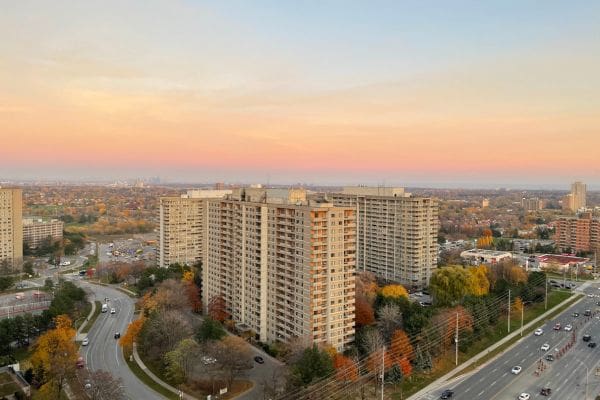
A golden twilight over Mississauga’s residential neighbourhoods. Lake Ontario and the Toronto skyline are in the distance.
Nestled on the scenic shores of Lake Ontario in Peel Region, Mississauga is a vibrant city next door to Toronto, a 24 km drive west of Toronto’s downtown core. What started long ago as a small farming community has grown into a bustling, successful city full of job opportunities. Today, it is famous for being one of the most welcoming, diverse, and friendly places in Canada to plant your roots and start a new chapter.
Jobs & Employment: What Living in Mississauga Offers
The modern office towers at the Sussex Centre reflect Mississauga’s commercial core and strong job market.
What are the top industries for jobs in Mississauga?
Mississauga has a strong economy because it is home to Canada’s busiest airport (Pearson International) and has direct access to the country’s main highways. This makes the city a top choice for major companies in manufacturing, technology, and design.
Top Industries Driving the Local Job Market:
Pharmaceuticals and Life Sciences
Information & Communication Technology (ICT)
Supply Chain, Transportation & Logistics
Food & Beverage Manufacturing
Banking, Finance, and Insurance
Major Fortune 500 employers with an active footprint in the city include Amazon, Google, Microsoft, Walmart, and Pepsi.
💡 Employment Trends: As of early 2026, Mississauga has a diverse job market. While corporate office jobs in technology have slowed down across the region, companies in shipping, manufacturing, and healthcare continue to show high demand for skilled newcomers.
Tips for Newcomers Seeking Jobs in Mississauga
Build a Canadian Network: Connect with local immigrant professional associations and bridge-to-employment programs run by Peel Region community centers.
Leverage Local Recruiting Firms: Agencies like Randstad Canada, Robert Half, Resolve Recruit Inc., and AppleOne Employment Services actively place talent in specialized corporate sectors.
Target Major Employment Zones: Focus your search on corporate business parks situated near the Airport Corridor, Meadowvale, and the Hurontario Highway strip.
The 2026 Cost of Living in Mississauga: Housing & Rent
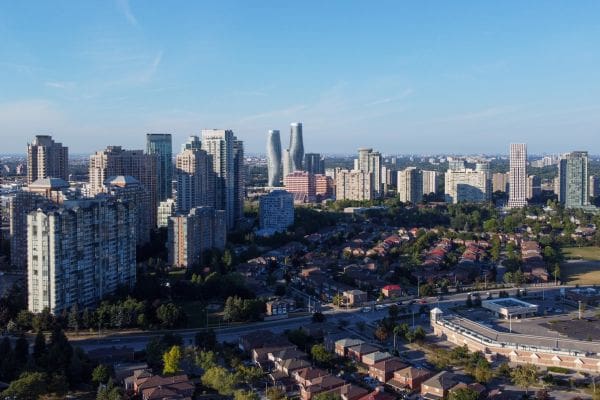
Mississauga’s diverse housing market offers established low-rise family neighbourhoods and a rapidly growing high-rise urban core.
Is Housing Expensive in Mississauga?
Yes, housing in Mississauga sits above the Canadian national average. However, it is a highly competitive, slightly more affordable alternative to downtown Toronto. Following an influx of new construction completions, the 2026 market offers renters more flexibility and choice than seen in previous years.
Mississauga Rent by Neighbourhood (July 2026)
Rental rates fluctuate by building type and lifestyle amenities. Renting a modern condo costs more, while older, purpose-built buildings provide greater value.
Here is a look at average rents according to our current 2026 tracking:
💡Ready to begin your housing search? Learn more about how to conduct your rental search as a newcomer.
Practical Tips for Renting in Mississauga
Understand Rent Control: In Ontario, buildings occupied for residential purposes before November 15, 2018, are subject to a strict provincial rent increase guideline (capped at 2.1% for 2026). Buildings built after 2018 have no rent caps.
Ask About Incentives: With the 2026 market balancing out, many landlords in the City Centre are offering one month of free rent or utility credits to secure stable tenants.
Secure Short-Term Housing First: It is much safer to look for a permanent, long-term rental in person once you can tour Mississauga’s unique neighbourhoods.
In 2026, buyers have the upper hand in the real estate market. Because there are plenty of homes to choose from, buyers don’t have to rush into a decision and can take their time finding the right place.
Here is how the Mississauga real estate market benchmarks by property type:
Property Type
Average Sold Price (As of June 2026)
Market Trend (Year-over-year)
Condo Apartment
$525,333
-8.9%
Condo Townhouse
$726,749
-5.1%
Freehold Townhouse
$883,038
-6.7%
Semi-Detached
$908,389
-8.4%
Detached Home
$1.482,130
+2.7%
(Data Source: Toronto Regional Real Estate Board/TRREB Local Market Analysis)
Tips for Newcomers Buying a Home in Mississauga
Connect with Local Experts: Find a licensed real estate agent to help you navigate Ontario’s purchasing laws and understand how to find, finance, and close on a home.
Get Pre-Approved: Secure mortgage pre-approval from your bank to show financial strength when placing offers.
Consider Budget-Friendly Neighbourhoods: Look into areas such as Cooksville, Malton, or Applewood. These pockets offer lower entry-level prices than luxury neighbourhoods like Lorne Park or Credit Mills.
Factor in Closing Costs: In Ontario, you are responsible for land transfer taxes, legal fees, and home inspection expenses upon purchase.
Community Support for Newcomers in Mississauga, ON
According to Statistics Canada, more than 53% of Mississauga’s residents were born outside of Canada. This diversity creates a uniquely global city.
South Asian residents make up about 25.4% of the population (over 180,000 people), and Chinese residents make up around 7.3% (~52,000 people). There are also growing Black, Arab, and Filipino communities. This means people living in Mississauga can easily find local support networks, cultural groups, and grocery stores that sell familiar foods from back home.
• LINC Classes with Childminding: Free English classes with on-site childcare. • Mental Health & Well-being: Culturally sensitive crisis counseling. • International Student Support: Helping students with housing and employment advice.
• Official Language Assessments: The official gateway to test your English before taking classes. • Corporate Bridging Programs: Helping internationally trained professionals get licensed in Canada. • Mentoring Networks: Connecting immigrants directly with Canadian employers.
Banking & Personal Finances in Mississauga, ON
Managing your personal finances is vital to living in Mississauga and building a stable life. To simplify your transition, major banks across the city offer newcomer packages, such as the Scotiabank StartRight™ Program.
Through the program, you can open a Canadian bank account online before you even leave your home country. Once you land, visit a local branch to activate your account, get a newcomer credit card (often without Canadian credit history), and access savings accounts or specialized mortgages. Meeting with a personal banking advisor early will help you budget during your initial settlement and plan for long-term goals such as buying a home.
Driving & Transit in Mississauga: Commuting While Living in Mississauga
Mississauga’s local transit network and bus routes connect residential neighbourhoods to the downtown core and regional transit hubs.
Public Transit
MiWay operates Mississauga’s local transit network. This bus network travels across the city, stopping near shops, schools, and neighbourhoods.
GO Transit operates regional transit on multiple rail paths (such as the Lakeshore West and Milton corridors). The GO Train travels to downtown Toronto’s Union Station in 30 to 45 minutes. Plus, the transit system is growing with the upcoming Hazel McCallion LRT on Hurontario Street and future connections directly to the Toronto subway grid.
Air Travel
Toronto Pearson International Airport (YYZ): Located inside the city borders of Mississauga, Pearson is Canada’s largest and busiest airport. It is 15 – 25 minutes north of Mississauga’s City Centre (Square One) with flights connecting residents to global destinations.
Driving & The 2026 Commuter Reality
Toll-Free Expressways: Mississauga connects directly to several major free highways, including Highways 401, 403, 410, and 427.
Toll Route Option: To avoid heavy traffic in the Greater Toronto Area, drivers can use Highway 407 (ETR), a fast, fully automated toll highway.
Driver Licensing: Newcomers must visit an authorized DriveTest centre or the ServiceOntario Bay Street location in Toronto to exchange an international or out-of-province driver’s licence for a valid Ontario driver’s licence.
Winter Readiness: Putting good winter tires on your car is highly recommended for Ontario weather. Because Mississauga sits right on Lake Ontario, the winter weather is humid and regularly brings heavy, wet snow, slush, and icy freezing rain. Read more in our guide, Winter Driving in Canada: 7 Essential Tips for Newcomers.
Healthcare & Medical Services
💡 Newcomer Tip: You should apply for provincial medical coverage immediately upon landing in Mississauga. To find out what documents you need, follow our guide for newcomers, How to Apply for an Ontario Health Card.
Provincial Health Insurance: The Ontario Health Insurance Plan (OHIP)
OHIP covers essential medical services for Mississauga residents. Permanent Residents moving directly from outside Canada are eligible for immediate coverage starting on the day of arrival, with no traditional three-month waiting period.
While essential care is free at the point of service, the public plan does not fully cover routine dental work, prescription eyeglasses, or ambulance transfers. Because of these gaps, many people choose to buy private extended health insurance or use employer benefit plans to help cover the extra costs.
Resident Category
Waiting Period
OHIPEligibility & Coverage Notes
Newcomers (International PRs)
No Waiting Period
Permanent Residents moving directly from outside Canada are eligible for immediate coverage starting on the day of arrival. You must apply for a health card as soon as you settle.
Moving from Another Province
Up to3 Months
Your “old” provincial plan covers you for the first 3 months in Ontario. OHIP coverage kicks in on the first day of the third month following your move (e.g., if you move July 10, coverage begins on October 1).
Work Permit Holders
No Waiting Period
Eligible for immediate coverage upon approval, provided you have a valid work permit and are working full-time for an Ontario employer for at least 6 months.
International Students
Generally Ineligible
Public OHIP does not automatically cover international students. Students must instead use the mandatory University Health Insurance Plan (UHIP) or equivalent private plans provided by their school.
Canadian Citizens/PRs(Returning)
No Waiting Period
Returning residents get immediate coverage upon approval. However, to keep your health card active, you must physically reside in Ontario for at least 153 days in any 12 months.
How to Find a Family Doctor When Living in Mississauga
Health Care Connect: Register for this provincial program to be placed on a priority list. A care coordinator will connect you with a local family doctor or nurse practitioner accepting new patients. You can register online at the Ontario.ca Find a Family Doctor page. You must have a valid Ontario health card number to register.
The College of Physicians and Surgeons of Ontario (CPSO): Use the “Find a Doctor” search tool on the CPSO website to filter local Mississauga doctors by language, neighbourhood, and active clinic status.
Health Connect Ontario (Dial 811): Call 811 to speak directly with a registered nurse for free, 24/7 non-emergency health advice.
Medical Emergency: For any immediate, life-threatening medical emergency, always dial 9-1-1.
Major Hospitals in Mississauga
Trillium Health Partners operates Mississauga’s hospital network:
Hospital
Primary Specialty
Key Focus for Newcomers
Mississauga Hospital(Central/South)
Stroke Care, Neurosurgery, & Regional Cardiac Center
Features one of the busiest 24/7 emergency departments in Canada and specialized critical care units.
Credit Valley Hospital(Northwest)
Regional Cancer Care, Genetics, & Maternal/Child Health
Equipped with a full 24/7 emergency department and highly rated labour, delivery, and pediatric units.
Queensway Health Centre(Etobicoke Border)
Day Surgery & Specialized Outpatient Care
Houses a major Urgent Care Centre for non-life-threatening illnesses and advanced rehabilitative services.
Schools & Learning: A Guide for Families & Students
Elementary & High School
The city has over 230 elementary and secondary schools across four boards:
Peel District School Board: Secular, English-language instruction.
Dufferin-Peel Catholic District School Board: Publicly funded Catholic instruction in English.
Conseil scolaire Viamonde: Secular, full French-language instruction.
Conseil scolaire de district catholique Centre-Sud: Catholic French-language instruction.
Specialized & Newcomer Support: French Immersion programs are widely accessible. High school students can enroll in specialized Advanced Placement (AP) or International Baccalaureate (IB) programs.
💡 Newcomer Tip: If your child is entering the Canadian system for the first time, you must register through the school board’s Welcome Centre. The centre will assess your child’s language skills to make sure they get the right English as an Additional Language (EAL) support from day one. Read more in our guide, Schooling in Canada | A Look at the Education System.
Post-Secondary Schools
University of Toronto Mississauga (UTM): A premier campus of the University of Toronto system, hosting over 15,000 students. It is highly regarded for its programs in innovation, management, biotechnology, and communication.
Sheridan College (Hazel McCallion Campus): Located in the heart of downtown Mississauga, this modern campus specializes in business education, architectural technology, and creative commercial programs that link with local corporate partners.
Pros and Cons of Living in Mississauga
The scenic Port Credit Harbour highlights Mississauga’s extensive waterfront paths, beautiful parks, and active lakeside lifestyle.
To help you weigh your options, here is a look at the major upsides and downsides of living in Mississauga.
Feature
Pros (The Benefits)
Cons (The Challenges)
Money & Jobs
Thriving Corporate Hub: Home to over 60 Fortune 500 headquarters, there are strong career paths in tech, finance, and pharmaceuticals.
High Daily Expenses: Living costs are high, and everyday items and services carry a premium price.
Housing
Built for Families: Neighbourhoods offer great schools and community centers, with stabilizing 2026 rent trends offering more options.
Expensive Property Market: Housing prices sit above the national average, making it hard to buy a home on a single income.
Lifestyle
Diverse Community: Over 53% of residents were born outside Canada, creating a rich, welcoming social fabric.
Heavy Traffic Gridlock: Peak rush-hour congestion is intense, and the sprawl makes a car highly necessary
Nature
Beautiful Waterfront Parks: Features over 3,100 hectares of green space, great biking trails, and stunning Lake Ontario beaches at spots like Jack Darling Memorial Park.
Unpredictable Winters: Winter weather brings icy road conditions, slush, and heavy snowfall to manage.
Culture and Day-to-Day Life in Mississauga, ON
Mississauga offers extensive green spaces and tree-lined neighbourhoods.
The Heart of the City
People in Mississauga take pride in their hometown and treat newcomers with genuine warmth. The city has a thriving arts scene, featuring premier cultural hubs like the Art Gallery of Mississauga. The state-of-the-art Living Arts Centre hosts diverse musical and theatrical performances year-round.
Nature and Natural Landscapes: Mississauga offers a beautiful, interconnected open space system with over 3,100 hectares of public parkland for those who enjoy an active outdoor lifestyle. Jack Darling Memorial Park is one of the city’s most popular lakefront destinations.
Celebration Square: Spanning the heart of the downtown core, this open-air civic square acts as the city’s social anchor. It features a sprawling lawn, a giant media screen, a summer wading pool, and a winter ice rink. This space offers a connection to community life through free outdoor movie nights and cultural festivals.
Local Sports and Entertainment: Local culture is heavily tied to sports and local entertainment. Mississauga is home to the Raptors 905 of the NBA G League, which plays in the Mississauga Sports and Entertainment Centre (formerly Paramount Fine Foods Centre). Catching a game offers newcomers an exciting and high-energy way to connect with local fans and get a taste of Canadian sports culture
Diverse Places of Worship: Reflecting its multicultural population, Mississauga features inclusive places of worship representing almost all global faiths. This includes historic Christian parishes, the majestic ISKCON Mississauga Temple, the Sayeda Khadija Mosque, and prominent regional Gurdwaras.
Newcomer Community & Cultural Events
Mississauga prides itself on delivering inclusive cultural programming and welcoming networks for everyone who settles here.
Multicultural Festivals: Mississauga hosts massive, city-wide celebrations like Carassauga — A Festival of Cultures every spring. As Ontario’s largest multicultural festival, it features pavilions throughout the city with traditional international food, music, live dance, and crafts from different countries. Newcomers can also explore popular celebrations like Muslimfest or the Bollywood Monster Mashup at Celebration Square.
Indigenous Connection: Newcomers can connect with the rich Indigenous history (Treaty Lands and Territory of the Mississaugas of the Credit First Nation) by visiting the Bradley Museum or attending traditional public Pow Wows and gatherings.
💡 Moving to Mississauga soon? Use our step-by-step checklist to track your arrival tasks and ensure a smooth landing.
Final Thoughts: Is Living in Mississauga Right for You?
A peaceful sunset over a Mississauga marina. The city is just a short distance from the busy streets of nearby Toronto.
If you want a safe, diverse city with great schools, plenty of jobs, and easy access to Toronto, Mississauga is an excellent choice. Even though housing costs more than in smaller cities or more rural Canadian markets, the great career options and newcomer support make it worth it for families and professionals.
MiWay transit provides reliable, affordable bus transit linking main neighbourhoods, schools, and transit hubs. However, Mississauga is a geographically large, sprawling city. Many residents living in Mississauga find that owning a vehicle is more convenient for grocery runs, family activities, and regional travel.
How do school boundaries work, and can my child attend any school in the city?
When living in Mississauga, your child must attend the specific school assigned to your residential address (known as your “catchment area”). You cannot choose a school outside of your catchment area. Newcomer families who want the best schools often check which school is assigned to a neighbourhood before renting or buying a home.
Is Mississauga safe for young families?
Yes, Mississauga is consistently rated as one of the safest large cities in Canada. With an overall Crime Severity Rate of just 56.36 (baseline score is fixed at 100), Mississauga and the surrounding regions sit well below the national average and most major Canadian metropolitan areas. Its residential neighbourhoods feature low crime rates, well-lit public parks, modern community recreation facilities, and exceptional school systems.
WRITTEN BY
Corinna Frattini
Senior Editor and Content Writer, Prepare for Canada
Corinna researches and writes content to help newcomers make informed decisions about housing, employment, banking, and aspects of settling in Canada. With a background in human resources and leadership development, her articles focus on how newcomers can continue their careers in Canada. Her writing combines research, practical guidance, and clear language to support newcomers on their journey.