Join the ScotiabankStartRight® Program designed for Newcomers‡ and get up to $2,300* in value in the first year.
How Can I Find Short-Term Rentals in Canada? A Newcomer’s Landing Guide
Written By
Corinna Frattini
•
Jul 21, 2026
•
Pre-Arrival
Finding short-term rentals in Canada for newcomers is a critical first step for Permanent Residents and international students. Booking temporary accommodation before you arrive gives you time to explore neighbourhoods, search for long-term lease options, complete settlement tasks, and settle in without pressure.
What You Need to Know
Find a short-term rental to give yourself time to explore long-term housing options and complete settlement tasks.
Use trusted platforms like Stay22, Airbnb, and VRBO; avoid classified ads to minimize the risk of rental scams.
Budget for nightly temporary housing costs ranging from $40 to over $250 CAD per night, depending on your needs.
Apply the “Commuter Strategy” to save 30% to 50% by choosing rentals outside city cores along major transit routes.
Watch for rental scam red flags, such as unrealistic low pricing or upfront demands for wire transfers.
Where Can I Find Short-Term Rentals in Canada?
Stick to trusted booking websites that protect your money, such as Stay22, Airbnb, Booking.com, VRBO, or newcomer services like Rentals for Newcomers. Avoid buy-and-sell sites like Kijiji or Craigslist, where anyone can post without verification.
Vetted hosts tailored for students and permanent residents.
Open Classifieds & Social Networks
Kijiji, Craigslist, Facebook Marketplace
High
Unregulated; high risk of lease wire scams and fake listings.
⚠️ Scam Alert: Classified sites like Kijiji and Craigslist are challenging to regulate. Never wire money, transfer cryptocurrency, or share sensitive banking info before verifying the physical unit and confirming the host can legally rent out their unit.
Why You Need Short-Term Rentals Before a Permanent Lease
Book temporary accommodation for your first 2 to 6 weeks in Canada. If you sign a 12-month lease before you arrive, you risk falling for a rental scam, renting an unseen place in bad condition, or getting stuck in a neighbourhood far from where you need to be.
📌 Immigration & Visa Tip: When applying for your Canadian visa or study permit, you need to show where you will live. A short-term booking confirmation from sites like Stay22, Airbnb, or Booking.com works as official proof of accommodation.
Key Settlement Tasks to Complete During Your Temporary Stay
Explore neighbourhoods: Check local transit, grocery stores, school districts, and safety before you commit to a 12-month lease.
Tour properties in person: View apartments, meet landlords face-to-face, and submit your rental applications.
How Much Do Short-Term Rentals Cost in Canada?
Temporary accommodation in Canada costs anywhere from $40 to over $250 CAD per night. To choose the right option, consider your family size, how much luggage you carry, and your budget.
Accommodation Type
Average Nightly Cost (CAD)
Best Suitable For
Primary Advantage
Furnished Apartments / Airbnbs
$120 – $250+
Families & Couples
Private kitchens and laundry; lowers dining costs by ~40%.
Low cost for initial 3–5 days while verifying longer leads.
What is the “Commuter Strategy” for Saving Money on Short-Term Rentals?
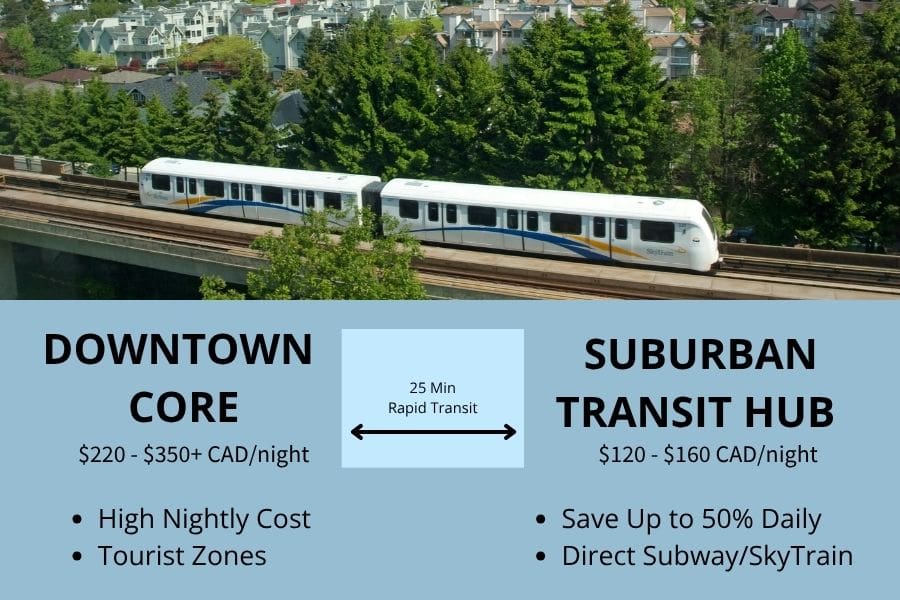
Staying near a suburban transit hub like a SkyTrain or subway line can cut your nightly short-term rental costs by up to 50%.
The Commuter Strategy reduces short-term housing costs by 30% to 50% by selecting rentals located 20 to 40 minutes outside downtown cores along rapid transit arteries.
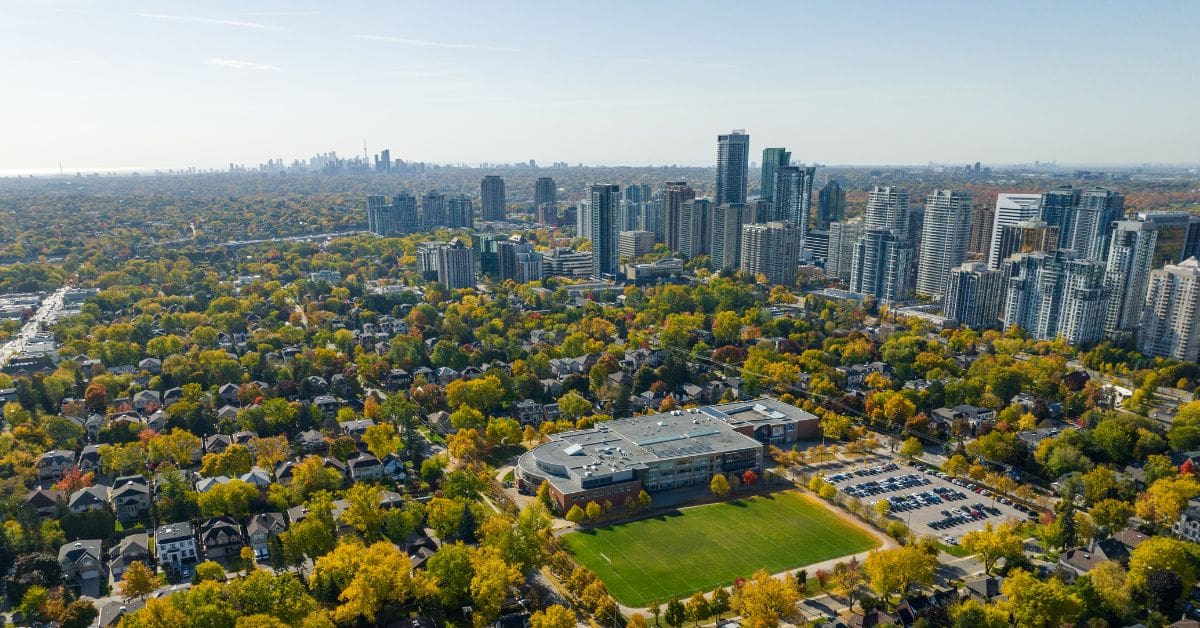
In high-demand markets like Toronto and Vancouver, downtown stays can cost $250/night, compared to suburban locations that average $120-$160/night.
Vancouver: The SkyTrain Strategy
Aerial sunset view of Surrey and Metro Vancouver high-rise condo clusters providing short-term housing and temporary accommodation near transit.
Surrey City Centre: A major newcomer hub with direct rapid transit links.
Coquitlam: A 40-minute SkyTrain ride that can save you thousands in rental costs over a two-week landing period.
If your long-term goal is to live in the city, explore our deep dive on Living in Vancouver to understand the housing and job markets.
Toronto: The Subway & GO Train Strategy
Focus on Toronto Transit Commission (TTC) subway and GO Train lines:
North York (Line 1): Focus on the Yonge & Finch corridor. It’s a massive newcomer hub with every service you need.
Etobicoke (South/West): Look for rentals near Mimico or Long Branch GO Stations. You can reach Union Station in 15 minutes.
Scarborough (Line 2): Stick to areas near Line 2 (Bloor-Danforth) or Agincourt GO to ensure a smooth commute. Scarborough offers some of the best value for families needing larger temporary spaces.
The “Deep Value” Option: Consider Hamilton or Oshawa. While the commute is 60 minutes via the GO Train, the savings during match weeks are significant enough to fund your first month’s permanent rent.
If your long-term goal is to settle in the city, check out our Living in Toronto guide to help you make an informed decision.
Calgary & Edmonton: C-Train & LRT Commute Routes
Focus on residential nodes near C-Train (Calgary) or LRT (Edmonton) lines to maintain access without paying downtown core rates.
How Long Can I Stay in a Short-Term Rental?
City bylaws regulate the length of short-term stays in Canada at under 28 to 30 consecutive days. For example, the rental period in Toronto is less than 28 consecutive days.
Understanding Key Rental Laws
Primary Residence Rules: In cities like Toronto, Vancouver, and Calgary, hosts offering stays under 28 consecutive days can legally operate within their primary residence.
The 30-Day Mid-Term Discount: Booking a stay for 28 to 30+ consecutive days shifts the listing to a “mid-term rental.” This exempts the booking from local hotel taxes and triggers platform discounts of 15% to 35%.
How Do I Choose the Right Location for Temporary Accommodation?
Select a short-term rental located near public transit or your prospective workplace to test commuting times and evaluate essential neighbourhood amenities.
Staying in or near a city’s central district provides immediate access to key settlement needs:
Schools & Childcare: Walkable access for registering children in local school districts.
Healthcare & Services: Proximity to walk-in clinics, Service Canada centers (for SIN registration), and major bank branches.
Employer Access: Easier commute options while attending job interviews.
If you know where you will be working, a rental near your work can help you judge commuting times and costs. A rental in or near a city’s downtown core allows you to look for your first long-term rental home and offers many benefits.
🧳 Ready to Secure Your Temporary Stay?
Skip the search stress. To find temporary options across major Canadian cities today, use our Arrival Stay Booking Portal↗️
Checklist: 5 Red Flags to Avoid Rental Scams
Newcomers and international students are often the primary targets of rental scams. Walk away immediately if you encounter any of these five warning signs:
Unrealistic Pricing: The rent is well below market average for the neighbourhood.
Wire Transfer Demands: The host asks for payment via wire transfer, e-Transfer before signing, or cryptocurrency.
Excessive Personal Data Requests: The poster demands sensitive credit card info or banking passwords prior to a formal application.
Unverifiable Property: The property address cannot be pinpointed on Google Maps or lacks official city registration numbers.
No Direct Communication: The host refuses to meet via video call or provides excuses for why they cannot show video proof of the unit.
Once your arrival stay is set, prepare for your permanent move. Join our free webinar, Renting Your First Home in Canada↗️, and discover how to secure the perfect home for you!
Frequently Asked Questions (FAQ)
Can paying for a short-term rental build my credit score in Canada?
Paying an Airbnb host does not build credit. However, using a Canadian credit card to pay for your booking or using third-party rent-reporting platforms for mid-term stays helps establish your initial Canadian credit history.
Is it legal for a host to operate a short-term rental in major Canadian cities?
In cities like Toronto, Vancouver, and Calgary, short-term rentals are legal if the property is the host’s principal residence and the host has registered with the city.
Can I negotiate rates on short-term rentals?
Yes. If you plan to stay for 3 to 4 weeks or longer, contact hosts on platforms like Airbnb or VRBO before booking to ask for a monthly or extended-stay discount.
Should I book my temporary stay before I get my visa?
This is a common dilemma. We recommend booking fully refundable accommodation on our map as soon as you have a target landing date. This secures your price while giving you the flexibility to cancel if your visa processing is delayed.
Is it safe to stay in the suburbs?
Absolutely. Suburbs like Burnaby or North York are safe, with access to amenities such as affordable grocery stores and settlement services. These locations are often more useful to a newcomer than being in a tourist-heavy downtown core.
WRITTEN BY
Corinna Frattini
Senior Editor and Content Writer, Prepare for Canada
Corinna researches and writes content to help newcomers make informed decisions about housing, employment, banking, and aspects of settling in Canada. With a background in human resources and leadership development, her articles focus on how newcomers can continue their careers in Canada. Her writing combines research, practical guidance, and clear language to support newcomers on their journey.