Join the ScotiabankStartRight® Program designed for Newcomers‡ and get up to $2,300* in value in the first year.
If you are looking for engineering jobs in Canada, you have come to the right place! The country needs more engineering professionals, and the job outlook is positive over the next few years. Engineers are in high demand in Canada due to its aging workforce, projected retirements, population growth, and the need to complete large-scale infrastructure projects in progress. Knowledge of the professional environment is vital if you want to continue your engineering career in Canada.
Engineering is a regulated profession in Canada and requires a license from one of Canada’s provincial or territorial engineering regulators. With a license from a regulating body, you can call yourself an engineer and use the title for your specific engineering career path.
Canadian employers place a high value on the professional engineer (P. Eng.) designation, which can open many career options. The regulating bodies have five requirements that engineers must meet including an engineering degree. Some jobs may require a master’s degree. However, if you are planning to immigrate to Canada and work as an engineer, there may be additional bridging steps to complete.
Working in Canada | How To Get Your First Job In Canada
Are you moving to Canada soon or already here? Do you need to find a job? Would you like to find good resources for finding employment in Canada? If so, join us for a free webinar where you can ask an expert your questions. We’ll discuss what you can do to make yourself more marketable to potential employers.
Canada offers a few immigration programs for internationally qualified engineers. These programs allow you to work in the country and gain permanent residency. The main programs are:
Unlike other professionals, you can start working in an engineering role as soon as you move to Canada. You will work under the supervision of a licensed engineer once you’ve started the licensing process.
How Can I Improve My Chances of Working as an Engineer Before Moving to Canada?
Newcomers looking for jobs in Canada often discover that they struggle to find work in their chosen field after they arrive. This is also true for engineers seeking recognition for their international qualifications and gaining Canadian work experience. However, there are steps that you can take before you move to Canada that can improve your chance to work and reduce the time it will take to get your engineering license:
Attend the free webinar How to Find Your First Job in Canada as a Newcomer to gain an overview of labour market conditions.
Contact the provincial regulatory body in the province or territory when you plan to settle in Canada to determine the:
Process to obtain a license and the steps to take before and after you move to Canada
Documents you will need to provide such as degrees, certificates, and diplomas. Ask if the documents require translation.
Specific education credential assessment that they require.
Gather and organize your official education, work, and identity documents while still in your home country.
Improve your language skills to meet licensing requirements. Enroll in language classes while in your home country and continue them after you move to Canada.
Understand how your profession is practiced in Canada and familiarize yourself with provincial laws and legislation that govern engineering in the province where you plan to settle.
Know the name of your job in Canada and make a list of potential employers.
What to Expect When Pursuing an Engineering Career in Canada
Canada employs engineers across many industries. Roles are available in a variety of engineering disciplines. You can find jobs for construction and infrastructure and other specialized engineering projects. And these projects fuel the demand for talent from different engineering disciplines. Other factors that contribute to the labour demand include Canada’s economic performance and tight labour supply. As a result, engineers from around the world will play a vital role to meet Canada’s labour needs.
Employment Outlook for Engineering Jobs in Canada
A report from Engineers Canada revealed that Canada will need to fill more than 100,000 engineer jobs by the end of 2025 as engineers retire and the economy grows. As the demand for engineers continues to be strong, immigration will be essential to fill positions. To meet the growing need, Canadian universities are granting more degrees to international students. As well, the federal government’s Express Entry system is an example of a program intended to meet Canadian labour market needs for skilled workers.
Requirements for Becoming an Engineer in Canada
How to Get an Engineer License in Canada?
You need to apply directly to the appropriate regulatory body to become licensed to work in Canada. To learn about the specific licensing requirements, you can contact the provincial engineering body where you plan to settle and work in Canada. While licensing requirements may vary by province, you must meet these five requirements:
Academic
Have obtained an engineering degree
Work experience
Have supervised work experience that shows your ability to apply engineering knowledge
Language
Have language competence in one of Canada’s two official languages
Character
Demonstrate truth, honesty, and trustworthiness
Professionalism & ethics
Have passed the Professional Practice Exam (PPE)
Five Engineering Licensing Requirements
The licensing process can be complex, but you can take advantage of free pre-arrival services that can help you navigate the process and help you to make valuable connections.
How to Become a Registered Engineer in Canada
Your process to becoming a registered engineer in Canada depends on your status. Are you a new graduate from an international school? Do you have foreign engineering work experience? Are you licensed in another country? Your current status will determine your next steps.
What is Required to Work as Engineer in Canada?
Before you can work as an engineer in Canada, the provincial regulator must evaluate your engineering background before they will issue a license to practice. And this can be a lengthy process. However, in some cases, you may be able to start the process before you arrive and connect with pre-arrival services to guide you. These vital steps can save you time, money, and effort.
You may receive a provisional license if you lack Canadian (or international) work experience. This is commonly given to newcomer engineers with three or more years of international experience.
New graduates or new immigrants without enough work experience can apply for the Engineer-in-Training (EIT) program. This allows you to accumulate enough hours to qualify for a full engineering license.
Credentials Recognition for Engineering Jobs
Credential recognition verifies that your international education and credentials meet the high engineering standards in Canada. The provincial regulator can provide information about the documents you require as well as the cost and amount of time it will take. It’s important to consider this information before you arrive in Canada so that you can decide if this is the path you want to follow.
You may be asked to submit some or all of the following:
Original diplomas, degrees, transcripts, and the official program syllabuses or course descriptions
Addresses of the schools where you obtained your engineering qualifications
Employment and character references.
The provincial regulator will review your university background, assess your academic qualifications, and may assign an exam program to ensure that you meet all academic requirements. The assigned exams will be based on your claim discipline or specialty of intended work. Exams are held once or twice a year, depending on the jurisdiction. You can get the exam schedule to help you decide the best time for you to depart for Canada.
If you are an engineering technician or technologist, you do not require a license but rather require a certificate. In this case, the regulator may ask for a Technologist/Technician Certificate.
Once you understand the licensure process and what the regulatory body requires, you can begin your application process.
Credentials Assessment Services
If you plan to attend college or university in Canada to upgrade your skills, contact the school where you plan to study to see if they require an education assessment from a specific agency. Using the correct agency will save you time and money.
To find more organizations that provide credential evaluation, assessment, and qualification recognition services, click here.
Pursuing an Engineering Career in Canada
Pursuing a career in engineering starts with education, registration, and then selecting a province to work in. Below is valuable information to help you pursue an engineering career in Canada:
Major Employers for Engineering Jobs in Canada
Professional engineers can work at construction companies, manufacturing companies, public power generation and utility companies, mining companies, various levels of government, and consulting firms. Engineers can also be self-employed.
Some of the largest engineering firms in Canada are:
Aecon Group Inc.
Bantrel Co.
Canadian Natural Resources (CNRL)
CIMA+
GHD Group
EllisDon
EXP
WSP Global Inc.
Golder Associates Inc.
Hatch Group
SNC-Lavalin
Stantec.
Companies are facing challenges in finding senior-level engineers. Though you might not get a senior-level job immediately, it’s good to start at a lower level and work your way up in the organization. BCCA-IN can also help you to connect with employers across Canada.
Skills Upgrading to Meet Engineering Job Requirements
To become licensed, you will have to complete an accredited program of study, supervised work experience, and a professional ethics exam. Skills upgrading courses and bridging programs can help you to obtain your license.
Employers in Canada expect engineers to have advanced math and science skills, strong communication and interpersonal skills, business writing and report writing skills, teamwork, critical thinking problem-solving, and project management skills. And while you likely possess strong technical skills, you may need training or skills upgrading to enhance your “soft skills”.
Soft skills can help you to get a job and successfully achieve your career goals. For example, in Canada, effective communication skills are essential and are as important as hard skills. And, if you are applying for a management position, soft skills are even more valuable than technical skills.
You may be eligible for Language Instruction for Newcomers to Canada (LINC) program. Otherwise, you can find free or affordable classes in English as a Second Language (ESL) or French as a Second Language (FSL) classes through school boards or settlement agencies. There are even language courses to teach you professional terminology, such as job-specific language training. And, if you already speak one of Canada’s two official languages at a high level, learning the other one is a good option, as it may offer you better job opportunities.
Bridging Programs for Engineering Jobs
Bridge training programs help eligible immigrants to continue their engineering careers when they arrive in Canada. The programs “bridge” international experience and training with the requirements to work in Canada. Many colleges, universities, and settlement agencies offer free bridging programs you may be eligible for.
Some programs offer general job search help while other programs offer engineering-specific language training, technical courses, and help to prepare to write the Professional Practice Exam. Some programs also provide the opportunity to gain Canadian work experience.
Explore some of the bridging programs to find one suitable for you.
Bridging programs help newcomers to continue their careers in Canada.
Engineering Schools in Canada by Province
There are over 100 post-secondary schools and 220 accredited programs offered across all engineering types. This includes civil, electrical, mechanical, chemical, computer, BioSource, environmental, mining, and many other engineering specializations.
Rank
School
#1
University of Toronto
#2
University of Waterloo
#3
University of British Columbia
#4
University of Alberta
#5
McGill University
#6
University of Montreal
#7
Concordia University
#8
University of Calgary
#9
University of Ontario Institute Technology
#10
University of Ottawa
Top 10 Engineering Schools in Canada
Engineering Associations in Canada
The associations listed below provide information about licensure and certification and offer professional development, education, and networking opportunities.
National Engineering Regulator
Engineers Canada: is the national organization that represents the 12 provincial and territorial engineering regulators in Canada. For over 80 years they have worked with provincial and territorial regulators to regulate and license engineering in Canada. Today, there are over 300,000 members of the engineering profession in the country.
Provincial and Territorial Regulators for Engineers in Canada
Each province and territory have a regulatory body to license engineers who meet professional standards, govern the practice, and integrate skilled immigrants. Regulators provide information about licensure and certification and offer professional training, education, and networking opportunities.
These societies play a key role in helping engineers learn about new theories, advanced techniques, and modern equipment through conferences, seminars, and publications:
Contribute to and enrich their respective communities
Provide opportunities for members to find meaningful employment and achieve their professional goals
These groups organize networking events, mentoring, information sessions, professional development opportunities, and connections to job opportunities.
Best Provinces to Work in Canada as an Engineer Based on Salary & Lifestyle
Engineering jobs in Canada are in demand and you can find work in any province. Where you choose to live will affect your earning potential. The average salary for an engineer in Canada is about $81,000 annually. This is over $41 per hour. The average salary for entry-level jobs starts at $60,000. Experienced engineers can make up to $125,000 per year.
Your starting salary may be higher or lower than the provincial average based on your skills, credentials, and experience. It’s important to research salary information to understand how much you can expect to earn and ensure you receive a fair market rate for your skills and experience.
In addition to a yearly salary, employers may also provide a benefits package. And these benefits contribute to your total annual compensation package, and a healthy engineer salary in Canada.
Common benefits may include:
Dental insurance
Supplemental medical insurance
Short-term and long-term disability insurance
Pension plan for your retirement
Bonus pay
Stock options
And other incentives.
Province
Average Salary
Alberta
$87,450
British Columbia
$80,421
Manitoba
$72,397
New Brunswick
$58,320
Nova Scotia
$61,532
Ontario
$90,702
Prince Edward Island
$47,500
Quebec
$70,903
Northwest Territories
$116,069
Nunavut
$114,182
Yukon
$72,579
Average Annual Engineering Salary by Province, 2022
Tips for Choosing a City When Looking for Engineering Jobs in Canada
When looking for jobs, broaden your search beyond Toronto and Vancouver, Canada’s gateway cities. While these cities may have a high number of jobs, they are also costly cities to live in. Consider if you prefer to live in a large, fast-paced city, or a small city. Many small and mid-sized cities in Canada want to attract newcomers to help grow their cities and economy. In addition, small cities can provide an employment advantage because the job market may be less competitive.
Housing in smaller cities also tends to be more affordable than in Canada’s largest cities. With lower housing costs, you can likely rent or buy a larger home for a more affordable cost. Finding a job in a city that offers affordable housing can greatly influence your economic success in Canada.
The point is, be sure to research where the greatest demand is for your engineering type and research cities to ensure they meet the needs of you and your family.
Best Locationsfor Engineering Jobs in Canada Based on Engineering Type
Career opportunities in Canada vary according to your engineering type, the industries you wish to work, and the province where you plan to settle. For example, electrical engineers can find plenty of jobs in Quebec and Ontario where there is a high volume of manufacturing activity. Chemical engineers are most in demand in Western Canada where energy production is concentrated. Given technology and innovation changes, software and computer engineers are in high demand in almost all geographic regions.
The point is that demand can vary. So, it’s important to understand the labour market. Ideally, you want to identify where Canada needs your specific engineering type.
Engineering Type
National Job Market Outlook Source: Job Bank Canada
Research job prospects in provinces and local regions for your specific engineering type before you move to Canada.
How to Find Your First Canadian Engineering Job
Looking for an engineering job in Canada may be different than in your home country. Settlement agencies can help you with your search.
Getting your engineering degree and getting your registration requirements are the first steps to starting an engineering career. The next step is to look for an engineering job in Canada. However, looking for an engineering job in Canada may be different than in your home country. The Canadian job market can be competitive. Use these tips to help you with your job search:
Engineering Job Search Techniques
It’s important to research jobs by province and local region and develop a plan to find work.
There are many ways to search for jobs including:
Broadening your search and including alternative careers
Seeking a mentor who could give you insights into Canada’s construction industry and introduce you to their network
Joining job-finding or networking clubs through settlement agencies
Attending job fairs and regularly checking online job boards.
You do not need a license to work in the many different professions within the field of engineering or applied science and technology. While you are obtaining your license, you may want to register as an engineer-in-training to receive guidance from the provincial regulatory body.
Settlement Agencies
Finding a job in Canada may be different than in your home country and you may need help with your job search. Most settlement agencies offer free services to help you:
Find job vacancies
Update your resume
Write cover letters
Prepare for interviews, and
Understand what Canadian employers are looking for.
These services can help you avoid the stress and anxiety of conducting your engineering job search in Canada. Find out more about the free services that settlement agencies offer to newcomers here.
Informational Interviews for Engineering Careers
An informational interview is a brief (20–30-minute) meeting that you schedule with someone who is currently working in the profession.
You should not try to get a job during an informational interview but rather learn more about the engineering profession in Canada. For example, you may want to learn more about trends, regulatory changes, or technology changes that are affecting the field.
An informational interview with a contact from your network can be a great source of engineer career information. In addition to getting information about the industry, you can benefit from their first-hand experiences working in the field in Canada.
Networking for Engineering Jobs
Networking is vital to help you find job leads, gain professional advice, and expand your network. In Canada, many job vacancies are not advertised. Also known as the “hidden” job market, you can discover these jobs through networking. So, it’s helpful to connect and build relationships with others in your field who can help you discover these jobs. Good places to network include conferences, associations, and other settings.
LinkedIn is another vital tool for networking. Using LinkedIn, you can connect with former colleagues and employers, search for jobs, and get introductions to others. You can also join some relevant groups to learn more about engineering in Canada.
But remember, that you must allow time to cultivate and grow the ties you establish through networking. Nothing will happen overnight, and you need to be patient.
Interview Techniques for Engineering Jobs
Engineers work in many fields, including aeronautics, biomedicine, manufacturing, chemicals, computers, and more. So how you prepare for your engineering job interview will depend on your engineer type.
Create a Portfolio
One way you can separate yourself from other job seekers is to create a work portfolio that you can take to interviews. Or you can even share a link to your online portfolio with the interviewer ahead of time. This way, they can review your portfolio and you can discuss it during the interview.
Practice Interview Questions
Before your interview, you can prepare and practice responses to common interview questions. And, while it’s difficult to predict every interview question, here are some common questions that you can prepare to answer:
Describe a major project you worked on in your most recent position and what you did to ensure the project’s success.
What do you enjoy most/least about engineering?
Describe how you stay current on industry trends and developments. Respond by discussing professional associations you belong to, trade publications you read, or recent education you completed.
Describe when you confronted a problem that tested your engineering know-how.
Ask the Interviewer Questions
You’ll have an opportunity to ask questions at the end of the interview. Use this chance to show your genuine interest in the engineering job and the company. Prepare two or three questions to help you assess if this is your desired job, and company to work for. It will be helpful if you are current on recent research and information about your prospective employer when posing your questions. Here are some questions to consider:
What new products or initiatives are on the horizon?
How do you help your staff grow professionally?
How would you describe the culture of the organization?
Social worker jobs remain a good career choice in Canada. Social workers play an important role in assisting people in many different settings, such as schools, hospitals, health clinics, and government-run social programs. If you have international experience working as a social worker, you’ll need to meet certain qualifications to work in Canada. These qualifications can help you improve your standing, get a better job, and even find a higher social worker salary. If you’d like to continue your social work career in Canada, find out more about requirements, licensing, job search techniques, and even the salary of a social worker in Canada.
There are specific job requirements and qualifications that you must have to work in the field of social work in Canada. And to find a job, it’s vital to know the employment and social work job requirements in Canada. Learn how to prepare for a social worker job in Canada by reading this helpful overview.
How to Immigrate to Canada as a Social Worker
It’s essential to research the social work profession before you come to Canada. Requirements to be a social worker may be different than in your home country. There are different skills, qualifications, and expectations. Fortunately, there are steps that you can take before you immigrate to improve your chances of continuing your social work career in Canada.
Before You Move to Canada to Pursue a Social Worker Career
To achieve social worker career success, it’s important to understand the skills that the Canadian labour market requires. And you need to know if your international qualifications will meet the social work job requirements. To learn what you require to work as a social worker in Canada, you can take these preliminary steps:
Contact the provincial association that regulates social workers in the province where you plan to settle in Canada.
Learn what licensing procedures to complete before and after you move to Canada.
Find out what documents you need to bring to Canada and verify if they need to be translated. You might need to use a professional translation service in Canada.
Gather your education, work, and identity documents when in your home country.
Learn about social worker salary scale, compensation, and benefits options.
Improve your language skills and enroll in language classes in your home country and continue them after you move to Canada. You’ll need to prove your English or French (depending on your destination province) language competency or be tested.
Learn about social work job requirements and become familiar with provincial laws and legislation.
Know the name of your job in Canada and make a list of potential employers.
What to Expect When Pursuing a Social Worker Career in Canada
Social work is a regulated profession in all provinces in Canada. And, only those who meet the standards set by the provincial regulatory bodies can use the titles of “Social Worker” and “Registered Social Worker.” These bodies issue licenses or certificates to individuals who meet their registration requirements.
The Canadian Association of Social Workers (CASW) is the national organization that represents social workers from across Canada. You need to apply directly to the appropriate provincial regulatory authority to become licensed as a social worker or registered social worker in Canada.
Before You Move to Canada to Pursue a Social Worker Career
Understanding the current status of social work jobs and career opportunities is an important thing to understand before moving. Labour market conditions change over time.
As of 2021, there are about 68,000 people working in this field. According to the Government of Canada’s Job Bank, the supply and demand for social work jobs are balanced currently, and this trend is expected to continue until 2031. This means there could be much competition for jobs. As an international applicant, you’ll need to have strong qualifications and experience.
Start Your Research with the NOC Code for Social Worker Jobs in Canada
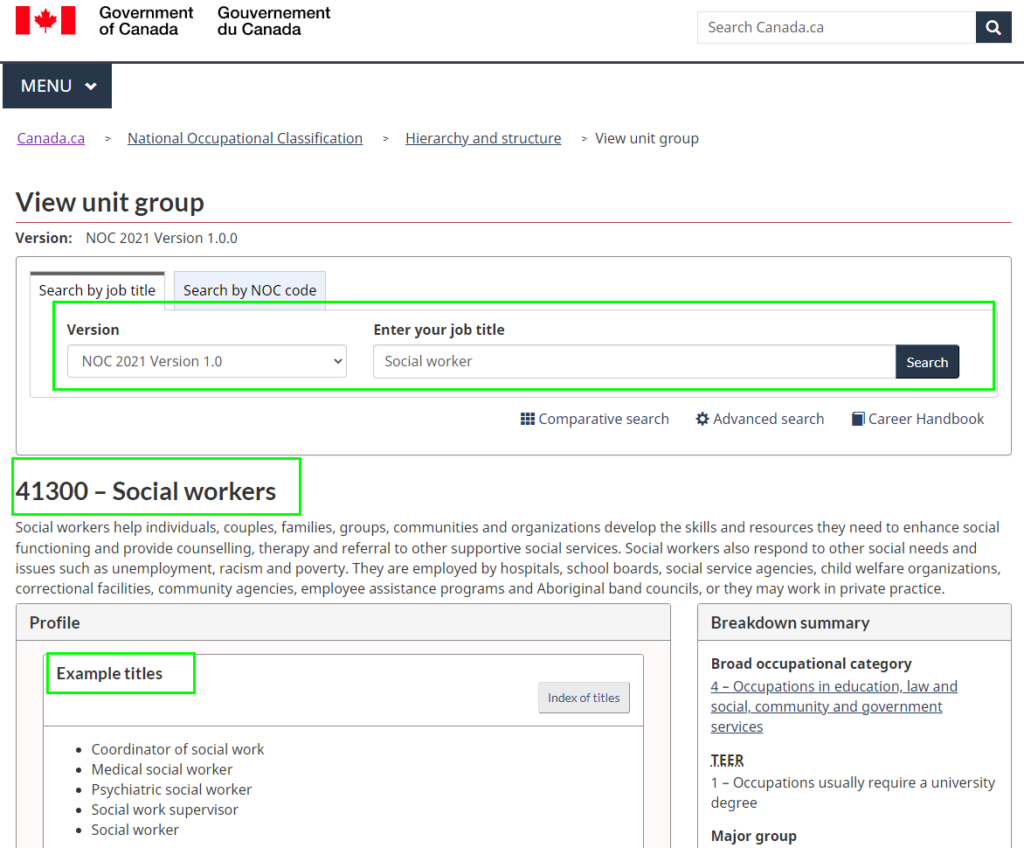
The National Occupational Classification (NOC) is Canada’s reference to occupations. You can use this tool to find social worker (NOC 41300) job requirements and labour market information. It’s a helpful place to start researching the social work occupation in Canada.
Social workers may have job titles such as:
Coordinator of social work
Medical social worker
Psychiatric social worker
Social work supervisor or
Clinical social worker.
Refer to NOC 41300 to gather more information about job requirements.
Social workers in Canada, including those internationally trained must meet certain academic and professional standards. You’ll need to meet the education, work experience, and certification needs of the job based on provincial standards. Below are the steps to follow to work as a social worker in Canada:
Credential Recognition to Meet Social Worker Job Requirements in Canada
One of the first things to do is to learn the employment and job requirements to work as a social worker in Canada. This will help you to understand if you meet the job requirements, or if you must take steps to meet the requirements. This could include getting recognition for your credentials.
To find out what you need, you can contact the regulatory body in the province or territory where you intend to settle in Canada. They will advise you on what documents and assessments you require. You may have to submit:
Original diplomas, degrees, or full transcripts recording your course and marks, and the official program syllabi or course descriptions
Names and addresses of the schools you attended and obtained your social work qualifications
Employment and character references
Work descriptions and letters from professional agencies.
All documents must have certified English or French translation (depending on the province).
Contact the professional association in the province or territory you will settle in before you move to get more information about the schedule of exams and consider that when deciding the actual date of your departure to Canada.
Knowing the licensure procedure and what the regulatory body expects from you is vital. So be sure to take time to complete the application process properly. The Canadian Association of Social Workers (CASW) assesses your credentials. Learn more about the CASW application procedure The CASW assessment is accepted in all Canadian provinces, except for British Columbia and Quebec. These two provinces have their own assessment process.
Credential Assessment Services
If you plan to enroll in a college or university program to upgrade your skills, you may need an education evaluation. You can contact the school you plan to attend to find out what credential assessment agency you should use and the steps to follow.
Make sure to showcase your international education and skills. As well, build on your existing knowledge and skills and explore university and college options thoroughly before deciding. You might be able to have advanced standing, transfer some of your credits, and benefit from prior learning assessment options by using your international credentials and experience to gain credit or course exemptions. This way, you will complete your program more quickly, without wasting money and repeating the education you already have.
Upgrading Your Skills to Meet Social Worker Job Requirements
In addition to accreditation, you may have to upgrade your skills to meet social work job requirements and get a job. So, you may have to:
Take courses
Enroll in a bridging program, or
Upgrade your language skills to become a certified social worker.
Canadian employers expect social workers to have strong professional ethics, computer skills, and the ability to work in difficult situations. And equally important are your soft skills, such as empathy, understanding, and communication skills. These skills can also help you increase your social worker’s salary.
Language Training for Social Workers in Canada
Having strong skills in one or both of Canada’s official languages – English or French –is extremely important for your future in Canada. Whether you choose to focus on learning or improving English or French will depend on which of the two languages most people speak in the area where you live.
You may be eligible for the Language Instruction for Newcomers to Canada (LINC) program. As well, many settlement agencies offer free English as a Second Language (ESL) or French as a Second Language (FSL) classes.
There are even language courses to teach you professional terminologies, such as job-specific language training and Occupation Specific Language Training (OSLT) in Ontario. And, if you already speak one of Canada’s two official languages at a high level, learning the other one is a good idea. And, it may offer you more employment options.
Bridging Programs for Social Worker Careers in Canada
Bridging programs are a good way to transition from your international experience and training to the Canadian workplace. Though there are not many bridging programs for internationally trained social workers, many colleges, universities, and immigrant-serving agencies offer courses or workshops related to the social work sector. You may be eligible for one. Do some research to find a program that’s suitable for you based on your social worker career aspirations.
This program helps internationally educated social work professionals to work in their field in Ontario. Program participants can access training, workplace experience, employment support, and an occupation-specific communications course. In addition, this program will develop a peer support program for the effective workplace integration of participants.
Most Canadian colleges and universities offer a social work program. These programs are offered at the undergraduate and graduate levels with many areas of specialization. Some of the top schools for social work education in Canada are:
University of Windsor
Carleton University
Toronto Metropolitan University (TMU)
University of Regina
Western University
University of Manitoba
Dalhousie University
McMaster University
Simon Fraser University.
Learn more about program offerings by visiting university websites.
Social Work Associations in Canada
Each Canadian province has its own regulatory body to license social workers. Each body governs the social work profession and ensures members meet professional standards. The associations listed below can provide information about licensure and certification and offer professional development, education, and networking opportunities.
Professional immigrant networks(PINS) are volunteer-run member-based associations or networks created by and for immigrant professionals. PINS exists to:
create a forum to contribute to and enrich their respective communities
provide opportunities for members to find employment and achieve their professional goals.
PINs organize networking events, mentoring, and job information sessions. As well, they provide professional development workshops, training, and connections to job opportunities.
While PINS may not exclusively serve the social work sector, they may have social workers among their membership:
Social worker salaries can range between $22 and $59 per hour. A full-time job working 40 hours per week could earn a social worker salary between $45,760 and $122,720 per year. The average hourly wage for a social worker in Canada is $36 per hour ($74,880 per year).
The region with the highest average hourly rate is Northwest Territories and the province with the lowest hourly wage is New Brunswick. Where you choose to live will play a big role in your social worker’s salary.
Social Worker Salary in Canada
The salary of a social worker in Canada can vary based on your level of experience, skills, and knowledge. Using the information from the Canada Job Bank, you can research how much you can expect to earn in different cities and provinces across Canada. For your reference, here are the most recent social worker salary numbers in Canada (as of November 2022):
Best Provinces to Work in Canada Based on Social Worker Salary & Lifestyle
There are thousands of social organizations across Canada that employ social workers. However, it’s best to research the labour market to determine what provinces and cities have the greatest demand for social workers. You’ll have better success finding a job in the cities with a high demand for your skills and experience.
According to the Canadian Occupation Projections Systems, job prospects are good in many provinces including New Brunswick, Nova Scotia, Ontario, Prince Edward Island (PEI), Quebec, Yukon Territory, and Nunavut.
Pursuing Social Worker Careers in Canada
Becoming a social worker in Canada follows a similar path as many other professions. You need the right academic credentials, relevant work experience, and a plan for where you want to work within the country. Below is valuable information to help you pursue a social worker in Canada:
Major Employers for Social Worker Jobs in Canada
Social workers can find employment in many organizations in Canada. Here’s a general list of places where social workers can work:
Family service agencies
Social housing agencies
Hospitals
School boards
Welfare administration agencies
Child welfare agencies
Community health centres
Employee assistance programs
Addiction services and government departments
Private practice.
You can view a directory of Canadian organizations and job postings in the social sector by visiting Charity Village. The directory contains information about the non-profit sector in Canada. You can also learn about the companies that hire recent immigrants by visiting Canada’s Best Diversity Employers website. These employers offer programs to help newcomers transition to a new workplace and a new life in Canada.
Job Search Techniques for Social Workers in Canada
Searching for a job in Canada may be different than how you would find a job in your home country. The Canadian job market is competitive, and it can be hard to find a job. And, it can take some time to find full-time work as a social worker, so you need to understand how to find a job and prepare for your job search.
Settlement agencies can help you with your job search. For example, they can help you broaden your search, identify other career options, or even other locations to consider. As well, they can suggest job-finding or networking groups in the social work field that you could join. Other job search techniques include:
Attending career/job fairs, info sessions, and conferences related to the social sector
Volunteering with social agencies and centres in your community
Seeking a mentor in the social work sector who could give you insight and advice about working in Canada.
Use Immigrant Settlement Agencies to Find Social Worker Jobs
Most settlement agencies can help you to:
Find job vacancies
Update your resume and cover letter
Prepare for interviews, and
Understand social work job requirements in Canada and what Canadian employers look for.
Informational Interviews to Gain Understanding of Job Requirements in Canada
An informational interview is a brief (20–30 minute) meeting with someone in your field. The purpose of the meeting is to learn more about working in the field in Canada. You can also use this interview to learn about social work job requirements.
You should not try to get a job during an informational interview. Instead, you want to explore whether a particular position or employer might be a good fit for your interests, skills, and knowledge. An informational interview with a contact from your network can be a helpful source of career information.
Networking for Social Worker Careers
Networking is an essential tool that may give you job leads, and offer you advice and information about a particular company or industry that can strengthen your resume, cover letter, and interview skills. As many job vacancies are not advertised, you must connect with social workers and others within your field.
Good places to network include conferences, associations, and social mixers to meet people, build relationships, and share information.
LinkedIn is another important professional tool for networking. It is great to connect with former colleagues and employers, searching by company or job, and getting introductions and recommendations.
Note that it’s not appropriate to ask a networking contact for a job, but if they know of any job leads, they may share them.
Remember, it takes time to cultivate and grow the ties you establish through networking. Nothing will happen overnight, and you need to be patient.
Writing your Social Work Resume
A degree in social work can lead to finding a job as a counsellor, admissions adviser, case manager, and management and director positions. Here are some helpful resume-writing tips:
Write a Functional Resume
To get an interview for any social work position, you need to tailor your resume to the specific position you want. A functional resume works best for social workers. If you have experience working with at-risk children and adults with substance abuse problems, you can group your skills and experience to show the group that you worked with rather than your chronological work history.
Include a Statement of Objective
When writing your resume for a social work position, include your statement of objective at the top. This will help frame your social worker career goals.
Align Your Resume with Agency Needs
Good social work resumes focus on your desire to serve society. So, your resume should align with the agency’s mission and its needs. Clearly state how your experience aligns with the agency you are applying to. Blending your personal experience and education with the needs of the agency or hiring manager is key to getting your resume noticed.
Quantify Your Achievements
Don’t be afraid to use numbers. If you worked with a 25-client caseload, tell a potential employer that, or list your success rate in preventing drug use in your adolescent clients. If you have served in director or management positions, state the budget you managed. Adding numbers can clearly show your work experience and give a potential employer insight into your skills and capabilities.
Highlight Your Education
The social work field requires continuous professional development. List your education and any bridging programs and continuing education courses you have taken. Potential employers want to see that you meet the educational requirements to be a licensed social worker and you are improving your skills.
Interview Techniques to Ensure You Meet Job Requirements
A job interview will include behavioural questions to ensure you meet social work job requirements. and experience or qualifications questions. These questions assess your experience and qualifications for the social work position.
Here are some sample interview questions that you might be asked for a social work position:
What are your experiences/qualifications for this position – working with people with social needs?
Why did you choose this career? What motivates you about social work?
Describe an unexpected or stressful situation you’ve experienced in your previous job as a social worker. How did you handle the situation?
Describe a time when you had a heavy workload. How did you prioritize your work?
Describe a social problem and how you collect information to establish a problem-solving model.
With a good outlook for social worker jobs in Canada, now is the time to check out your options.
There are many benefits to living in a small city. Smaller cities in Canada can provide advantages such as:
Better quality of life
Lower cost of living and affordable housing costs
Fewer people compete for jobs.
Discover the advantages and benefits of choosing to live in a small city in Canada and important questions to guide your decision!
Vikram and Nutan had great lives as budding professionals in India’s IT capital Bangalore. But, after a close friend immigrated to Canada, they decided to explore moving to Canada. They soon discovered they met the requirements to immigrate to Canada! However, they were unsure about where they wanted to live. Canada is a vast country.
Both agreed, on factors that were important to them. For example, they wanted to live in a small city that offered job opportunities, affordable housing options, and a nice quality of life. The Atlantic Provinces were a big draw and they settled on Fredericton, New Brunswick for its beauty, charm, and sense of community. Two years later, they had jobs, a 5-bedroom home, and the lifestyle they wanted. But, most importantly, they became members of a welcoming community.
Why is Small City Living a Good Choice for Newcomers?
Small cities across Canada attract newcomers by providing quality job opportunities, and a better quality of life. Living in a small City can offer newcomers an option to avoid congestion issues, high housing costs, and hectic pace.
Discover how innovation drives the economy in Fredericton, New Brunswick.
Quality Jobs
While large cities attract newcomers, you may find high competition for jobs. But, smaller Cities often experience job growth when existing residents leave the community, or retire. So, many small cities look to newcomers with the right job skills to meet their employment needs.
Charming Fredericton, New Brunswick.
Quality of Life
A small city can be much quieter and laid back than life in a large city. This can benefit newcomers looking to integrate into the community more easily. Living in a small city may help you to easily immerse yourself in the local community. But, you must decide if you prefer to live in a large and bustling city or a more relaxed, small city.
Support for Newcomers
In Canada, smaller cities recognize the many benefits of welcoming newcomers. To attract and keep newcomers, they continue to build communities that welcome, embrace, and support newcomers.
Newcomers often move to large Canadian cities such as Toronto and Vancouver because of the social, economic, and community networks. With these networks in place, newcomers may find better access to jobs, cultural and social communities, and support services. However, newcomers often find these same services and jobs in small cities!
Traffic congestion on a Toronto roadway.
Population Growth in Large Cities
Population and migration growth in large cities often puts pressure on areas such as:
Competition for quality jobs
House prices and rental costs
Social services and education
Transit and traffic congestion (which means more time to commute to work).
As a result, large cities often have a higher cost of living and can create financial stress. As a newcomer, you must decide what you prefer, living in a large or small city. You may discover that a small City can provide the lifestyle and many of the amenities you seek.
Considering Living in a Small City in Canada?
When choosing a city, it’s vital to research job opportunities, housing costs, and the culture of the city to determine if it’s the right city for you.
1. Will I find a job living in a small city?
This is a very important question. If few jobs match your skill set, you will leave the community if you and your spouse cannot find suitable jobs. While you may initially settle in the community, you will likely make a costly secondary move to another city.
Questions to Consider:
What jobs are in high demand?
Do my skills and experience match the available jobs?
What are the main industries in the community?
Who are the major employers?
What employment services exist for newcomers?
Are mentorship programs available for newcomers?
What is the unemployment rate in the community?
2. What is the cost of housing in a small city?
While many cities in Canada face rising housing costs, small cities can offer more affordable options. As of July 2024, the national average price for a home in Canada was $667,317. The median home price in Fredericton, New Brunswick during the same period was $404,534.
Questions to Consider:
What is the cost for rental housing and homebuying? How does cost compare to other Canadian cities?
Renting your first home in Canada | Options & solutions for newcomers
Searching for your first home in Canada? Join this exclusive session for key insights on housing market conditions, affordable options, and renting without credit history. Tailored for newcomers settling in the next six months, register now for valuable tips and a free guide!
3. What cultural support does the community offer to newcomers?
Immigrants often consider the existing cultural and social network when deciding where to live. This can include services in different languages, faith-based, and nationality-based communities.
Small cities recognize the economic, cultural, and social benefits of welcoming newcomers. Supporting newcomers creates benefits for the community and attractive options for future residents.
Questions to Consider:
What groups, ethnic networks, and professional associations support newcomers?
What activities promote cultural diversity?
Are there groups, ethnic networks, and professional associations for newcomers?
What is the ethnic diversity of the community?
What’s the quality of life? (fast-paced or relaxed? Access to nature, bike trails, etc?)
4. What social support is available to newcomers living in a small city?
Newcomers benefit from services available to help them settle and find jobs in the local community. Services could include help to conduct job search activities, write a Canadian resume, enroll children in school, apply for government programs; and many other activities.
Questions to Consider:
What services are available to help newcomers adapt to the community?
Small city living can be a great option for newcomers seeking a relaxing pace and an option to bustling, hectic, and expensive Canadian cities. With many advantages, it’s worth exploring!
For many across Canada, the spring/summer season means one thing – the NHL Stanley Cup playoffs are here!
And Canada’s Edmonton Oilers are in the finals. They fought back from a 3-0 deficit against the Florida Panthers to make it a 3-2 best-of-seven series.
They can even the series with a win in Game 6 tonight in Edmonton.
For newcomers to Canada and international students, the Stanley Cup playoffs between 16 National Hockey League (NHL) teams provide an insight into the sport of ice hockey and perhaps Canada’s national culture and identity.
On Saturday, June 8, Canada’s Edmonton Oilers and the Florida Panthers began their 7-game Stanley Cup final series to decide the 2023-24 season champion.
Canada looks to bring the Cup home
The Oilers, led by Connor McDavid – currently the best player in the world – entered this series as the underdogs. They will be the first Canadian team to win the Cup since the Montreal Canadiens in 1993 if they beat Florida.
Meanwhile, Professional Women’s Hockey teams, including Toronto and Montreal, competed for the Walter Cup for the first time. Minnesota won the Cup on May 29, defeating Boston in five games.
So, what’s behind all this hockey fever, and why should newcomers care?
Lloyd L. Wong and Martine Dennie are the authors of a 2021 report entitled “I feel more Canadian with hockey.” Identity and Belonging via Ice Hockey in a Diverse Canada.
In their paper, published in Canadian Ethnic Studies, Wong and Dennie argue that their “findings show that for most immigrants and racialized minorities engaged in organized ice hockey, there is more likely a sense of Canadian national identity and a sense of belonging to Canada compared to the Canadian-born and to whites.”
They also state that the game and sport of ice hockey are embedded in Canada’s national culture and identity mythically and literally and that hockey has its most significant presence in Canada regarding people, places, and social spaces.
Hockey’s Popularity is Far-reaching
According to their report, about 1.8 million people globally are registered hockey players, of which over one-third, or 631,295, live in Canada.
Per capita, the number of registered hockey players in Canada is well above all other countries by a wide margin, with 17,277 registered hockey players per one million people.
Further, hockey’s popularity in Canada extends beyond players and referees to include coaches, managers, workers in the hockey industry, parents, and fans.
Here are Some Facts from their Report:
There are about 5,000 outdoor rinks and 3,300 indoor hockey arenas in Canada,
The only other country with more than one thousand indoor arenas is the United States, which has about 1,535.
There are 555,935 hockey players in the United States, 113,425 in the Czech Republic, 105,059 in Russia, 76,387 in Finland, and 63,901 in Sweden, rounding up the top six ranked hockey-playing countries.
As Wong and Dennie point out, Canada “is also an ‘immigration society’ where immigrants are considered as society-building assets and as central to national identity,” just like hockey.
Stanley Cup Playoffs Facts for Newcomers
So, here are some Stanley Cup facts for newcomers and international students who want to find out what all the fuss is about:
The Stanley Cup is named after Frederick Stanley, the 16th Earl of Derby, who was Governor General of Canada from 1888 to 1893.
Lord Stanley’s family were ice hockey fans. He donated the trophy in his name in 1892 as a challenge cup for Canada’s best amateur hockey clubs. Starting in 1909, only professional teams competed for the Cup. Since 1926, only teams of the National Hockey League (NHL) have competed for it.
NHL teams play a gruelling 82-game regular season to determine who will compete for the Stanley Cup.
Every year, 16 of the 32 teams in the NHL qualify for the Stanley Cup playoffs.
The Stanley Cup playoffs started Saturday, April 20, and will end no later than June 24.
CBC, Sportsnet, and OMNI broadcast Stanley Cup playoff games in Canada.
Stanley Cup Broadcast in Punjabi
Hockey Night in Canada: Punjabi Edition also broadcasts playoff games every Saturday on OMNI Television. The broadcast crew comprises Randip Janda, Gurp Sian, Harpreet Pandher, Taqdeer Thindal, Amrit Gill, and Mantar Bhandal.
Leaf Singh, a comedian and hockey insider, regularly posts about hockey and the playoffs on X (formerly Twitter).
The eventual winner of the Stanley Cup will have played and won four rounds (each round is a best-of-seven series).
Four Canadian teams qualified for the Stanley Cup playoffs this spring. They are the Toronto Maple Leafs, the Winnipeg Jets, the Edmonton Oilers and the Vancouver Canucks.
The Winnipeg Jets were eliminated in the first round by the Colorado Avalanche.
The Oilers, after eliminating the Los Angeles Kings in the first round, then eliminated the Vancouver Canucks in a 7-game series. Edmonton advanced to the Western Conference Final on June 2, defeating the Dallas Stars in six games. They now face the Florida Panthers in the Stanley Cup finals.
The Leafs lost to the Boston Bruins in overtime on Saturday, May 4 and were eliminated.
The Calgary Flames, Ottawa Senators, and Montreal Canadiens did not qualify for the playoffs.
No Canadian team in the NHL has won the Stanley Cup since 1993.
The Montreal Canadiens were the last Canadian team to win the Cup.
The Vegas Golden Knights, who play in Las Vegas, Nevada, are the defending Stanley Cup champion.
According to BetMGM Sportsbook, the Carolina Hurricanes, Florida Panthers, and Dallas Stars (in order) were the betting favourites to win the Stanley Cup.
Every NHL team features players from all over the world.
The style of hockey in the Stanley Cup playoffs differs significantly from the regular season. It features more physicality, fewer penalties, and higher player passion and commitment.
Stanley Cup playoff games are generally more low-scoring, defensive games than the regular season.
Meanwhile, another hockey playoff championship series is taking place this spring.
The Professional Women’s Hockey League (PWHL) is a new-team league in North America holding its first-ever playoff series.
Women Compete for the Walter Cup
There are six franchises (three from Canada and three from the United States). The three Canadian teams are PWHL Montreal, PWHL Ottawa, and PWHL Toronto.
Each franchise played a 32-game regular season to earn one of four places in a postseason tournament. The winner claims the “Walter Cup.”
On Feb. 17, The PWHL’s first game at Toronto’s Scotiabank Arena set a league and women’s hockey attendance record with a crowd of 19,285.
CBC and TSN, their French-language affiliates Radio-Canada and RDS, and Sportsnet broadcast PWHL games nationally in Canada. YouTube has global streaming.
Recently, Scotiabank announced that it had become the official bank of the PWHL.
The PWHL playoffs began May 8. The best four teams qualified for a postseason tournament that determines the champion. The playoffs comprise two semi-finals and a final played as a best-of-five series.
Toronto, Montreal, Boston, and Minnesota all made the playoffs. Ottawa was eliminated in the final game of the regular season.
Toronto, which finished first in the regular season, chose to play Minnesota and was eliminated in five games. Montreal played Boston and was eliminated in three straight games.
Minnesota defeated Boston in five games on May 29 to make history by winning the first-ever Walter Cup.
Obviously, between the Stanley Cup and the Walter Cup, there is plenty of hockey for newcomers and international students to embrace this spring.
Making Hockey More Inclusive
As Wong and Dennie wrote in their report:
“Engagement in the game, either as players or fans or in some other capacity, provides a multicultural common space potentially enabling interactive pluralism amongst diverse communities.
These findings further support the value of making hockey more inclusive through equity, diversity, and inclusion policies and initiatives.
Steve Tustin is the Editor for Rentals for Newcomers and a contributing editor for Prepare for Canada. He is also the former managing editor of Storeys.com and a former senior editor at the Globe and Mail and the Toronto Star.
Senior immigrants often face significant challenges when settling into Canada. Many struggle with language barriers, mobility issues, and feelings of isolation. They may rely heavily on their adult children who sponsored them to come to Canada, but this can lead to feelings of being taken advantage of, such as being overused for babysitting. Additionally, some may feel disconnected from their children and grandchildren as they adapt to Canadian society.
However, there is good news. Many elderly immigrants find comfort in connecting with others who are in similar positions. They often organize events or meetings tailored to their age group or ethnic background. For instance, in Vancouver, a group of retired Russian people runs a chess club that hosts weekly tournaments. To find similar groups and programs, seniors can turn to their local ethnic newspapers or immigrant settlement agencies. These resources offer a variety of activities, ranging from outdoor outings to weekly dance classes to English lessons.
It is crucial for senior immigrants to actively engage with their community and explore all that Canada has to offer. By doing so, they can enhance their quality of life and find a sense of belonging in their new home.
Tips for senior immigrants to make the most of living in Canada:
Learn the language: Learning English or French can help senior immigrants communicate with locals, make friends, and feel more comfortable in their new home.
Get involved in the community: Joining community groups, volunteering, and attending local events can help senior immigrants meet new people and learn about Canadian culture.
Go to settlement organisations to receive free assistance in accessing services designed for seniors.
Get to know seniors from outside your ethnicity.
Go for walks in your neighbourhood and get to know the area; learn how to take public transportation or call a taxi.
Explore the city: Canada has many diverse cities and attractions. Exploring the city can help senior immigrants discover all it has to offer.
Stay active: Canada has many opportunities for seniors to stay active, such as senior centers, walking groups, and fitness classes. Staying active can help senior immigrants maintain their physical and mental health.
Stay connected with family and friends: If senior immigrants have family and friends back in their home country, staying connected with them through phone calls, video chats, and social media can help them feel less isolated.
Know their rights: It’s important for senior immigrants to know their rights and the services available to them in Canada. This includes healthcare, housing, and financial support.
Embrace Canadian culture: Embracing Canadian culture while also maintaining their own cultural identity can help senior immigrants feel more connected to their new home.
Be understanding of your children and grandchildren about their changing roles and expectations living in Canada.
We often discuss many practical and interesting topics about migration, but not about the mixed emotions when living in the great white North! And, those mixed emotions come with migrating to Canada.
As we approach another change in season, and with it a lot of mixed emotions, I would like to share my personal experience when I first landed in Canada two Fall/Winters ago.You’re almost packed with your landing date in sight. And, buried deep with all the stress and excitement of your new life, a job, a home, a car, etc. But, have you thought of how your body and mind will react to the extreme change in climate when you first land in the great white North?!
For helpful information about your next steps when you arrive in Canada, join our free webinar:
[cjtoolbox name=’Your First Weeks In Canada Webinar CTA’]
We are into the Fall season and soon heading into the harsh and white winters. Just like everybody else, I too did not give this much thought when I planned my trip in the fall/winter months. Most pictures I researched online about my destination city had nice warm sunshine, plenty of people walking the streets, shops and activities galore. And, that painted a very beautiful yet deceptive picture in my mind. Not here to demotivate anyone but a series of emotions and feelings that I went through after I first landed in the freezing cold months, aka The Canadian Winters!!
Dealing with Canadian winters
Migrating to Canada, I had never before experienced such cold weather for months! Leave alone snow falling from the sky non-stop for 3-4 days on end. I had heard of it, but took it in my stride, like I was going on a holiday and would easily cope with it. Though, the first fall of snow for someone like me was like a blessing from the sky. And, I played in the snow for a good few hours.
But, I soon realized it’s not that easy to take it in for days! And mind you, I am not referring to the cold weather here. What I am really getting to is the dark and gloomy skies, poor visibility, and shorter days (less and less sunlight) during the winter months.
I landed in Vancouver, British Columbia (the mild west). And, the winters are mild compared to some of the other provinces. The rain, and the layers of clothing are no different for someone who had moved from a hot and humid tropical country. But, soon I noticed a sudden change in my behaviour, mood, and thoughts.
I was new to the city, sans friends or family and had migrated by myself. So, I often found myself lost in a lot of soul searching and sometimes doubtful questions:
Have I made the right move?
Why did I leave everything behind?
I was such an extrovert back home but, why can’t I talk to anyone freely here?
Why is everything so expensive here?
Trust me, a few months down the line when you’re settled in and things seem to have moved along well, you will laugh at yourself. And, with the warmer summer months and long days coming about you’ll find life comes full circle as we approach this season again next year. So, I felt it important to discuss this and termed it as mixed emotions. as it’s often mixed with excitement, yet some soul searching.
This is my third fall/winter in Canada, and I again find myself in that zone I was the first time around. This prompted me to write about it and maybe help those who are about to land, or are on the brink of their first experience with the change of season. Let me tell you, it’s completely natural to feel that way! Don’t add to your stress.
Tips to deal with the mixed emotions of life in the great white North!
We are so used to the sunshine, having loads of people around, and being up and about until the wee hours of the night. So, it’s a very strange situation when suddenly everything looks so glum. This is a cold country! We all know that. So, that’s something none of us can control. But, what we can do is:
Smile. Most important! It’s ok to cry out once in a while so that you can smile later ???? It’s about balance.
Stay away from people who spread any negative thoughts around you.
Exercise 4-5 days a week in a gym or an outdoor location (if possible). Trust me. you will meet people there in that similar exercise/workout environment. And, you might just make a friend or two sharing some valuable health tips. Side benefit, your mind will remain active, healthy, and trigger positive thoughts too.
Find anoutdoor winter activity; and make snow your friend! Try skiing, snowboarding, snow skating, small and moderate winter hikes or maybe develop an interest in Canada’s very own winter sport, ice hockey. I don’t know if that will really capture your attention upfront but trust me, Canadians love their sports teams. And. watching a game live in a sports arena, sports bar, etc can help build a happy tempo within you too.
If you have a job and work colleagues, plan to meet for a house party once a month. Or, just go grab a drink after work on TGIF. It helps to bond outside of your professional environment. And, you’ll have a good time.
Stay less connected to people back home! Yes, I know some of you would disagree with me here. But, I personally realized that every emotion attached with a small audio/video call, chat messages brings back memories that dampen your loneliness even more. You could probably increase contact once you have settled in well in your new home.
Travel! Canada is a huge country and if time and budget permits make sure to witness the winter from different perspectives and provinces. You will be blown away how diverse this country truly is. I did Quebec and Ontario in peak winters and felt so fortunate I was living in BC! Lol!! It just brought a smile to my face that’s it. Also remember winter fares on airlines and hotels are usually cheaper so, why not!
Try this app called Couchsurfing. It changed my world completely! I made a lot of friends through that and unknowingly got my first full time job thanks to a reference I made while having a BEER! Seriously! You never know when, who and what can get you where. Don’t stop attending your professional networking events though! This is just a fun add-on not a resume distribution centre. Go to make friends, if something more happens consider it destiny!
Live life everyday, make daily plans, don’t think too far ahead. Even the weather forecasts are not completely accurate so any cancellations can dampen your spirits totally. This might sound easier said than done. But, believe me you’ve got to instill this in yourself every single day until you start doing it.
Indulge in volunteer activities. You won’t get paid, but you will be out there doing something constructive, meeting new people, and building some much-needed Canadian work experience. And, most importantly giving back to the society which you never had time for back home. This is your new home, so no harm in making a new beginning, right!?
There are many more interactive things you can do to kill the negativity or uncertainty that the winter season brings. I have only listed a few activities that I did do personally or learned along the way looking at others like me. And, it has kept me in good shape and spirits through the changing seasons in Canada.
It is very easy to feel lost or overwhelmed. So, we need to find love (in the small things in life), and a reason to smile each day. Because, you can’t just think about making money, paying bills, buying a car, a home, etc, (even though those are vitals thorns in the shoe that we need to consider. You need to sit back, relax, and absorb every day you live through these seasons.
So, the mixed emotions are not as bad as it may sound…it’s just a phase and remember, Summer is just around the corner! ????????????
Canada is a mosaic of languages and cultures. Half the residents in Toronto alone cited a mother tongue other than English or French, according to a 2011 census. In fact, Statistics Canada identified 160 different mother tongues among Greater Toronto Area (GTA) inhabitants and 200 home languages across the country. (more…)
Finding Childcare in Canada
Childcare is the responsibility of the parents. If both parents work and you don’t have grandparents or other family or friends to watch your children in your absence, you’ll have to find — and pay for — suitable childcare.
To help offset the costs, Canada offers the Universal Child Care Benefit, which provide financial assistance to all Canadian families with young children, regardless of where they live, their family circumstances or preferences. Parents receive $100 a month for each child under six years of age. This is in addition to being eligible for the Canada Child Tax Benefit.