Join the Scotiabank StartRight® Program designed for Newcomers and get up to $2,300* in value in the first year.

How Can Newcomers Get Public Health Insurance in Canada?

Written By

Corinna Frattini

May 27, 2026

Healthcare

A friendly female family doctor checking a young girl's breathing with a stethoscope while her smiling mother holds her during a checkup.

What You Need to Know

  • It is not entirely free: Government healthcare in Canada is a publicly funded insurance model paid through income taxes. It covers essential medical care but excludes routine dental care, vision care, and prescriptions outside a hospital.
  • Waiting periods vary: Some provinces offer first-day coverage, while others have a mandatory waiting period of up to three months. Private health insurance is highly recommended during any gap.
  • Apply on arrival: You cannot apply for a provincial health card before landing. Make gathering your original residency documents a day-one priority.
  • Childbirth is protected: Medically necessary hospital stays, prenatal care, and childbirth are 100% covered, provided the province approves your residency and your waiting period is over.

Canadians take pride in their universal, publicly funded healthcare system. However, for newcomers, navigating healthcare in Canada can be confusing. One of the most common points of confusion is the distinction between what is truly “free” and what is legally classified as an insured service.

To avoid unexpected, costly out-of-pocket medical bills, it is vital to understand clear eligibility criteria, exactly what the government covers, and how to apply for your provincial or territorial health card as soon as you land.

1. Demystifying Healthcare in Canada: “Free” vs “Insured” Services

A common misconception is that all healthcare in Canada is completely free. In reality, healthcare in Canada is publicly funded. The federal and provincial governments use tax revenues to cover specific, essential medical costs.

To make medical billing easy to understand, we group Canadian healthcare into two separate categories:

Insured Services (100% Covered)

Under the Canada Health Act, your provincial health card covers medically necessary services. You do not pay the clinic, hospital, or physician directly for these:

  • Hospital Care: Accommodation in a standard ward, operating room fees, nursing services, surgical supplies, and maternity services (including prenatal, childbirth, and postnatal care).
  • Physician Services: All medically required visits to family doctors (General Practitioners) and specialists.
  • In-Hospital Medications: Any prescription drugs given to you while you are a hospital patient.

Uninsured Services (Out-of-Pocket or Private Insurance)

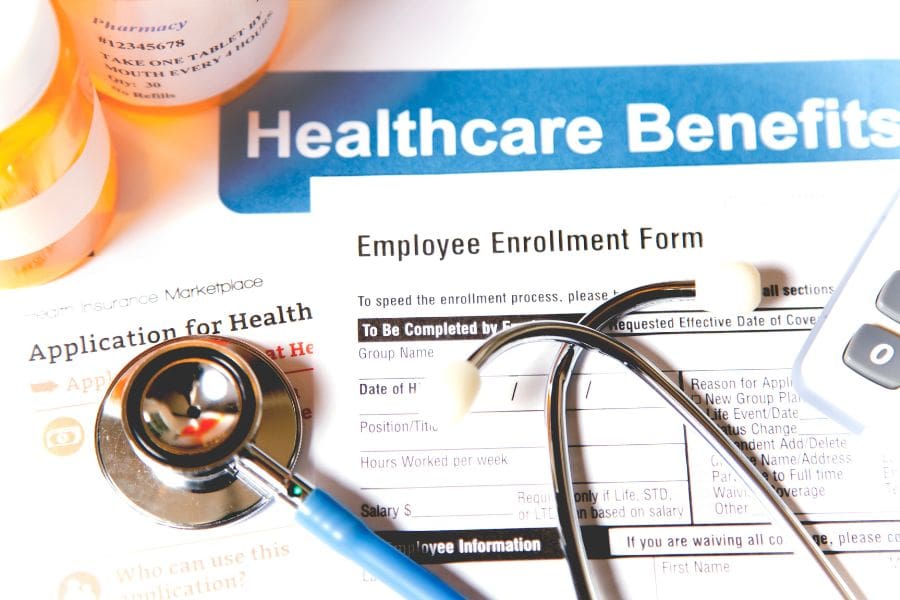
An employee enrollment form for healthcare benefits laid out on a table with a stethoscope, calculator, and prescription pill bottles.

When managing your healthcare in Canada, if you don’t have an extended workplace benefits package or personal private healthcare insurance, you must pay for these services yourself:

  • Prescription Drugs: Routine medications that you pick up at a retail pharmacy (even if a doctor prescribes them).
  • Dental Care: Routine cleanings, fillings, extractions, and major dental surgeries performed in a dentist’s office.
  • Vision Care: Routine eye exams, glasses, contact lenses, and laser eye surgery.
  • Ambulance Services: Most provinces charge a fee for emergency ambulance transportation.
  • Paramedical Services: Chiropractors, physiotherapists, massage therapists, and psychologists.

For peace of mind, you can buy private health insurance for medical needs while you wait for provincial health insurance to cover you.

2. Who Qualifies for Public Healthcare in Canada? Broad Eligibility Criteria

To qualify for public healthcare in Canada and apply for a provincial health card, you must meet specific rules. Generally, you qualify if you meet all of the following:

  • Legal Status: You are a Canadian citizen, Permanent Resident (PR), Protected Person/Refugee, or hold an eligible, valid temporary work or study permit.
  • Primary Residence: You make the specific province or territory your primary home.
  • Physical Presence: You are physically present in that province for a minimum mandated number of days each year (typically 183 days).

⚠️ Important Note for Temporary Residents: In early 2026, provinces updated their criteria for temporary residents. For example, Alberta no longer provides public Alberta Health Care Insurance Plan (AHCIP) coverage to International Experience Canada (IEC) work permit holders (Working Holidays). Always verify your specific permit case type with local provincial registries.

Checklist: Documents You Need for Your Health Card Application

When you apply for your provincial health card, you must present original, physical documents (photocopies or digital screen captures are rarely accepted). You will need to provide one document from each of the three categories below:

A male traveller walking through a bright airport baggage claim area while pulling a suitcase and wearing a backpack after landing.

[ ] Permanent Resident Card (PR Card)

[ ] Confirmation of Permanent Residence (COPR)

[ ] Valid Work Permit (stating an eligible employer/duration)

[ ] Valid Study Permit (accompanied by proof of full-time enrollment)

[ ] Convention Refugee documentation

2. Proof of Provincial Residency

[ ] A signed residential mortgage, rental, or lease agreement

[ ] A utility bill (hydro, gas, water) showing your name and current address

[ ] A bank statement or credit card statement mailed to your provincial address

[ ] A valid provincial Driver’s License or Photo ID Card

3. Proof of Identity

[ ] Valid foreign passport

[ ] Certificate of Canadian Citizenship

[ ] A previous provincial health card (if relocating from within Canada)

Contact Your Provincial or Territorial Healthcare Program

Click the official link for the province or territory where you plan to settle. These government directories provide up-to-date health card application forms, office locations, and local processing timelines:


🚀 Ready to Build Your Settlement Action Plan?

Planning for your family’s healthcare in Canada is just the first step of your transition. Join our upcoming free webinar, Your First Weeks in Canada, and discover the important actions to take in your first 30 days, from securing housing to setting up your essential services.


3. Mandatory Waiting Periods for Healthcare in Canada

A waiting period is the time you must wait before your government health insurance begins. If you settle in a province with a waiting period, secure private travel medical health insurance before you fly. To learn more about how private insurance policies work, read our complete guide: Do You Need Travel Medical Health Insurance to Move to Canada? Protecting your family ensures you can start your new life in Canada without worrying about a sudden, expensive hospital bill.

Quick Reference: Provincial and Territorial Waiting Periods

Province / TerritoryWaiting Period StatusCoverage Start Date & Key Details
Alberta (AHCIP)NoneEffective immediately upon arrival for direct international newcomers, provided you apply within your first 3 months. Read our guide on the Alberta Health Card | What it Covers and How to Apply.
British Columbia (MSP)~3 MonthsBegins after the balance of the arrival month plus two full months. Private insurance is highly recommended for this gap.
ManitobaUp to 3 MonthsBegins on the first day of the third month following your official arrival date.
New Brunswick3 MonthsA mandatory three-month wait from your official date of arrival in the province before coverage begins.
Newfoundland and Labrador (MCP)NoneEffective immediately from your first day of arrival, though application processing time applies.
Northwest TerritoriesNoneEffective immediately once your residency application is officially approved.
Nova Scotia (MSI)NoneEligible permanent residents receive first-day coverage upon arrival.
NunavutNoneEffective immediately upon establishing permanent residency and applying.
Ontario (OHIP)NonePermanently eliminated its 3-month wait period. Coverage is immediate upon application approval, though you must live in ON for 153 of your first 183 days to maintain it.
Prince Edward IslandNoneDirect international arrivals receive first-day coverage.
Quebec (RAMQ)Up to 3 MonthsA mandatory waiting period of up to three months applies to most international newcomers.
Saskatchewan6 to 8 WeeksCoverage usually backdates to your arrival, but there is a 6-to-8-week administrative lag before your physical card is issued. Review the specific Newcomer Steps to Apply for a Saskatchewan Health Card to avoid application delays.
Yukon3 MonthsBegins on the first day of the third month after establishing residency.

Are Maternity Care and Childbirth Covered under Provincial Healthcare?

A smiling mother wearing a hijab holds her swaddled newborn baby close while resting in a hospital bed after giving birth.

Yes. Once your provincial residency is active and approved, public health insurance plans cover 100% of medically necessary hospital stays, prenatal care, midwife- or physician-assisted childbirth, and postnatal care. Because these are classified as “insured services” under the Canada Health Act, eligible parents do not pay the hospital or delivery team directly, and there are no deductibles.

⚠️ The Waiting Period Warning: This 100% coverage depends on your province’s Waiting Period. If you give birth in a province like British Columbia or Quebec before your mandatory 3-month waiting period is over, the hospital will bill you directly as an uninsured non-resident. This can cost thousands of dollars in out-of-pocket costs. Always secure private travel medical insurance to bridge this gap if you are arriving while pregnant.

4. Finding a Family Doctor

After you receive your provincial health card, your next priority is to find a General Practitioner (GP) or family doctor. Because healthcare in Canada faces a widespread shortage of medical doctors, this process can take several months.

You can use these three primary routes to begin your search for a family doctor:

Provincial Registries

Most provinces offer a central matching system, such as Ontario’s Health Care Connect or British Columbia’s Health Connect Registry, which places you on a waitlist for a physician currently accepting new patients.

The College of Physicians and Surgeons

Visit the online college directory to search for clinics listed as “accepting new patients” in the province where you live.

Walk-in Clinics

While waiting for a permanent family doctor, you can visit local walk-in clinics or urgent care centers for non-emergency medical needs. Present your provincial health card at reception to ensure the visit is fully insured.

Final Thoughts: Navigating Your First Steps

Securing healthcare in Canada is one of the most critical parts of your settlement action plan. While Canada offers an excellent, world-class network of publicly funded hospital and physician care, you must prepare to ensure you and your family are protected. Keep these three golden rules in mind:

  1. Apply Immediately: Do not wait until you get sick to apply for your health card. Gather your immigration and proof-of-residency documents and submit your application during your first week in the country.

Bridge the Gap: If you are settling in British Columbia, Manitoba, New Brunswick, Quebec, or Yukon, you will face a waiting period before your public coverage kicks in. Protect your savings by purchasing a private travel medical insurance policy to cover those initial months.

Budget for “Uninsured” Care: Because routine dental work, vision care, and prescription drugs are paid out of pocket, actively look for employment that offers extended workplace health benefits to offset these costs.

When you separate insured government services from uninsured personal expenses, you protect your family from expensive out-of-pocket medical bills and successfully manage your Canadian healthcare budget.

Common Questions about Newcomer Healthcare

Can I use my health card if I visit another Canadian province?

Yes, for emergencies. Under the Canada Health Act, your home province’s health card will cover urgent or emergency medical care if you are travelling within Canada. However, routine or non-urgent care (like visiting a walk-in clinic for a minor issue or seeing a specialist) will generally not be covered outside your home province, and you may be billed directly.

Do temporary residents (workers and international students) get government healthcare?

It depends entirely on your province and your permit.

International Students: Some provinces (like British Columbia, Alberta, and Saskatchewan) allow full-time students with valid study permits to register for public health insurance, though BC charges a monthly health fee. Other provinces (like Ontario and Quebec) do not cover international students under public plans; students must purchase mandatory health insurance through their university or college.

Temporary Foreign Workers: Most jurisdictions extend coverage if you hold a work permit valid for at least six months and can prove full-time employment. Always check local guidelines because rules for specific visa classes can change frequently.

Can I use a prescription written by a doctor from my home country?

No. Canadian pharmacies cannot legally fill prescriptions written by doctors outside of Canada. When you arrive, you must bring a 90-day supply of your medication in its original pharmacy packaging, then book an appointment with a Canadian doctor at a walk-in clinic or family practice to get a new Canadian prescription.

WRITTEN BY

Corinna Frattini

Senior Editor and Content Director, Prepare for Canada

Corinna researches and writes content to help newcomers make informed decisions about housing, employment, banking, and aspects of settling in Canada. With a background in human resources and leadership development, her articles focus on how newcomers can continue their careers in Canada. Her writing combines research, practical guidance, and clear language to support newcomers on their journey.

© Prepare for Canada 2026

Related Articles